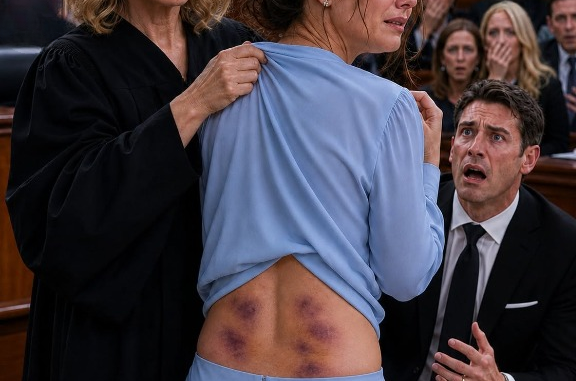
My daughter came home for what was supposed to be a peaceful visit, but everything changed the moment I walked into her room. As she changed her clothes, I caught sight of the bruises covering her back, and my heart nearly stopped.
“Oh, sweetheart… what happened?” I whispered.
She quickly pulled on her shirt, her hands shaking. “Please, Mom. Don’t. My husband is a lawyer. He says no one will ever believe me.”
I looked her in the eyes. “Then let’s see how he explains laying a hand on a federal judge’s daughter.”
The bruises across Clara’s back looked like fingerprints left by someone who believed he’d never face consequences. In that instant, the worried mother inside me gave way to the judge who had spent decades holding dangerous people accountable.
She begged me not to make things worse, but I had already noticed more than the marks on her back—faded bruises along her ribs, a healing cut near her spine, and older injuries hidden beneath newer ones.
“What really happened?”
“I fell.”
“Clara.”
Tears filled her eyes. “Daniel loses his temper. Then he apologizes. He says it’s my fault.”
The hallway of her childhood home suddenly felt suffocating. Outside, rain tapped softly against the windows. Clara had arrived that morning carrying no luggage, wearing no wedding ring, and forcing a smile that barely held together.
“He says he knows judges and police,” she continued. “He works at Mercer, Vale & Knox. He says nobody would believe an anxious wife over him.”
I held her icy hands.
“Has he threatened you?”
“He says if I leave, he’ll convince everyone I’m unstable and take Sophie away.”
My four-year-old granddaughter was still at preschool near Daniel’s home.
That single sentence erased any hesitation I had.
Years on the federal bench had taught me how easily powerful people hid behind polished appearances. Daniel’s confidence wasn’t new to me—it was the same arrogance I had seen from countless defendants.
I stayed calm.
“We’re going to the hospital,” I said. “Then we’re bringing Sophie home.”
At the hospital, every bruise was carefully photographed. Clara finally revealed years of physical abuse, isolation, financial control, and intimidation. A victim advocate helped her obtain an emergency protective order, and by evening, Sophie was safely reunited with her under police supervision.
Later that night, Daniel called.
“You took my daughter,” he said evenly. “Bring her back, or I’ll ruin your life.”
I switched the call to speaker.
“You should think carefully before saying another word,” I replied.
He laughed.
“And who exactly are you?”
I glanced at the phone as the recording continued.
“The person who just listened to you threaten someone protected by the court,” I answered. “Please… keep talking.”
The following morning, Daniel arrived dressed in an expensive suit, carrying himself like a man who believed he was untouchable.
Sheriff’s deputies greeted him with the protective order.
He skimmed the paperwork, smirked, and declared, “This will be gone before lunch.”
Standing beside Clara on the porch, I watched his confidence without reacting.
“You’re interfering in a marriage you know nothing about,” he told me.
“I know evidence,” I replied.
He dismissed me as nothing more than a widow who enjoyed charity events before turning to Clara.
“Come home. I’ll tell the court this was all a misunderstanding.”
Clara stood her ground.
“No.”
His expression hardened.
“Then I’ll take Sophie.”
Within hours, he filed emergency custody papers accusing Clara of drug abuse, mental instability, and manipulation by her mother. He even included sworn statements from his law partner, his sister, and a therapist Clara had never met.
He had planned everything.
But even the most carefully built lies collapse under real evidence.
We hired an experienced family-law attorney who handled the case independently. I refused to use my judicial position for any advantage. My role would be simple: mother, witness, and supporter.
Soon, Daniel’s accusations began falling apart.
Medical records showed repeated injuries over several years. Pharmacy records proved Clara had no history of drug abuse.
The supposed therapist was exposed as Daniel’s former college roommate who had never treated Clara.
Then Clara remembered something even more important.
Daniel had installed security cameras throughout their home.
Although he controlled the account, an old tablet linked to the cloud still contained archived footage.
The videos were devastating.
One showed Daniel blocking the front door while Clara pleaded to leave.
Another captured him cornering her against a wall, confidently saying no judge would ever side against his prestigious law firm.
The final recording showed Daniel and his law partner rehearsing false custody claims.
“Tell everyone she abuses pills,” the partner advised. “Once you get temporary custody, she’ll come crawling back.”
Clara stared at the screen in disbelief.
“They knew,” she whispered.
“Yes,” I answered. “And now investigators will know too.”
The recordings were turned over to prosecutors, disciplinary authorities, and the court.
Even then, Daniel remained convinced he would win.
Outside the courthouse before the hearing, he leaned close.
“You think bruises and a few edited videos will destroy me?”
“No,” I replied. “Your own decisions will.”
Then he smiled.
“You still haven’t told me who you are.”
Before I could answer, a court reporter walked past, paused, and quietly said,
“Good morning, Judge Hart.”
The color drained from Daniel’s face.
For the first time, he realized the woman he had threatened wasn’t simply his wife’s mother.
She was a federal judge who had spent decades recognizing manipulation, coercion, and lies.
The courtroom filled quickly for the hearing.
Judge Marisol Vega confirmed on the record that although we knew each other professionally, she had no personal relationship with me, and both sides agreed she could fairly hear the case.
Daniel chose to represent himself.
At first, he spoke confidently, portraying Clara as emotionally unstable and claiming our family had exaggerated everything.
Then the recordings were played.
The courtroom heard Clara crying as she was shoved into a wall.
They heard Daniel discussing false allegations.
They heard him confidently state that even photographs of bruises could be explained away.
Medical experts testified that Clara’s injuries matched repeated abuse rather than accidents. Older fractures confirmed a long history of violence.
During cross-examination, Daniel tried to undermine her.
“You stayed with me.”
“Yes.”
“You told people we were happy.”
“Yes.”
“So either you lied then or you’re lying now.”
Clara looked directly at him.
“I lied because I believed you would kill me.”
Silence filled the courtroom.
Judge Vega granted Clara a two-year protective order, temporary sole custody of Sophie, supervised visitation only after psychological evaluation, and ordered Daniel to pay attorney’s fees.
She also referred evidence of perjury and obstruction to prosecutors.
Daniel glared at me.
“You caused this.”
“No,” I answered calmly. “You did.”
His world unraveled quickly afterward.
His law partner pleaded guilty to conspiracy and surrendered his law license.
The therapist faced criminal charges for submitting a false affidavit.
Daniel himself was indicted on multiple charges, including assault, intimidation, perjury, and unlawful surveillance. His law firm removed his name long before trial.
After four days of testimony, the jury returned guilty verdicts on the major charges.
He received a prison sentence, permanent disbarment, and strict no-contact orders.
Months later, Clara and Sophie settled into a bright new home.
Clara returned to school and began training to help survivors of domestic violence.
One afternoon, Sophie proudly painted purple flowers across her bedroom wall.
“Purple belongs on flowers,” she smiled, “not on bruises.”
The following spring, Clara joined me outside the courthouse wearing a dress that no longer hid the scars on her back.
“Were you ever afraid?” she asked.
“Every single day.”
“You never looked afraid.”
I smiled.
“As judges, we learn to let fear stay silent while truth does the talking.”
She slipped her hand into mine.
Daniel once insisted nobody would ever believe her.
But the evidence did.
The court did.
The jury did.
Most importantly, Clara finally believed herself—and that became the most important victory of all.
Leave a Reply