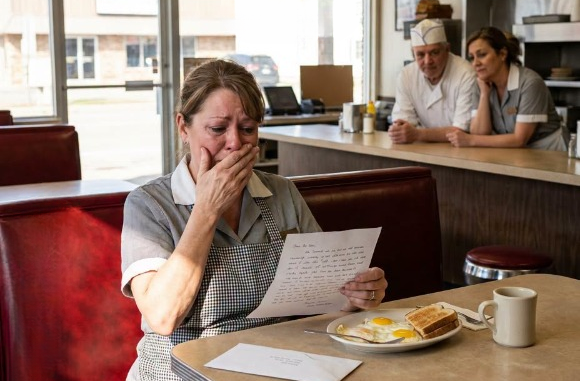
He Never Missed His Monday Breakfast — Until Two Lawyers Arrived With a Message That Changed Everything
At exactly 7:15 on a Monday morning, two men wearing dark suits walked into our diner and asked for me by name.
They didn’t hesitate. They went straight to booth three—the same booth I had left untouched for three weeks—and placed a sealed envelope beside the coffee cup that had been waiting there.
“Are you Dorothy?” the older man asked.
Almost everyone had called me Dot for nearly three decades, so hearing my full name caught me off guard.
I nodded.
Then he quietly told me that Walter Harmon, our longtime customer, had passed away two weeks earlier.
My heart sank.
Big Ray immediately turned off the grill, and Marlene gently helped me sit down in the booth where Walter had eaten breakfast alone every Monday for fourteen years.
On the envelope, written in his neat handwriting, were five simple words:
“For Miss Dot, at 7:15.”
Walter had been coming to our diner every Monday morning since 2012.
He always arrived wearing the same pressed gray suit, carrying his folded newspaper. His order never changed: two eggs cooked over medium, wheat toast, and black coffee.
The meal cost $8.40.
But every time, he left a $20 tip.
Walter was never a man of many words. He usually only said “please,” “thank you,” and “Good morning, Miss Dot.”
Yet those extra tips had quietly helped me through some of the hardest moments of my life.
They helped pay for Nathan’s $3,600 braces, a $2,400 car repair, and even helped make difficult holiday seasons a little easier.
I knew very little about him. I knew he loved reading the newspaper, preferred peace and quiet, and sometimes helped clear dishes when the diner became crowded.
But when he failed to show up one Monday morning, I immediately noticed.
After years of seeing him in booth three, his absence felt strange.
So I placed a reserved sign there.
The second Monday passed.
Then the third.
And I started wondering if I would ever know why those weekly breakfasts had meant so much to him.
Inside the envelope was a four-page letter.
The first few sentences made me cover my mouth.
Walter explained that he had spent forty years working as an estate attorney, preparing wills and managing trusts for others. But nothing in his career had prepared him for losing his wife, June.
Mondays had once been their special breakfast day.
After she died, Walter struggled with loneliness and stopped knowing what to do with his mornings.
Then, one day, he walked into our diner.
He wrote that I had guided him to the quietest booth, kept his coffee filled, and offered kindness without asking questions.
I barely remembered that moment.
But to Walter, it had mattered.
That small act of compassion gave him a reason to get out of bed and return every week.
Then the older attorney opened his briefcase.
He placed several documents on the table and said:
“Mr. Harmon left very specific instructions regarding this diner, your son, and the home you thought you might lose.”
I had no idea what was coming.
Walter’s first request was a generous donation to a hospice foundation created in memory of his wife, June.
But that was only the beginning.
He had also established a trust for our diner.
The money would cover a new roof, buy the espresso machine Marlene had always joked about, and improve the quality of Big Ray’s bacon supplier.
Then came the news that left me speechless.
The remaining balance on my mortgage had been completely paid off.
The settlement also covered future insurance and property expenses.
Another fund had been created for Nathan’s education, whether he chose college, trade school, or another career path.
Everything had been carefully arranged and legally documented long before Walter passed away.
At the bottom of the final page, he had written that fourteen years of kindness could never truly be measured.
But according to his professional estimate, my account was:
“Paid in full through 2026.”
The changes came quickly.
The new roof was finished before the rainy season arrived.
The espresso machine showed up a month later.
Nathan enrolled in a diesel technology program and became the first person in our family to continue his education after high school.
He still carries one of Walter’s $20 bills folded inside his wallet.
He says he wants to use it someday to remind someone else that they matter.
Above booth three, we placed a small chalkboard with a message:
“Everyone is somebody’s Monday.”
We still make Walter’s usual breakfast every Monday at 7:15.
But now, someone always sits down and shares it.
For fourteen years, I believed I was simply serving a quiet customer.
I never realized that one small booth had become a place where two lonely people quietly helped each other survive.
Leave a Reply