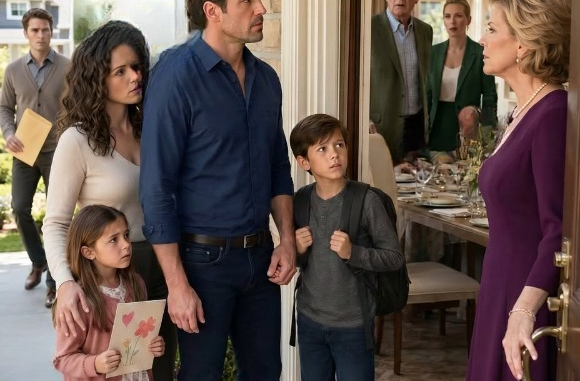
My mother leaned in and quietly said, “there’s simply no space for any of you.” Then she stepped back inside, leaving my little boy on the porch with his backpack clutched tightly in his hands. I didn’t yell. I didn’t argue. I just took my son’s hand, looked through the open doorway, and said, “You don’t get to shut my children out of a house you never helped pay for.”
The room behind her fell completely silent. Because in that moment, everyone remembered who was actually listed on the deed.
My son was nine years old, and he had packed his backpack like he was leaving for a trip instead of heading twenty minutes away for Sunday dinner.
Inside were two toy cars, a library book he was excited to show Grandpa, and a carefully folded drawing of our family standing in front of my parents’ split-level home. My daughter Emma, seven years old, had spent the entire morning at the kitchen table making a card for Grandma, carefully placing foam hearts on pink paper with the kind of love only a child can give.
My wife Laura watched them from the kitchen counter, her coffee untouched and growing cold.
“You’re sure about this?” she asked softly.
I glanced toward the driveway where our old SUV sat packed with the cheesecake my mother always loved showing off whenever guests came over.
“It’s only dinner,” I said.
Laura didn’t reply. She just gave me the look that said she already knew what I was slowly accepting.
When we arrived at my parents’ neighborhood, everything looked exactly the same. Perfect lawns. Basketball hoops hanging above garages. Porch flags moving gently in the breeze. My father’s rose bushes lined the walkway like they were standing guard, and Melissa’s expensive SUV was already parked closest to the house, as if even the driveway belonged to her.
Tyler held the bakery box carefully on his lap.
“Grandpa likes chocolate, doesn’t he?” he asked.
“He does,” I told him.
Emma leaned forward from her booster seat. “Do you think Grandma will put my card on the fridge?”
I glanced at Laura. Her expression tightened slightly.
“I hope she does, sweetheart,” she answered.
Before we got out of the car, I reminded the kids about our signal. If they ever felt uncomfortable, they were supposed to tug on one earlobe. Tyler nodded, understanding something no child should have to learn. Emma immediately tugged both ears and laughed, trying to make him smile.
That little laugh was still fading when my mother opened the front door.
She looked flawless. Her church dress was pressed, her hair perfectly styled, and her pearl earrings were shining. She wore the same polite smile she always used around others, but it vanished the second she saw my children standing behind me.
“Oh.”
One word.
But Tyler noticed. Emma noticed. Laura, standing near the driveway, noticed too.
“Hi, Mom,” I said. “We brought dessert.”
Her eyes moved from the bakery box to the kids, then over her shoulder toward the dining room.
I could see everything from where I stood. Seven place settings. White plates. Folded napkins. Full glasses of water. My father sitting at the head of the table. Melissa beside him, looking at her phone while her three children sat comfortably in chairs that had clearly been saved for them.
My mother stepped outside and pulled the door almost shut behind her.
“Jack,” she whispered, “we only prepared seats for the adults and Melissa’s kids.”
For a moment, I wondered if I had heard her correctly.
“We talked about this on Tuesday,” I said. “I told you Tyler and Emma were coming.”
Her smile became forced.
“There just isn’t enough room.”
Tyler adjusted the strap of his backpack. Emma lowered her eyes and looked at the card she had made, like it suddenly felt embarrassing to hold.
Behind my mother, my father stopped eating. Melissa looked up, saw my expression, and let out a quiet sigh like I was the one creating a problem.
The old me would have apologized. He would have made an excuse, taken the kids somewhere else, and told them Grandma was just stressed. He would have protected everyone else’s comfort while letting his own children feel rejected.
But that version of me had been disappearing for years.
I thought about every mortgage payment I had sent from my phone while sitting in hospital parking lots between work shifts. Every “temporary” situation that somehow became another monthly responsibility. Every time my parents said Melissa needed help, and I was the reliable one who was expected to sacrifice because “family takes care of family.”
Then I looked down at my son’s hands gripping his backpack.
“No,” I said.
My mother stared at me. “No?”
“We’re leaving.”
Her expression hardened. “Don’t make this bigger than it is. It’s just a seating problem.”
I looked past her at the dining table.
Seven plates. Seven glasses. Seven chairs.
It wasn’t an accident.
It was a choice.
“This was never about seats.”
My father pushed his chair back, the legs scraping against the floor. The sound brought back memories from childhood, the same way it always had.
“What did you say to your mother?” he called from inside.
I stepped closer to the doorway, still holding Tyler’s hand.
“I said you don’t get to turn my children away from a house you never paid for.”
The dining room became completely quiet. So quiet I could hear the ice shifting inside someone’s glass.
Melissa stood halfway from her chair, already wearing that familiar expression.
“Are you seriously causing a scene over dinner?”
I looked at her.
Her children had plates in front of them.
Mine were standing on the porch.
Leave a Reply