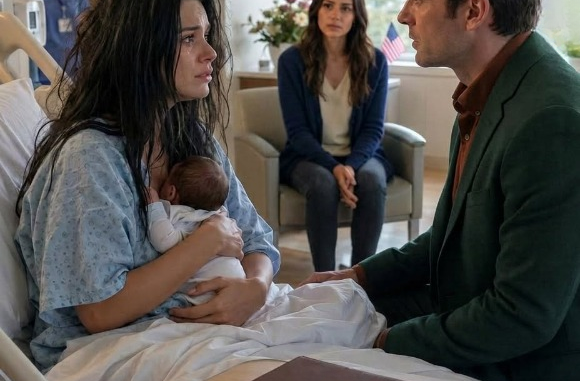
Two hours after our daughter was born, I looked at my husband, expecting him to reach for her and experience the same overwhelming love I felt. Instead, he stood across the hospital room in his perfectly tailored gray coat, staring at our newborn as if she were an inconvenience he had never planned for.
Soft morning light filtered through the blinds, falling across the bed, the bassinet, and the untouched cup of melting ice on the tray beside me. The nurse had just finished adjusting my daughter’s blanket and stepped out, leaving behind the quiet sounds of the hospital—the machines humming, footsteps passing in the hallway, and the gentle silence that surrounds a new baby.
I was completely exhausted. My body ached, my hair stuck to my forehead, and even lifting my arms felt difficult. But none of that mattered because my daughter was lying against my chest. She was tiny, warm, and perfect. Her little face relaxed as she slept, completely unaware that the world waiting for her was already changing.
“Weston,” I whispered. “Do you want to hold her?”
He didn’t answer.
He stayed by the window, one hand inside his coat pocket, the other resting at his side. His wedding ring caught the morning light. He had dressed for the hospital like he was heading into a corporate meeting, not the moment his child entered the world.
I assumed he was overwhelmed.
I wanted to believe that.
For nine months, he had talked about meeting her. He had painted the nursery himself. He had placed his hand on my growing stomach every night and told me he couldn’t wait to become a father. We had argued over names, laughed over possibilities, and finally chose Marlo because he said it sounded strong and beautiful.
So when he stood there silently, I gave him the benefit of the doubt.
“She’s perfect,” I said softly.
He turned slightly toward me.
But his eyes never moved to her face.
“Sable,” he said.
Just my name.
Nothing more.
A cold feeling settled in my chest.
“What?”
He stepped closer, but not toward the bed. He stopped several feet away, keeping a distance between himself and both of us.
“I need to tell you something,” he said.
His voice was controlled. Too controlled.
“I already have a son with Camille.”
For a moment, I thought I had misunderstood him.
The hospital sounds suddenly felt louder—the machines, the air vent, the footsteps outside the door.
My daughter shifted against me, and I instinctively held her tighter.
“He was born four months ago,” Weston continued.
I stared at him.
Four months.
While I was preparing our nursery.
While he kissed me goodnight.
While he told me we were building a family.
He had already built another one.
“My parents know,” he said. “They’ve met him. There are things you need to understand.”
I looked at the man standing in front of me.
The same man who had held my hand through labor.
The same man who had told the nurses he was excited to meet his daughter.
Now he looked like someone delivering a business decision.
“What are you saying?” I asked.
His eyes finally met mine.
“I’m not putting my name on this baby the way you expect.”
The words didn’t make sense.
“I can support you,” he continued. “I’ll make sure you’re taken care of. But I can’t acknowledge her as a Callaway heir.”
The word hung between us.
Heir.
Not daughter.
Not baby.
Not our child.
Our little girl was only two hours old. Her hospital bracelet was still loose around her tiny ankle. She hadn’t even opened her eyes to see the world, and already her father was deciding where she belonged.
I didn’t scream.
I didn’t throw anything.
I didn’t ask about Camille or how long he had been living two separate lives.
Something inside me simply went quiet.
“You’re choosing them,” I whispered.
Weston sighed, almost like I was making this harder than it needed to be.
“I’m choosing my family’s future.”
I almost laughed.
Not because it was funny.
Because it sounded rehearsed.
Like he had practiced saying it somewhere else.
I looked down at Marlo.
Her tiny fingers had escaped from the blanket and rested against my gown. Her eyelashes fluttered softly as she slept.
Then I looked back at my husband.
“Remember this moment,” I said quietly. “Because this is the last time you will ever get the chance to hurt us.”
Weston stared at me.
Then he smiled.
A small, dismissive smile.
The kind a person gives when they believe someone is speaking from exhaustion instead of certainty.
He had no idea what was coming.
He didn’t know that an estate attorney had been trying to reach me for weeks.
He didn’t know that my late uncle had left behind documents that would change everything.
And he had no idea that the daughter he refused to hold would become the person who could completely reshape the Callaway family’s future.
Four years earlier, Weston Callaway entered my life like a man who had never doubted he belonged anywhere.
I met him during a contract review meeting in a Charlotte office tower. I was working as a contracts auditor, a job most people found boring until they needed someone to catch the mistake hidden in the fine print that could cost them millions.
Weston arrived late that day wearing a navy suit and carrying the confidence of someone born into influence. His family owned Callaway Holdings, a company that had grown from a single roadside motel into a powerful real estate and hospitality empire.
But what caught my attention wasn’t his money.
It was that he listened.
When I pointed out a dangerous clause in one of his company’s agreements, he didn’t interrupt me. He asked questions. He thanked me afterward.
“Sable Reed,” he said, reading my name from my folder. “You just saved us from a very expensive problem.”
“I save people from expensive problems for a living.”
He smiled.
“That sounds more valuable than most jobs.”
It was a simple moment.
I believed it was genuine.
Our first date was at a small Italian restaurant where he asked about my work, my family, and my dreams. He remembered details. He made me feel seen.
Later, I would realize Weston had always been good at making people feel exactly what he wanted them to feel.
His family was different.
His mother, Adele, was polite but distant. She smiled, complimented my clothes, and asked questions that felt more like evaluations than conversations.
His father, Preston, was even colder.
He treated me like someone temporarily standing in a room I didn’t belong in.
I convinced myself they were simply wealthy people with different manners.
I convinced myself love mattered more.
Weston and I married eighteen months after meeting.
It was a small courthouse ceremony. No ballroom. No extravagant celebration.
“I want the day to belong to us,” he told me.
I believed him.
I remembered his nervous hands as he fixed his tie. I remembered him saying he didn’t want to ruin what we had.
I thought a man who feared losing me would never betray me.
I was wrong.
The first signs were small.
Phone calls taken outside.
Late nights at work.
A phone always turned face down.
Explanations that sounded reasonable enough to make me feel guilty for questioning them.
Then there was Camille Russo.
She was Weston’s assistant.
Beautiful. Intelligent. Always perfectly composed.
I met her at a company holiday event.
She shook my hand.
“It’s nice to finally meet you.”
The words were polite.
But something in her expression bothered me.
I ignored it.
For years, I had trusted Weston more than I trusted my own instincts.
When I became pregnant after two years of trying, Weston cried during the ultrasound.
He looked at the screen like our baby had changed his entire world.
That memory stayed with me.
Because later, I wondered how someone could look at his child with so much emotion and still create a life that would destroy another.
He painted the nursery.
He bought baby clothes.
He talked about fatherhood.
But there were signs I ignored.
The late-night calls.
The secretive behavior.
The way he grew uncomfortable whenever the baby was mentioned alongside the Callaway name.
At a family dinner while I was pregnant, Camille asked about the nursery.
“Weston painted it himself,” I said proudly.
Her expression changed for just a second.
“That’s nice,” she replied.
I didn’t understand why those words stayed with me.
Until later.
Marlo was born on a Tuesday morning.
Weston was there.
He held my hand.
He told me how proud he was.
When she cried for the first time, he smiled.
That was what made everything harder.
Because betrayal is rarely obvious from the beginning.
People don’t usually reveal their worst selves immediately.
They show you enough kindness to make you believe the rest.
After Marlo arrived, Weston stepped into the hallway to make a phone call.
Through the door, I heard only pieces.
“Not now.”
A pause.
“I said not over the phone.”
Another pause.
“No, Camille. I know.”
Her name hit me like a warning.
When he returned, he was wearing his gray coat.
The same coat he wore when he delivered the news that destroyed our family.
Two hours later, he told me everything.
About the son.
About Camille.
About the family expectations.
About the name he refused to give our daughter.
But he didn’t understand one thing.
He thought he had taken my power away.
He didn’t realize he had just forced me to find it.
The next morning, while Marlo slept beside me, I returned a phone call I had ignored for weeks.
It was from Josephine Nadeir, my late uncle’s estate attorney.
My uncle Elliot had always been quiet and practical. He taught me to read contracts, question fine print, and never sign anything I didn’t fully understand.
“Never trust a blank line,” he used to tell me.
I thought Josephine was calling about ordinary paperwork.
I was wrong.
“Sable,” she said. “Your uncle left instructions that I was only to discuss this with you personally.”
“What is it about?”
“A partnership agreement connected to Callaway Holdings.”
I sat up.
“Callaway?”
“Yes.”
She paused.
“You inherited more than family keepsakes.”
I looked over at Marlo.
“What are you saying?”
Josephine’s voice softened.
“I’m saying you may have more influence in the Callaway family business than your husband realizes.”
For the first time since Weston walked away from us…
I felt something other than heartbreak.
I felt hope.
Leave a Reply