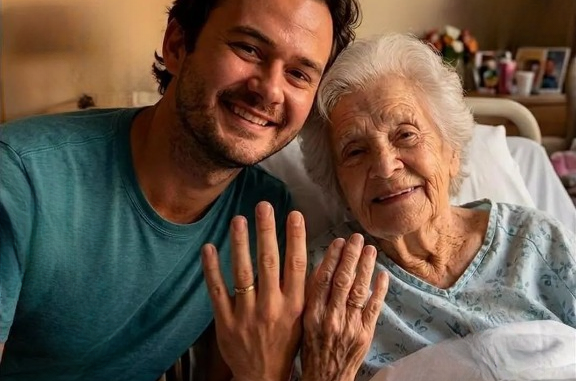
The small hospital chapel was nearly empty when I stood beside 82-year-old Gloria and promised to become her husband. The few people present looked at me with confusion, unable to understand why a 34-year-old nursing home orderly would marry a woman in the final days of her life. Only a week earlier, I had simply been caring for residents at the facility, doing my best to brighten their days despite earning a modest living. Having grown up in foster care, I knew what loneliness felt like, and that shared understanding drew Gloria and me together. She often spoke fondly about her late husband, treasured family traditions, and happier times, yet no one from her family ever visited. One object never left her side—a worn canvas hospital bag that looked as though it had carried a lifetime of memories. Whenever I asked about it, she would smile and quietly say it held everything that truly mattered. When her health took a sudden turn and she asked me to fulfill one final wish by marrying her, I sensed there was a deeper reason she had yet to reveal.
Our wedding was simple, held beside her hospital bed with only a chaplain and two witnesses present. Three days later, Gloria passed away peacefully while I held her hand. At the funeral, her attorney, Mr. Charleston, handed me the same weathered hospital bag and told me Gloria had chosen me for a very specific purpose. Before he could explain, her nephew Marcus confronted us, accusing me of marrying his aunt for money and vowing to contest the marriage, her will, and every aspect of her estate. Gossip quickly spread through the nursing home, prompting management to investigate my actions, while coworkers who had once trusted me began keeping their distance. Overwhelmed by the accusations, I nearly surrendered the mysterious bag to avoid further conflict—until a single phone call convinced me to open it for the first time.
Inside, I found no hidden fortune, valuable jewelry, or property documents. Instead, the bag contained hundreds of carefully preserved letters, an old family photograph, and a sealed envelope addressed to me in Gloria’s handwriting. At a meeting with her attorney, I finally learned the truth. Decades earlier, Gloria had been forced to place her infant son up for adoption. After years of searching, she eventually discovered he had died, leaving behind a child who was raised in foster care—me. She had recognized me almost immediately after we met but wanted the opportunity to know me as a person before revealing our connection. Mr. Charleston explained that Gloria had carefully arranged everything in advance. The marriage ensured her final wishes would be honored, while DNA evidence, adoption records, and legal documentation left no room to challenge her estate. Marcus soon realized that neither court proceedings nor disputes over financial records could overcome the proof Gloria had prepared long before her passing.
Several weeks later, I moved into the modest house Gloria had left me and finally understood why she had guarded that old hospital bag so closely. Rather than seeing the inheritance as a reward, I used part of it to establish a visitor program for nursing home residents who rarely received family visits, hoping fewer people would face their final years alone. My close friend Sarah helped bring the project to life, reminding me that Gloria had always believed I would continue sharing the compassion she valued so deeply. Every time I look at the old photograph displayed above my fireplace, I’m reminded that Gloria’s greatest gift wasn’t the house or the money—it was giving me the family I had spent my entire life searching for without ever knowing it existed.
Leave a Reply