For years, my mother-in-law found subtle ways to remind me I would never truly belong in her family. I convinced myself I could tolerate it. But everything changed the day my eight-year-old daughter called me in tears, and I realized Evelyn’s cruelty had crossed a line I could never overlook.
When I married Daniel, his mother greeted me at the reception with a polite handshake, as though I were an unexpected guest rather than her son’s bride.
Evelyn came from old money. She was polished, sophisticated, and remarkably skilled at disguising insults as compliments. She never raised her voice or said anything openly offensive. Instead, she relied on carefully chosen words that sounded innocent to everyone except the person they were aimed at.
From the beginning, I became the target of those quiet remarks.
On our wedding day, she looked at my dress, smiled politely, and said, “Daniel has always had a talent for surprising people.”
Everyone chuckled.
So did I.
I was deeply in love, and I quickly learned that reacting to Evelyn only made me seem overly sensitive.
At family gatherings, she admired everyone else’s accomplishments, careers, and refined tastes. When it came to me, every compliment carried a hidden sting. If I baked dessert, it was described as “comforting.” If I dressed elegantly, she would say I looked “unexpectedly confident.”
No matter how hard I tried, she always found a way to remind me I didn’t quite fit.
Whenever I mentioned it to Daniel, he always gave the same answer.
“That’s just how Mom is.”
I eventually grew to hate those words almost as much as Evelyn’s behavior.
Then our daughter Lily was born, and for a while I hoped everything would be different.
Evelyn adored appearances, and having a granddaughter fit perfectly into the image she liked to project. She bought expensive gifts, hosted beautifully organized birthday lunches, and proudly told people Lily had “excellent manners.”
She admired Lily the same way she admired fine china—as long as everything looked perfect.
Every summer she invited all of her grandchildren to spend a week at her estate.
Lily is eight years old now.
She’s thoughtful, kind, loves drawing, refuses to eat tomatoes, and still sleeps beside a stuffed rabbit she insists she doesn’t actually need anymore.
Recently, she had started noticing how Grandma’s smile changed whenever I entered the room.
That summer Evelyn planned another gathering, along with an elegant luncheon for several influential guests.
As I packed Lily’s suitcase, Daniel leaned against the bedroom door.
“She’ll be fine,” he assured me.
I pulled the zipper closed harder than necessary.
“Your mother’s entertaining important people. That’s when she’s at her worst.”
“She isn’t going to be cruel to Lily.”
“No,” I replied quietly. “She’ll do what she always does. She’ll make her feel small without sounding unreasonable.”
Daniel didn’t argue.
Just then Lily appeared holding her rabbit.
“Mom?”
“Yes?”
“Do I have to wear the blue dress?”
“The one Grandma likes?”
She nodded.
“Wear whichever one makes you happy.”
She smiled with relief.
Then she hesitated.
“Grandma likes me… doesn’t she?”
I forced a reassuring smile.
“Of course she does.”
The next morning I drove her to Evelyn’s estate beneath a cloudless summer sky.
Evelyn greeted us outside in an elegant cream outfit that looked freshly pressed.
She kissed Lily lightly on the cheek.
“There you are,” she said. “Remember your manners today. We’ll have important guests.”
There was no warm welcome.
Only instructions.
For a brief moment I almost turned around and drove Lily home.
Instead I hugged her goodbye and reminded her to call me if she needed anything.
She smiled as though that would never happen.
Three hours later my phone rang.
The instant I heard Lily crying, my heart sank.
“Mommy… please come get me.”
I jumped to my feet.
“What happened? Are you hurt?”
“No…”
She struggled through sobs.
“I spilled my water.”
I grabbed my keys.
“What happened after that?”
Between tears she explained.
Evelyn had allowed her to sit with the adults because Lily wanted to feel grown-up.
Then she accidentally knocked over a glass of water.
That was all.
“Grandma got angry,” Lily whispered.
“How angry?”
A pause.
“She moved my plate.”
I froze.
“What do you mean?”
“She said I didn’t belong at the table with the guests.”
My hand tightened around the phone.
That had always been Evelyn’s favorite punishment.
Exclusion.
Making people believe they deserved to be left out.
“Where are you now?”
More quiet crying.
“In the garage.”
I closed my eyes.
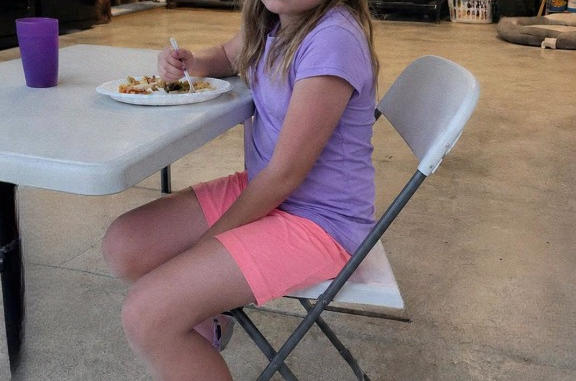
“They put a little table out here.”
A small table.
In the attached garage.
Because my daughter spilled water.
I immediately called Daniel.
“Your mother put Lily in the garage.”
Silence.
Then disbelief.
“What?”
He left work immediately and met me on the way.
For years he had excused his mother’s treatment of me.
But hearing our daughter’s voice shattered every excuse he had ever made.
We drove straight to the side entrance instead of the front door.
The garage door stood open.
Inside, next to stacks of folding chairs and bottled water, sat a tiny round table covered with a white cloth.
A plate of untouched food rested in front of Lily.
She sat quietly with her stuffed rabbit against her chest, making herself as small as possible.
When she saw us, relief washed over her face.
Then embarrassment.
That hurt even more.
I knelt and wrapped her tightly in my arms.
“You did absolutely nothing wrong,” I whispered.
Daniel crouched beside us.
For once, he had nothing to say in defense of his mother.
“Lily,” he said gently, “this will never happen again.”
She burst into tears.
We walked her outside.
Daniel climbed into the back seat beside her because she refused to let go of his hand.
I closed the car door.
Then I walked back into the house alone.
Inside, everything looked flawless.
Fresh flowers.
Polished silver.
Soft conversation.
An elegant room hiding something deeply ugly.
Evelyn sat smiling at the head of the table.
She looked surprised when she saw me.
“Claire,” she said. “We’re in the middle of lunch.”
“I noticed.”
I immediately recognized one of her guests.
Margaret Leland, the respected head of Saint Bartlett Academy—the very school Evelyn desperately hoped would accept her grandson.
I looked around the room.
“I’m sorry for interrupting,” I said calmly. “But I think everyone deserves to know where Evelyn decided my daughter should eat today.”
Evelyn quietly warned me with my name.
I ignored her.
“Lily accidentally spilled a glass of water.”
I paused.
“Evelyn removed her plate from this table because she decided my daughter didn’t belong among the guests.”
The room became completely still.
I continued in the same calm voice.
“The staff placed a small table for her in the attached garage, where she’s been eating by herself.”
Evelyn immediately defended herself.
“She was upset. She needed time to calm down.”
Margaret looked directly at her.
“You put an eight-year-old child in the garage?”
“It’s attached to the house,” Evelyn replied.
Margaret simply stared for a moment.
Then she quietly placed her napkin on the table.
“I understand.”
Nothing more.
No lecture.
No raised voice.
Just those two words.
One by one the guests stood, offered polite goodbyes, and left.
No one wanted to remain at that table.
Before Margaret departed, I asked if she would say hello to Lily.
She agreed.
Outside she bent down beside the car.
I only heard one sentence.
“One spilled glass should never determine where a child belongs.”
Lily nodded.
That evening Daniel called his mother.
“We won’t be visiting again this summer.”
She argued.
He didn’t change his mind.
“When you mistreated Claire, I convinced myself that was simply your personality,” he said. “I won’t make that excuse for what you did to our daughter.”
Three days later Evelyn came to our home.
She stood quietly in our living room, gripping her purse.
There were no gifts.
No dramatic apology.
Only silence.
“I never intended for things to become this,” she finally said.
“You humiliated an eight-year-old girl.”
She glanced toward the hallway where Lily’s drawings covered the wall.
“I know.”
“I was focused on the lunch… on appearances.”
“That’s not an excuse.”
“No,” she admitted. “It isn’t.”
For the first time in years, I saw a crack in the perfect image she had spent her life protecting.
I told her regret meant very little when it only appeared after public embarrassment.
She nodded.
Months later, Lily’s school hosted an art fundraiser.
Her painting showed one long family dinner table with everyone sitting together.
One chair remained empty.
Beneath it she had carefully written:
Room for Everyone.
Evelyn stood staring at that painting for a long time.
Then she quietly purchased it.
Later Daniel told me she hung it in her formal dining room where every guest would notice it.
I don’t believe Evelyn transformed overnight.
Real change rarely happens that quickly.
But she had finally been forced to confront the person she had become.
As for Lily, she never questioned whether she belonged again.
Instead, she started making sure no one else ever felt left out either.
Leave a Reply