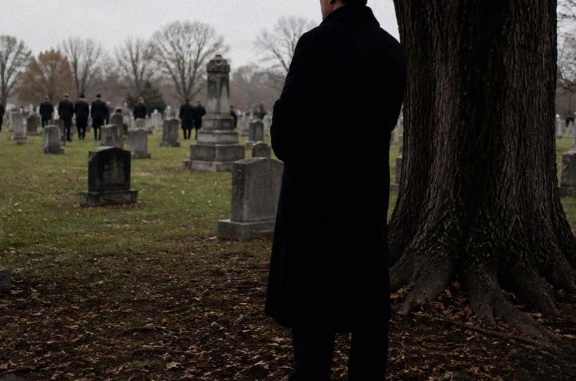
The man in black attended every funeral in town, though nobody seemed to know who he was. He always stood beneath the same old oak tree, never spoke to anyone, never shed a tear, and slipped away before the service ended. Then I found his face in a newspaper photo from 1998. He looked exactly the same.
I never noticed him at the first funeral.
Or the second.
Truthfully, I don’t think anyone did.
In Bellweather, funerals were simply part of life. Neighbors brought casseroles, families gathered in dark clothes, and everyone knew someone they had come to honor.
Everyone except him.
He always stood alone beneath the old oak tree at the edge of the cemetery.
His hands stayed folded in front of him. A black coat. A black hat. Silent from beginning to end. And before the last goodbye, he was always gone.
I first paid attention at my Uncle Ray’s funeral.
Ray was loud, stubborn, and impossible to please. Half the town came because he’d fixed their cars, loaned them tools, or argued with them in the hardware store.
While the pastor spoke, I noticed the stranger standing beneath the oak.
“Who’s that?” I whispered to my aunt.
She glanced over.
“I don’t know.”
“Did Uncle Ray know him?”
“I knew all of Ray’s friends,” she replied. “I’ve never seen that man before.”
The question stayed with me.
A few weeks later he appeared again at Mrs. Donnelly’s funeral.
Then at Carl’s.
Then at Emily’s, the teenager killed in a car accident that devastated the entire town.
Every time, he stood in the same place.
Every time, he vanished before anyone could stop him.
Something about it unsettled me.
Maybe it was how he never cried.
Maybe it was how he watched without joining anyone.
After Emily’s funeral, I asked the funeral director if he knew the stranger.
He admitted he’d seen him before but assumed he belonged to the family.
The family thought he worked with the funeral home.
No one knew him.
The cemetery caretaker recognized my description immediately.
“The man in the black coat?” he asked.
When I nodded, he laughed uneasily.
“People have been asking about him for years.”
“So who is he?”
“No one’s ever figured that out.”
That answer didn’t satisfy me.
Bellweather had barely four thousand residents. A man couldn’t attend every funeral for years without leaving a trace.
So I started digging.
I searched newspaper archives, obituaries, and old funeral photographs.
There he was.
Year after year.
Always beneath the oak tree.
Always alone.
Then I found a newspaper photo from 1998.
I placed it beside one taken only weeks earlier.
The same coat.
The same hat.
The same face.
He hadn’t changed.
At the next funeral, I arrived early and hid near the oak tree.
Just before the service began, he appeared.
I never heard footsteps or a car.
One moment the space was empty.
The next, he was standing there.
After the funeral ended, instead of leaving, he walked toward an old grave no one had visited.
He knelt, removed a small painted blue stone from his pocket, and gently placed it against the headstone.
Then he turned and looked directly at me.
Without saying a word, he tipped his hat and walked away.
The grave belonged to a woman named Eleanor.
The library archives revealed she had spent decades arranging funerals for people who had no family—strangers, forgotten souls, children, and the lonely.
One newspaper described her as “the woman who never let anyone be buried alone.”
Wanting answers, I visited Reverend Cole, who had known Eleanor.
When I showed him the stranger’s photograph, he recognized him immediately.
“His name is Samuel,” he said quietly.
Years earlier, Samuel had been a lonely teenager whose mother died with almost no one attending her funeral.
Eleanor stayed with him long after everyone else had gone.
Before leaving, she told him something he’d never forget.
“No one should ever have to stand alone at a funeral.”
When Eleanor herself died years later, almost nobody came.
Samuel did.
Afterward, he made himself a promise.
He would attend every funeral he possibly could.
Not because he knew the people.
Because someone should be there.
The blue stones made sense too.
Eleanor used to paint them with grieving children as symbols that someone remembered.
Samuel had left one on her grave after every funeral for decades.
When I finally met him, he admitted he rarely knew the people being buried.
“I witness,” he told me. “That’s different.”
He never wanted recognition.
If people thanked him, they would make the story about him instead of the people being remembered.
He simply wanted every name to be spoken one last time.
Over the years, I began standing near the back with him.
At funerals where only a handful of mourners came, Samuel made one more.
Eventually, so did I.
Years later, Samuel passed away.
I expected only a few people to attend.
Instead, nearly the entire town gathered beneath the old oak tree.
Everyone carried blue stones.
Teachers.
Firefighters.
Neighbors.
Families whose loved ones Samuel had quietly honored for decades.
Many had never spoken to him.
But they had noticed him.
And finally understood.
After the service, people covered Eleanor’s grave with blue stones before placing the last one beside Samuel’s.
From that day forward, no one in Bellweather was buried alone.
Not while any of us were still there to stand and witness.
Leave a Reply