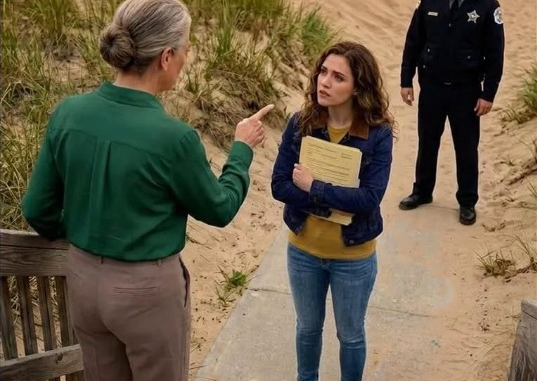
“You’re NEVER setting foot in the family beach house again. I’ve changed every lock.” My stepmother, Diana, sounded almost pleased with herself when those words came through my phone as I stood inside my Boston apartment. She insisted my father had transferred the Cape Ann property into her name and warned me not to come back. But this wasn’t just some ordinary vacation home—it was the house my grandparents had built, the place where my late mother and I had spent countless summers together. Diana even said she had already informed the local police that I was no longer allowed on the property.
Rather than argue with her, I calmly thanked her for letting me know about the new locks and ended the call. Then I pulled out an old envelope my mother had labeled, “BEACH HOUSE DOCUMENTS. IMPORTANT.” What I found inside explained exactly why Diana’s threat didn’t scare me.
Years before her death, my mother had secretly placed the beach house into an irrevocable trust, naming me as the legal owner. Her longtime attorney, Evelyn Porter, had helped arrange everything because Mom feared Diana saw the property as something to claim rather than a treasured piece of our family history.
I immediately forwarded Diana’s messages to Evelyn. She told me it was finally time to deal with the situation properly. Even my father appeared confused about what he had supposedly signed. He admitted Diana had convinced him that I no longer wanted the responsibility of owning the house.
The following morning, I flew to Massachusetts and drove through heavy coastal fog toward the property. Diana was already outside, with Madeline filming everything on her phone. Two police cars were pulling into the driveway just behind me.
Diana confidently told the officers that I was trespassing. But her confidence disappeared when one of them opened the folder containing the documents my attorney had provided.
The property legally belonged to ME.
Because my mother had placed the house in an irrevocable trust, my father had no legal authority to transfer an asset that had never belonged to him personally. Diana’s attorney soon arrived, reviewed the paperwork, and quickly recognized that the trust was legitimate.
Any attempt to prevent me from accessing the property could now lead to serious legal consequences. The documents also raised important questions about the house’s insurance, mortgage status, and any renovations or investments Diana had made while mistakenly believing she owned the property.
My father stood on the porch in complete disbelief, finally admitting that my mother had never told him about the arrangement.
Diana had changed the locks, installed security cameras, and renovated portions of the house because she believed it was hers. But none of those actions changed the ownership that had been legally established years earlier.
Over the next several weeks, I focused on restoring the beach house rather than celebrating Diana’s humiliation. I repainted parts of the porch and brought my mother’s old family photographs back downstairs after discovering they had been tucked away in the attic.
My father began visiting from time to time, slowly coming to terms with how many things he had accepted without ever questioning them.
Then, unexpectedly, Madeline showed up carrying several letters she had discovered inside Diana’s desk. They were letters my mother had written before she died—letters I had never received.
Months later, I discovered one final envelope hidden beneath the porch swing. Inside, Mom had written that the house itself was merely a symbol. The true legacy was having the courage to protect the things that truly mattered.
As I sat there watching the Atlantic grow darker beneath the evening sky, I finally understood.
Owning the house was never the real victory.
That property carried generations of memories, and after years of uncertainty, I finally knew those memories—and the place where they had been created—were safe.
Leave a Reply