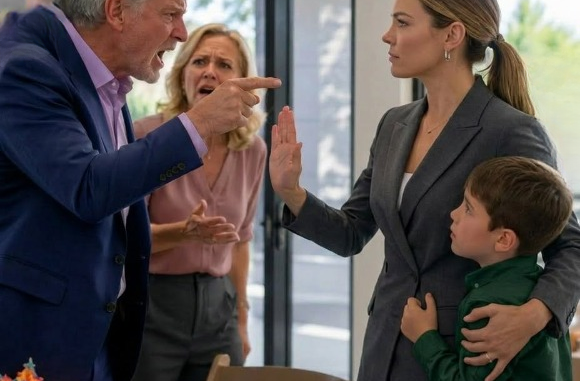
My father walked away from me when I was fifteen. Years later, he showed up without warning at my son’s birthday party, demanding $50,000 and threatening to take me to court. But I stayed calm, looked him in the eye, and gave him five minutes to leave.
My father arrived at my son’s seventh birthday celebration uninvited, carrying a legal threat in one hand and a gift bag in the other.
He hadn’t seen me in years.
He had never even met my son.
Yet he walked through my backyard gate like he still had the power to step into my life and cause damage whenever he wanted.
The yard was full of children chasing balloons. My husband was preparing the cake. Noah was laughing with frosting on his face when my father stepped onto the patio and spoke as if no time had passed.
“We need to talk.”
For a moment, I froze.
Not because I was scared.
Because I remembered.
When I was fifteen, I came home from school and found my belongings packed into garbage bags sitting outside. My father stood at the door and looked at me without emotion.
“You’re too much responsibility. You’ll have to figure things out yourself.”
My mother had already passed away two years earlier. My aunt became the person who raised me. My father never called.
Not on my birthday.
Not when I graduated.
Not when I got married.
Not when my son was born.
Nothing.
And now, two decades later, he was standing beside my son’s birthday cake wearing an expensive-looking suit and expecting to be welcomed.
“Leave,” I said.
He smiled as if I were still that scared teenager standing on the porch.
“You don’t want to cause a scene.”
I looked at the children playing nearby. Then I looked at my husband, who had already moved closer.
My father lowered his voice.
“I know you’re doing well now. Your company is successful. After everything I sacrificed, I deserve something.”
I almost laughed.
Sacrifice.
He had abandoned me when I needed him most, then returned when I became someone who could provide for him.
“How much do you want?” I asked.
His smile grew.
“Fifty thousand dollars. Consider it repayment. Or I can take you to court for support. Maybe I’ll tell them you abandoned your own father.”
I kept my expression calm.
“You abandoned me when I was fifteen.”
He shrugged.
“You survived.”
That was the moment the last bit of sympathy I had for him disappeared.
Noah ran toward me holding a balloon.
“Mommy, who is that?”
My father immediately bent down.
“I’m your grandpa.”
I stepped in front of my son.
“No, you’re not.”
His expression hardened. He reached toward Noah as if sharing blood gave him the right.
I grabbed his wrist before he could touch my child.
“Do not touch my son.”
For the first time, my father looked unsure.
I leaned closer and spoke quietly.
“You have five minutes to leave.”
He gave a bitter laugh.
“Or what?”
I glanced at the security camera above the patio.
“Or everyone gets to see exactly why I stopped being afraid of you.”
My father looked at the camera.
Then at the guests.
Then back at me.
“You’re threatening me?”
“No,” I said. “I’m keeping records.”
My husband stepped beside me.
“The exit is right there.”
My father looked at him with a mocking smile.
“So you’re the man who thinks he can replace me?”
My husband didn’t raise his voice.
“You abandoned that role yourself.”
The conversations around the party had stopped. Everyone was watching.
My aunt stood near the cake table, anger written across her face. She was the person who had taken me in all those years ago. She bought my clothes, helped me with school, signed my papers, and held me when I cried because I couldn’t understand why my own father didn’t want me.
She walked toward us.
“Robert,” she said. “Leave.”
He sneered.
“You always filled her head with lies.”
My aunt looked him directly in the eyes.
“I filled her refrigerator. You filled garbage bags.”
For once, he had no response.
I pulled out my phone and opened the folder I had kept for years.
Pictures of my belongings outside the house.
Messages from neighbors.
The report my aunt filed after he abandoned me.
A letter from his attorney refusing financial responsibility when I was sixteen.
I held the phone toward him.
“You want to sue me? Start with this.”
The confidence disappeared from his face.
Then Noah started crying behind me.
The shouting had scared him.
That was the only thing I cared about.
My father looked past me.
“He deserves to know his grandfather.”
I shook my head.
“He deserves peace.”
One of the parents at the party, my attorney, stepped forward.
“Mr. Ellis, you should leave now before this turns into a police matter.”
My father stared at her.
She continued calmly.
“And if you contact my client again, we will take legal action first.”
My father left through the gate still holding the gift bag.
No one applauded.
No one needed to.
The quiet afterward felt better than any celebration.
I knelt beside Noah and wiped the frosting from his cheek.
“I’m sorry, sweetheart.”
He looked up at me.
“Was he mean to you?”
I looked at my son, his dinosaur shirt, the candles on his cake, and the childhood I wanted to protect.
“Yes,” I said honestly. “But he doesn’t get to bring that here.”
My husband relit the candles.
My aunt served the cake.
Slowly, the party returned to normal. Children are good at bringing happiness back into places where adults create pain.
That night, after Noah fell asleep holding his toy dinosaurs, I sent every document to my attorney.
The next morning, my father sent a demand letter.
He wanted $50,000.
A public apology.
And access to my son.
My attorney responded with a cease-and-desist letter, the abandonment records, the security footage, and a warning that any false legal claims would result in further action.
He never filed a lawsuit.
People who depend on intimidation usually lose when facts appear.
Two weeks later, he left one final voicemail.
“You’ve become heartless,” he said. “Your mother would be disappointed.”
I listened once.
Then I deleted it.
My mother would never have been disappointed in the child who survived being abandoned.
She would have been disappointed in the parent who walked away.
A month later, Noah asked if the “mean grandpa” was coming back.
“No,” I told him. “Some people don’t deserve another chance just because they arrive late.”
He nodded and went back to playing with his dinosaurs.
And that was when I finally understood something I wish I had known at fifteen.
Being abandoned did not mean I wasn’t worthy of love.
It meant I was free to create a family where no child ever had to wonder if they were wanted.
My father came looking for fifty thousand dollars.
He left with the only thing he truly earned.
Nothing.
Leave a Reply