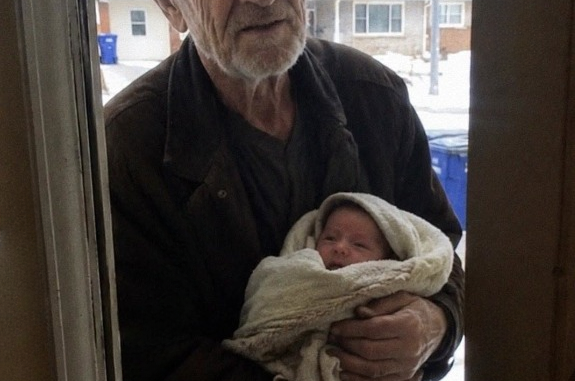
Ian’s quiet Sunday was shattered when an elderly mute man appeared on his porch holding a baby in his arms. The stranger couldn’t speak, but there was something urgent in his eyes—and the child’s tiny wrist bore a birthmark Ian recognized instantly, pulling him toward a truth he had buried long ago.
I was alone at home that afternoon when someone knocked on my door.
The sound felt unusually loud in the stillness.
My Sundays were always like this—too quiet, too empty, according to my sister, who insisted a 36-year-old man shouldn’t live like a ghost in his own house. She said I had turned silence into a habit I refused to break.
Maybe she was right.
The room was dim, curtains half-drawn, a cold cup of coffee sitting untouched on the table, and a book I hadn’t finished resting face-down beside me.
I had been sitting there longer than I cared to admit, lost in thoughts I usually avoided.
Then came the knock again.
Firm. Then slower.
I frowned and looked toward the hallway.
I wasn’t expecting anyone. No one ever really came by unannounced.
I considered ignoring it.
But then it came again.
Something about it made me stand.
“Coming,” I called out, my voice rough from disuse.
I walked to the door, hesitated for a moment, then opened it.
An elderly man stood there.
He looked around seventy, thin shoulders hunched under an old coat, white hair peeking from beneath a worn cap. His face carried deep lines—not just from age, but from exhaustion, like life had worn him down more than time ever could.
And yet… something about him felt familiar. Not clearly. More like a memory I couldn’t fully reach.
Then I saw what he was holding.
A baby.
Wrapped in a faded blue blanket, small and sleeping against his chest.
For a moment, I just stared.
A baby. On my doorstep. In the arms of a stranger.
“Can I help you?” I asked carefully.
The man opened his mouth—but nothing came out.
No sound. Not even a whisper.
I froze.
He tried again, straining, his throat working, but it was useless.
He was mute.
He began gesturing instead—pointing to himself, then the baby, then outward toward the street. His hands moved quickly, then slowed when he realized I didn’t understand.
“I’m sorry,” I said softly. “I don’t—”
His face fell, and something inside me shifted.
He wasn’t threatening. He looked desperate… and afraid. Especially when he checked the baby’s blanket as if making sure the child was still warm.
Against my better judgment, I stepped aside.
“Come in,” I said. “It’s cold out here.”
He hesitated, then nodded and entered.
Inside, the silence felt heavier.
We sat at the kitchen table. The baby remained asleep in his arms, the man holding him with careful, protective tension.
“Do you need help? A hospital? Police?” I asked.
He shook his head quickly.
“Family?” I tried. “Are you looking for someone?”
He nodded, then reached for a pen and paper.
I fetched them without thinking.
When I returned, I noticed again that strange feeling—that almost-recognition I couldn’t place.
Then I saw the baby’s wrist.
The blanket had slipped slightly.
A tiny birthmark sat near it.
My breath caught.
I knew that mark.
My body went cold.
Memories I had locked away for years surged back—hospital lights, whispered conversations, a woman crying, a promise I thought I had lost the right to remember.
The room tilted slightly.
The man noticed my reaction instantly.
My hands were shaking before I even realized it.
I stepped forward abruptly. “Write,” I said sharply, pushing the paper toward him. “Please. Write.”
He flinched, pulling the baby closer.
Shame hit me immediately, but panic was louder.
“I’m sorry,” I said quickly, forcing my voice down. “I need to know who this child is.”
His hand trembled as he wrote.
“My name is Gerald.”
Everything stopped.
Gerald.
The name wasn’t unfamiliar—it belonged to Nina’s father. A man she had spoken about only a few times, always with complicated emotion.
My throat tightened.
“Are you… Nina’s father?” I asked.
He nodded.
My legs felt weak. I sank into the chair across from him.
“Where is she?” I whispered.
His expression broke as he wrote again.
“She is gone.”
At first, I thought I had misunderstood.
Gone could mean many things.
But then he underlined it.
She is gone.
My chest went hollow.
“No,” I said faintly. “That’s not possible.”
Then he reached into his coat and pulled out an envelope.
My name was written on it.
Ian.
My hands shook as I opened it.
The first line nearly broke me.
If you are reading this, it means I didn’t find the courage in time.
It was Nina’s handwriting.
She wrote that she had been pregnant after leaving, that fear and shame had kept her silent, and that she had convinced herself she would reach out eventually… but never did.
Until it was too late.
The baby stirred softly in Gerald’s arms.
My son.
“What’s his name?” I asked, barely able to speak.
He wrote beneath the letter:
“Jeremy. She wanted you to know him.”
Something inside me cracked completely.
I had spent years believing Nina left because she didn’t want me. I had built my life around that absence until it became part of who I was.
But she hadn’t left a void.
She had left a life.
“What happened to her?” I asked.
Gerald hesitated, his hand trembling.
“Cancer. It was fast. She asked me to bring him to you.”
The anger came first—confused, directionless, overwhelming. Then it collapsed just as quickly when the baby made a small sound.
Jeremy was waking.
I stood instinctively. “I don’t know how,” I admitted.
Gerald gave a small, tired smile. Then he pointed from his chest to me to the baby.
Try.
So I did.
I took my son.
He was warm. Real. Heavy in a way I wasn’t prepared for. His cries faded slowly as I held him, unsure and unsteady.
“Hey,” I whispered, voice breaking. “Hey, Jeremy… I’ve got you.”
The words hit me harder than I expected.
I’ve got you.
Gerald wiped his face quietly.
“I’m sorry,” I told him. “For everything.”
He wrote one last line.
She loved you. She was just afraid.
That night, the house no longer felt empty.
It felt changed.
Uncertain. Fragile. Full of something I hadn’t allowed myself to have in years.
And as I stood over the crib, watching my son breathe, I finally understood what that knock had really brought me.
Not just a child.
But a second chance I never saw coming.
Leave a Reply