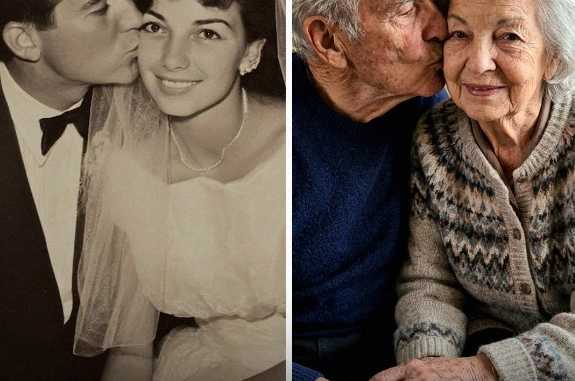
My husband always asked me never to enter his garage. I trusted him enough not to question it. But the day I finally opened that door, I uncovered something that shook my faith in our 60-year marriage and left me facing a truth I wasn’t prepared for.
My name is Rosemary. I’m 78 years old, and Henry and I have been together for nearly six decades. We met in high school, sat side by side in chemistry class, and built a life from there—marriage at 20, four children, seven grandchildren, and even a great-grandchild. Our life was steady, loving, and full of small, meaningful routines. Every night, he still tells me, “I love you, Rosie.”
Henry has always been attentive—he knows exactly how I like my tea, notices the smallest changes in my mood, and quietly takes care of me in ways that don’t draw attention. People used to say we were inseparable, and I believed it too.
But there was one thing he never budged on: I was not to go into his garage.
That space was his sanctuary. Late at night, I’d hear jazz playing softly from inside, and sometimes catch the smell of paint or chemicals drifting under the door. He could spend hours in there. When I once teased him about hiding another woman, he laughed it off, telling me it was just his mess and nothing I’d want to see. I let it go. After all, everyone deserves a bit of privacy.
Still, over time, something began to feel off. I’d catch him looking at me—not lovingly, but almost fearfully.
One afternoon, he left for the market and forgot his gloves. Thinking he might still be in the garage, I went to return them. The door was slightly open, light cutting through the dust inside. I hesitated… then stepped in.
And froze.
The walls were covered in hundreds of paintings—portraits of a woman at different ages and in different emotions. Laughing, crying, sleeping, lost in thought. Some even had dates written on them… including ones that hadn’t happened yet.
I picked one up, my hands trembling. “Who is she?”
Henry appeared behind me, clearly shaken. He reminded me I wasn’t supposed to be there, but I pressed him. Who was this woman? Why had he painted her over and over again?
He hesitated, saying only that he painted to hold onto time, and begged me to trust him. But I couldn’t. Not anymore. I left the garage deeply unsettled.
In the days that followed, Henry became even more attentive, watching me closely. I needed answers. One morning, I pretended to be asleep and saw him take a large amount of cash from the safe before quietly leaving. Suspicious, I followed him.
He didn’t go for a walk—he went to a private neurology clinic.
Inside, I overheard his conversation with a doctor. They were discussing a patient whose memory would gradually fade over the coming years—eventually not recognizing family. The timeline sounded eerily specific… and then I realized.
They were talking about me.
The dates on the paintings weren’t random. Henry had been painting my future—capturing who I was before I might forget everything.
When I stepped in, he was devastated that I found out this way. He admitted he’d known for five years: early-stage Alzheimer’s, slowly progressing. He’d been too afraid to tell me.
Suddenly, everything made sense—the small lapses, the moments I couldn’t recall names or tasks. I thought it was just aging. It wasn’t.
Henry had been preparing—not to leave me, but to hold onto me.
He told me, “If you forget me, I’ll remember enough for both of us.”
Later, he took me back to the garage and showed me the paintings. Not exact likenesses, but memories—how he saw me through the years. Then came the future ones: confused, distant, slowly fading. He had painted them so he could still recognize me, even if I couldn’t recognize him.
On one painting of the future, he’d written: “Even if she doesn’t know my name, she will know she is loved.”
Through tears, I added my own line beneath it: “If I forget everything else, I hope I remember how he held my hand.”
We decided to fight it together. I chose to try treatment, no matter the cost. I also began writing everything down—our children’s names, our memories, our life—while I still can.
Sometimes I go back into the garage and look at those portraits: who I was, who I am, and who I may become.
And I think about Henry—the man who has loved me for 60 years, and who promises to keep loving me even if I forget why.
I recently wrote something in my journal, just in case:
“If one day I look at Henry and don’t know who he is, remind me: this man is your heart. He has always been your heart. Even if your mind forgets, your soul will remember.”
Because even if memory fades… I hope love remains.
Leave a Reply