Here’s a paraphrased version that keeps the emotional storytelling while improving flow and originality:
Ivony believed nothing could hurt more than hearing her neighbor cruelly label her eight-year-old autistic daughter, Lily, a “freak.” But her worst nightmare began when Lily disappeared one morning, and security footage revealed she had wandered to the one place Ivony had always feared she would go.
The day started with a chilling discovery: the front door was standing open, and Lily was nowhere in sight.
A wave of panic crashed over Ivony. She searched every room, already knowing the answer before she reached Lily’s bedroom. The bed was empty, her favorite blanket tangled on the floor. Lily was gone.
As a non-verbal autistic child, Lily faced unique challenges. She wouldn’t call for help if she got lost or respond when someone shouted her name. Instead, she communicated through quiet gestures—a touch on the wrist, a flower placed in someone’s hand, or a gentle lean against a loved one when the world became overwhelming.
Flowers, especially, brought her comfort. She was fascinated by their colors, textures, and delicate petals. Her favorite were blue flowers, which is why the neighbor’s vibrant hydrangeas captivated her.
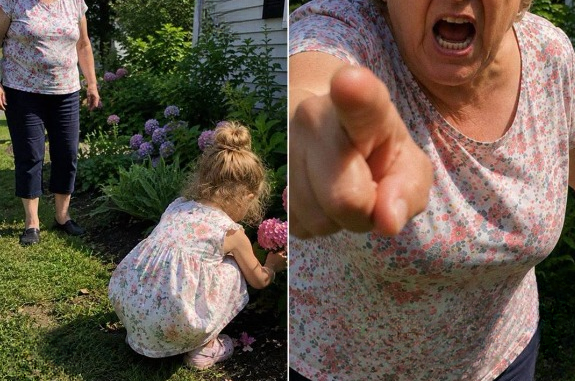
A few weeks earlier, Lily had carefully picked three blooms from the hydrangea bushes growing along the fence shared with their neighbor, Mrs. Gable. To Lily, they were beautiful treasures. To Mrs. Gable, they were damaged property.
The encounter that followed was painful. Furious, Mrs. Gable shouted at Lily, calling her destructive and undisciplined before cruelly referring to her as a “freak.” The outburst triggered a severe sensory meltdown that left Lily distressed for hours.
Ivony confronted her neighbor later that day, but the conversation only escalated. Mrs. Gable threatened police involvement and demanded that Lily stay away from her yard.
Determined to protect her daughter, Ivony kept Lily away from the fence. Yet every morning, Lily continued gazing at the blue hydrangeas from the window.
Then one terrifying morning, Lily vanished.
Desperate for clues, Ivony reviewed footage from her security camera. What she saw stopped her cold.
The video showed Lily quietly leaving the house at dusk and walking directly to Mrs. Gable’s porch. Instead of causing trouble, she sat gently on the porch swing and carefully placed three dried hydrangea blossoms beside a framed photograph of a man.
The flowers were the same ones she had picked weeks earlier.
Lily touched the photograph softly, as if offering a gift.
Moments later, Mrs. Gable stepped outside. Expecting conflict, Ivony watched nervously. Instead, Lily pointed to the photo, then to the flowers, silently expressing something only she fully understood before walking away.
The footage revealed a heartbreaking truth: Lily had not taken the flowers out of mischief. She had saved them and returned them as a tribute.
The photograph belonged to Mrs. Gable’s late husband, Henry.
Soon after, Ivony found Lily near a busy road, safely held by Mrs. Gable, who had spotted her from the window and rushed to protect her from oncoming traffic.
Shaken by what she had learned, Mrs. Gable finally understood. Lily had recognized the loss Mrs. Gable carried and had tried, in her own quiet way, to honor Henry’s memory.
When Mrs. Gable watched the camera footage herself, she broke down in tears.
“She wasn’t stealing,” she whispered. “She was bringing them to him.”
Filled with remorse, Mrs. Gable apologized for her cruel words and admitted she had misunderstood both Lily and autism itself.
Over time, healing replaced hostility. The fence between their homes gained a small gate. Mrs. Gable learned how to support Lily’s sensory needs, and Lily began leaving flowers on Henry’s porch each week.
What had once been a relationship defined by anger became one built on compassion, patience, and understanding.
In the end, it was Lily—the child so many failed to understand—who taught everyone around her the meaning of empathy and grace.
Leave a Reply