PART 1
My name is Emily Rivera today, although I was born Emily Parker. I’m twenty-eight years old, and this is the story of how I finally defended the little girl my own parents abandoned when she needed them most.
This is not a story about forgiveness coming easily. It is about accountability, resilience, and discovering that the people who share your blood are not always the people who truly become your family.
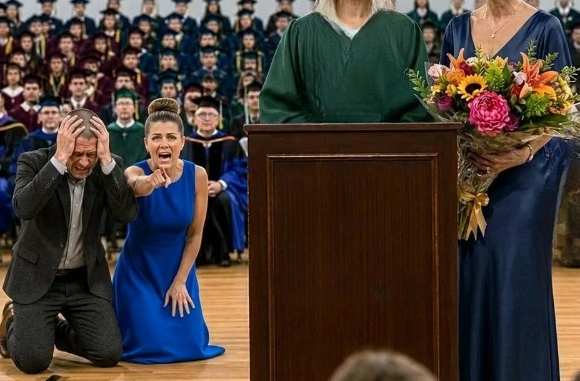
Before I tell you what happened on the graduation stage at Columbia University, before I explain how my biological mother sat silently in the audience while thousands of people learned the truth, I need to take you back to where everything started.
I was thirteen years old on a freezing October afternoon, sitting in Room 218 at Mercy General Hospital.
I still remember every detail. The harsh scent of disinfectant. The sting of rubbing alcohol. The artificial flower air freshener plugged into the wall. I sat on the examination table wearing a paper gown that barely stayed closed, my feet dangling above the floor because I was still so small. My hands shook so badly that every breath made the paper beneath me move.
Dr. Collins had just given us the news.
Acute lymphoblastic leukemia.
He explained that it was one of the more common childhood cancers and that treatment had a strong success rate. With aggressive chemotherapy, he told us, my chances of survival were very high—around eighty-five to ninety percent.
“Those are very hopeful numbers, Emily,” he said gently.
But while he spoke, my mother, Karen, sat by the window staring at the ceiling. My father, Richard, stood near the door with his arms folded, his expression tense. My older sister Ashley sat in the corner focused on her phone.
She never looked up.
Not even when the doctor said the word cancer.
“The treatment will be difficult,” Dr. Collins continued. “The first phase will require intensive chemotherapy and frequent hospital stays. After that, we move into additional stages of treatment that can last several years.”
My father’s first question was not about my health.
It was about money.
“How much will this cost?”
The room seemed to go silent.
Not “Will she be okay?”
Not “How painful will this be?”
Not “What can we do to help?”
Only the cost.
Dr. Collins paused before answering.
“With insurance, your portion may be around twenty percent. Over the entire treatment period, it could reach sixty to one hundred thousand dollars. However, there are assistance programs, payment options, and financial resources available—”
My father let out a bitter laugh.
“So we’re supposed to spend a hundred thousand dollars because she got sick?”
My mother quietly said his name, but she still wouldn’t look at me.
Dr. Collins looked uncomfortable.
“Richard, I understand this is overwhelming, but Emily has an excellent chance of recovery if treatment begins immediately.”
My father shook his head.
“Ashley is applying to college next year. Harvard. Stanford. She scored 1520 on her SAT. We have saved for her education since she was born.”
I felt something cold settle inside me.
The doctor looked between my parents and me.
“Perhaps we should discuss financial concerns privately,” he said. “Emily doesn’t need to carry this burden.”
But my father disagreed.
“She needs to understand reality.”
Then he looked directly at me.
And what I saw hurt more than the diagnosis.
There was no fear.
No sadness.
No instinct to protect me.
Only a calculation.
“We have $180,000 saved for Ashley’s future,” he said. “That money is for her education. We are not destroying that because of medical expenses.”
Something inside me broke.
“There are other options,” Dr. Collins said firmly. “Government assistance, charity programs, hospital support—”
“We are not taking charity,” my mother suddenly said. Her pride was stronger than her compassion. “What would people think?”
The doctor stared at them.
“What exactly are you suggesting?”
My father answered without hesitation.
“She’s thirteen. She can become a ward of the state. Medicaid can cover the treatment, and our finances remain protected.”
For a moment, I couldn’t process what I had heard.
I waited for someone to tell him he was wrong.
I waited for my mother to stand up and defend me.
Neither happened.
Leave a Reply