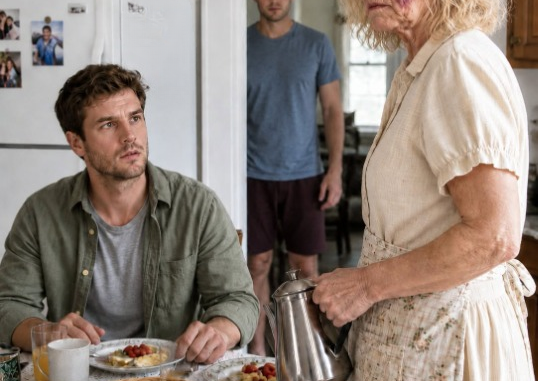
“If you tell me no one more time, you’ll regret it.”
When my son Brandon spoke those words in our kitchen just outside Dallas, I tried to brush them aside as another angry outburst. For months, I had convinced myself that his behavior was temporary—that he was struggling, frustrated, and lost. Deep down, I kept believing the sweet little boy I once knew was still there somewhere beneath the anger.
But that night, something shifted.
For the first time, I stopped seeing a troubled young man who needed another chance. I saw a grown adult who had learned to turn his disappointments into threats and expected everyone around him to absorb the consequences.
Brandon hadn’t always been this way. As a child, he was energetic, affectionate, and endlessly curious. He would run through the backyard collecting flowers and treasures, eager to share every discovery with me. Watching him grow up, I never imagined we would one day be strangers living under the same roof.
Over the years, I found reasons to excuse his behavior. After the divorce, I blamed the instability in his life. When he dropped out of college, I told myself he simply needed time to find his direction. When jobs came and went, I assumed he was still searching for the right opportunity. When relationships failed, I believed heartbreak was making him lash out.
Eventually, though, the excuses stopped making sense.
The truth was much harder to accept.
Brandon had become increasingly angry at the world, and he expected everyone around him—especially me—to carry the burden of that anger. I overlooked things I should never have tolerated. I excused the shouting, the insults, the drinking, the broken dishes, and the holes punched into walls. Whenever money disappeared or cruel words were thrown my way, I convinced myself it was only a phase.
I believed that if I remained patient enough and loved him hard enough, he would eventually return to the person he used to be.
Instead, the situation kept getting worse.
One evening, after a long shift at the elementary school library where I worked, I came home completely exhausted. Bills were piling up, the mortgage payment was approaching, and every paycheck seemed stretched thinner than the last. I was already carrying more stress than I could manage when Brandon walked into the kitchen.
He didn’t ask how my day had been.
He didn’t notice how tired I looked.
He simply asked for money.
“I need three hundred dollars,” he said casually.
When I asked what it was for, he brushed the question aside and demanded that I hand it over. Something inside me finally snapped.
“No,” I said.
For a moment, he looked genuinely shocked.
Then his expression hardened.
We argued. For the first time in years, I refused to back down. I told him I was finished financing his bad decisions and enabling behavior that was hurting both of us.
The room fell silent.
Then he smiled—not with humor or warmth, but with cold hostility.
Before I could react, he stepped forward and slapped me across the face.
The sound echoed through the kitchen.
For a few seconds, I stood frozen beside the counter, unable to process what had happened. The physical pain barely registered. What hurt far more was the realization that followed.
He wasn’t sorry.
He didn’t look ashamed.
Instead, he seemed annoyed, as though I had somehow forced him into the situation.
A moment later, he turned and walked upstairs, leaving me standing alone in the kitchen.
That was when I understood something I had spent years refusing to acknowledge.
I was no longer safe in my own home.
Late that night, after sitting alone for hours replaying the moment in my head, I picked up my phone and called my ex-husband, Richard.
We had been divorced for more than a decade. Our conversations were usually limited to birthdays, holidays, and family matters. Calling him was the last thing I wanted to do.
But I needed help.
When he answered, I struggled to get the words out.
Finally, I said, “Brandon hit me.”
The silence that followed felt endless.
Then Richard replied with a calmness that somehow carried even more weight than anger.
“I’m coming.”
He arrived before sunrise.
While Brandon slept upstairs, Richard and I sat at the kitchen table discussing what needed to happen next. For years, I had avoided difficult decisions because I was afraid of losing my son completely. But after what had happened, doing nothing was no longer an option.
Instead of spending the night crying, I cleaned the house and prepared breakfast.
I cooked bacon and eggs, baked biscuits, brewed coffee, and laid out my best embroidered tablecloth—the one normally reserved for holidays and special family occasions.
It looked like a celebration.
In reality, it marked the end of something and the beginning of something else.
When Richard arrived, he carried a folder filled with legal paperwork, treatment program information, and resources I had avoided looking at for years because they made the situation feel too real.
One glance at my face told him everything he needed to know.
We agreed that the cycle would end that morning.
A short time later, Brandon came downstairs.
At first, he looked pleased by the breakfast spread, assuming everything was normal. Then he noticed Richard sitting at the table.
His smile disappeared instantly.
Richard instructed him to sit down.
Reluctantly, he obeyed.
What followed was the most difficult conversation our family had ever had.
Richard calmly presented the documents. There were forms restricting Brandon’s access to financial accounts, information about a treatment program, and legal options that would protect me if necessary.
Brandon initially denied responsibility. Then he minimized what happened, describing the assault as “just a slap.”
But neither of us backed down.
For the first time, he was confronted with consequences instead of excuses.
When he asked whether I was really willing to stop protecting him, I looked him in the eye and told him the truth.
“Yes.”
The confidence he had carried into the room began to fade.
Underneath the anger was fear, shame, and exhaustion.
For years, I had shielded him from accountability because I thought I was helping him. In reality, I had only allowed the problem to grow.
Eventually, Richard gave him a choice: accept help and enter treatment, or face the legal consequences of his actions.
The room grew quiet.
For several long moments, nobody spoke.
Then Brandon walked upstairs.
A few minutes later, he returned carrying a duffel bag.
For a brief second, I saw traces of the little boy I used to know.
The anger was still there, but it was no longer hiding everything else.
He looked tired.
Defeated.
Human.
Before leaving, he asked whether he would ever be welcome back home.
The question broke my heart because I knew he wasn’t really asking about the house.
He was asking whether I still loved him.
I told him the answer depended entirely on what he chose to do next.
Tears filled both our eyes.
For the first time in years, there was honesty between us.
No excuses.
No blame.
No pretending.
Just truth.
When Richard picked up the car keys and headed for the door, Brandon quietly agreed to go.
There was no dramatic reconciliation and no instant solution.
Only the first difficult step toward change.
After they left, I stood alone in the house and listened to the silence.
For the first time in years, that silence felt peaceful rather than lonely.
The weeks that followed were challenging. I changed the locks, attended therapy, completed paperwork, and learned concepts I had spent years avoiding: boundaries, accountability, recovery, and self-respect.
Healing was not immediate.
Some days were harder than others.
But little by little, I began reclaiming my life.
Several weeks later, a letter arrived from Brandon.
In it, he accepted responsibility for his actions and admitted that he had become someone he never intended to be. He acknowledged the pain he had caused and wrote that if he ever returned home, he wanted me to feel safe when I saw him.
Reading those words brought me to tears.
Not because everything had been fixed.
It hadn’t.
Trust takes time to rebuild, and forgiveness is a process rather than a single moment.
But for the first time, genuine accountability had entered our relationship.
That changed everything.
The experience taught me a lesson I wish I had learned much earlier. Love is not about enduring endless mistreatment. It is not about sacrificing your safety or dignity in the hope that someone else will change.
Sometimes love means setting firm boundaries.
Sometimes it means refusing to enable destructive behavior.
And sometimes the most compassionate thing a parent can do is stop protecting their child from the consequences of their own actions.
Sitting alone at that beautifully prepared breakfast table that morning, I finally understood something I had spent years avoiding:
A mother can love her child with all her heart and still demand better from them.
In some cases, that choice may be the very thing that saves both of their lives.
Leave a Reply