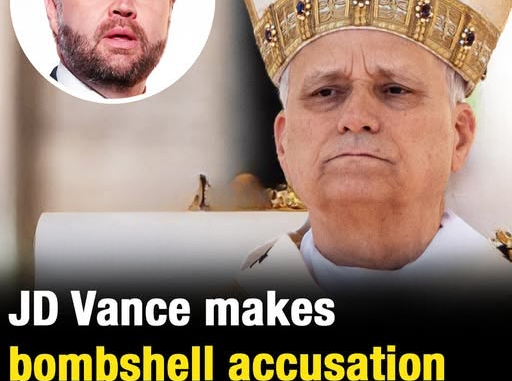
The political centers of Washington and the spiritual authority of the Vatican have become locked in an increasingly intense confrontation that is reshaping long-standing assumptions about the relationship between religion and state power in the modern world. What started as a series of pointed public disagreements has grown into a wider ideological struggle over who ultimately has the authority to define a nation’s moral direction. At the center of this escalating dispute is a direct clash between Donald Trump and Pope Leo XIV, further intensified by controversial remarks from JD Vance, pushing tensions toward a breaking point. The conflict has moved well beyond simple policy disagreement, evolving instead into a broader contest over leadership, legitimacy, and moral authority.
The tension first emerged when Donald Trump issued strong criticism of Pope Leo XIV, accusing him of being ineffective on issues such as crime and challenging his position on international affairs. The dispute became especially heated around the Pope’s opposition to rising military tensions, including the situation involving Iran and the broader Middle East. While the Pope maintained his consistent stance in favor of peace and humanitarian concern, the Trump administration viewed his interventions as an intrusion into matters of national sovereignty. The situation escalated further when Trump shared an AI-generated image depicting himself in a Christ-like portrayal, an act that sparked global debate over the blending of political imagery and religious symbolism, with interpretations ranging from satire to provocation.
The controversy deepened significantly after JD Vance publicly entered the discussion. As a Catholic convert with political influence, his remarks carried added weight and drew widespread attention. Vance questioned the extent of the Pope’s authority in political matters, arguing that religious leadership should remain focused on moral guidance rather than direct involvement in policy decisions. His comments effectively drew a sharp boundary between spiritual influence and governmental authority, reinforcing the idea that elected officials, rather than religious leaders, should make decisions in matters of state.
From the perspective of the administration, this position is rooted in the belief that governance must remain accountable to voters and grounded in constitutional authority. Political leaders argue that complex issues such as foreign policy and national security require practical expertise and direct responsibility to the public. In this view, religious leaders—no matter how globally respected—do not possess the mandate to shape or override decisions that carry geopolitical consequences. Vance’s stance reflects a broader political philosophy that prioritizes national sovereignty and state interests over external moral commentary.
On the other hand, the Catholic Church maintains that moral leadership is inseparable from its spiritual mission. From this perspective, the Pope is not only permitted but obligated to speak out on issues involving war, suffering, and human dignity. Silence in the face of potential mass harm would be seen as a failure of spiritual responsibility. The Church argues that its role is to serve as a moral counterbalance to political power, especially when decisions risk widespread human consequences, and that ethical intervention is justified even when it intersects with state affairs.
Public reaction to the dispute has been sharply divided. Supporters of the administration view the criticism as a defense of national strength and sovereignty, praising the refusal to defer to external moral authority. They interpret Trump and Vance’s rhetoric as a firm assertion of political independence. Critics, however, see the response as a troubling disregard for religious authority and an attempt to diminish legitimate moral critique, particularly in matters involving war and human suffering. The controversy has therefore become a broader cultural flashpoint reflecting deeper political and ideological divides.
What makes this moment particularly significant is how rare and openly confrontational it is. While tensions between political leaders and the papacy are not new, the directness and visibility of this exchange mark a notable departure from past precedent. It highlights a growing polarization in which even long-established institutions are now fully entangled in modern political conflict. At its core, the dispute raises a fundamental question about whether moral judgment and political decision-making can—or should—remain separate.
As the standoff continues, both sides remain anchored in fundamentally different views of responsibility: one focused on immediate political realities and security concerns, the other on universal moral consequences. The result is an increasingly visible divide between state power and spiritual authority. Whether this leads to a clearer separation of roles or a renewed recognition of their interdependence remains uncertain, but the implications of this confrontation are likely to shape discussions of faith, politics, and authority for years to come.
Leave a Reply