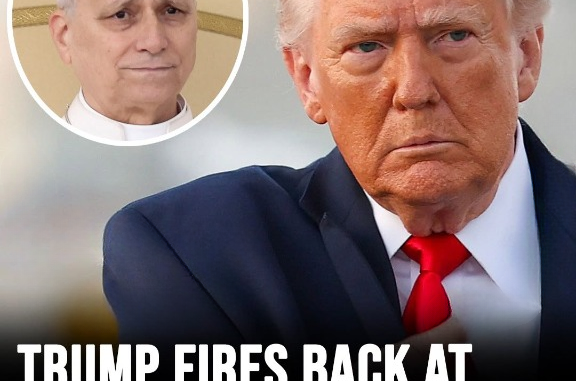
The world finds itself at a dangerous crossroads where political authority and spiritual leadership have collided in an intense public clash of ideology and influence. In a moment that has shaken international discourse, Donald Trump responded sharply to Pope Leo XIV, escalating tensions with remarks that quickly reverberated across global headlines. What began as a disagreement over global affairs has now transformed into a far more charged exchange—one that many observers describe as a symbolic battle over morality, power, and influence in an increasingly unstable world.
The conflict escalated after Pope Leo XIV broke from traditional diplomatic restraint and issued a forceful moral critique of ongoing international crises. Referencing widespread suffering and images of civilian hardship, the Pope framed the situation not as a strategic or political contest, but as a profound ethical failure. His message emphasized the human cost of conflict, particularly the impact on vulnerable populations such as children, the elderly, and the sick. In doing so, he urged world leaders and citizens alike to prioritize compassion and restraint over escalation and force.
Donald Trump, however, interpreted the Pope’s remarks as a direct political challenge. In response, he launched a pointed counterattack that sought to undermine the Pope’s authority by framing him as politically biased and out of his depth. Rather than engaging with the humanitarian message, Trump shifted the focus toward questions of legitimacy, influence, and leadership strength, portraying the exchange as a contest of credibility and control on the global stage.
This confrontation highlights a deeper divide in leadership philosophy. Pope Leo XIV represents a worldview rooted in moral responsibility, empathy, and the protection of human life, viewing power as a duty to safeguard the vulnerable. Trump, by contrast, embodies a more force-driven approach centered on strength, dominance, and uncompromising self-assertion, where challenges to authority are met with aggressive rhetorical resistance. The clash between these perspectives has intensified an already polarized global conversation about governance, ethics, and influence.
As the exchange continues to unfold, its impact extends beyond political commentary into broader cultural and social divisions. Religious communities, political supporters, and global observers find themselves interpreting the situation through sharply different lenses, further deepening existing fractures. What might have remained a diplomatic disagreement has instead become a highly visible symbol of modern polarization, amplified by media and public discourse.
Ultimately, the human dimension of the underlying crisis risks being overshadowed by the spectacle of high-profile conflict. While leaders exchange escalating rhetoric, the real-world consequences of instability continue to affect ordinary people. The situation underscores how quickly moral and humanitarian discussions can be transformed into power struggles in the modern media landscape. In the end, this confrontation reflects not only a clash between two figures, but also a broader struggle over how authority, truth, and responsibility are defined in today’s world.
Leave a Reply