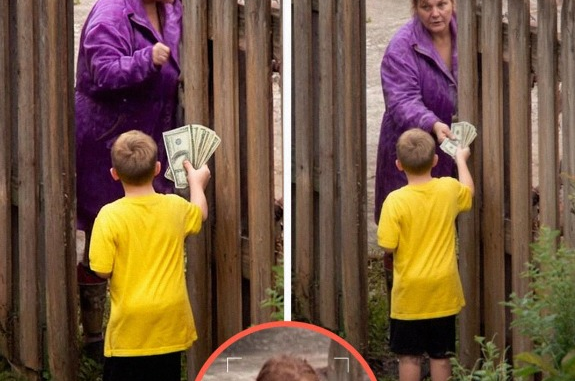
My husband’s eye surgery savings kept vanishing. When I finally confronted my 6-year-old son, he casually said he’d given the money to “Granny.” The shock? I grew up in foster care, and the woman he described wasn’t my mother-in-law. I set up a camera—but nothing could have prepared me for the truth.
The first time the money disappeared, I thought I’d miscounted.
I sat in my home office, staring at the bills spread on the desk. I had been carefully saving for my husband’s eye surgery, and now the total was $20 short.
I checked the envelope where I’d been keeping the money—empty.
“That’s strange.”
I counted again, more slowly. Still short.
Maybe I’d remembered the total wrong. I sighed, jotted down the current amount, and tucked the cash and note back into the envelope.
Three weeks. That was the window before Mark risked permanent vision damage.
Insurance wouldn’t cover enough. Surgery had to be paid upfront. For months, I’d been cutting corners, selling items, taking extra jobs.
It was working. If I kept careful track, we could scrape together the funds just in time. I made dinner, helped Joseph with his wooden puzzle, and told myself it would be okay.
Then $50 was missing the next time I opened the envelope.
My hands shook. My pulse raced. This couldn’t be happening.
Over the next two weeks, money kept vanishing. $20, $30, $50. Nothing made sense. I searched every corner of the house. I worked harder, cut back more, tried to make the numbers add up. The surgery deadline loomed closer.
One afternoon, the envelope felt noticeably thin. I dumped the bills onto the desk. One fluttered to the floor. I counted again, and again, hands shaking, until the truth hit—$1,000 was gone.
I ran into the living room. “Mark!”
He scrambled up, glasses crooked. “What?”
“The money—your surgery savings. A thousand dollars is gone.”
His face drained. “That’s impossible.”
“I know!” I snapped.
We both turned to the hallway. “Joseph,” I said.
“He’s six; maybe he was just playing,” Mark offered.
I entered Joseph’s room. He was playing with blocks. I dropped to my knees, trying to stay calm.
“Hey, sweetheart. Did you take any money from Mommy’s office?”
He nodded. “Yeah.”
“You… you did?”
“I gave it to Granny.”
I froze. I grew up in foster care. I didn’t have a mother. Carolyn, Mark’s mom, was staying with us to help—she would never have taken the money.
“Sweetheart, who did you give it to?”
“Granny. She begged me for it.”
I shook my head. “Grandma Carolyn wouldn’t ask you for money.”
“Not that Granny.”
A chill ran up my spine. “Then which one?”
“She doesn’t come inside. She talks to me by the fence.”
That night, I installed a small camera facing the back fence. I didn’t tell Mark. I had to know for sure.
The next afternoon, Joseph dug in the dirt while a figure appeared at the fence. She bent down, speaking to him through the slats. I zoomed in, heart pounding.
I recognized her. Eight years ago, I had told this woman never to contact me again. And now she was back, charming my son with the same soft smile that had once deceived me.
The next day, I let Joseph play outside, then quietly circled the house. She appeared again, crouched near the fence. Our eyes met across the space filled with years of history.
“My biological mother,” I thought. The woman who abandoned me at birth, now manipulating my child to get money.
I confronted her. “Linda, I told you to stay away.”
“I didn’t want to upset you,” she said softly. “I just wanted to see him.”
“You told my son to steal from me.”
Her mouth opened. “No, I—”
“You did, Granny,” Joseph interjected, confused. “You said I needed to get money for you because you’re all alone.”
I guided Joseph inside. Turning fully to Linda, I said, “You lied to my son and manipulated him, just like you did with me. You don’t need money—your goal was my grandson.”
Carolyn appeared behind me, furious. “Being blood doesn’t make you family!”
Linda reached for an envelope. “I was going to give it back.”
Every missing dollar was there.
“Don’t come near my son again,” I warned.
That night, Joseph curled against me on the couch.
“Am I in trouble?” he asked.
“No, baby. But no grown-up should ask a child for money or make them carry adult problems.”
A week later, we paid for Mark’s surgery. Walking into the clinic, Mark squeezed my hand. “We’re going to be okay,” he said.
For the first time, I believed it—not because life suddenly became fair, but because family isn’t blood. It’s the people who protect you, tell the truth, and stand by your child when life gets ugly.
Joseph reached for Carolyn’s hand, I held hers—and the fear no longer felt like the only thing in the room. It felt survivable.
Leave a Reply