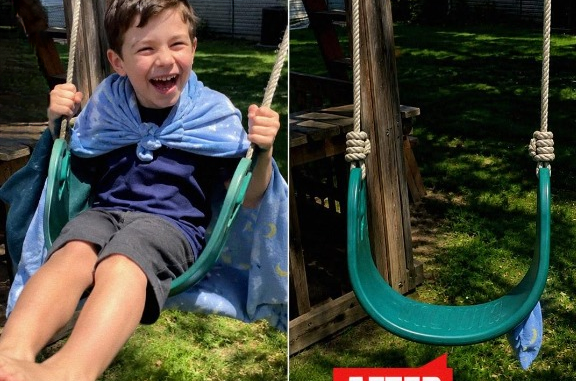
I believed my six-year-old son had vanished from our backyard fifteen years ago. Then one day, a stranger appeared at my door holding his old blue blanket with yellow moons, and everything I thought I knew about loss began to unravel.
“I think this belongs to you,” he said.
And when he saw my husband’s photo in the hallway, he went pale.
“Under no circumstances should you tell him I’m here,” he warned.
But my hand was already reaching for the phone.
I hadn’t seen my son since he was six years old.
Noah disappeared from our backyard on a Thursday afternoon.
One moment he was on his tire swing. The next, he was gone.
All that remained was a torn strip of his favorite blanket snagged on the fence—blue fabric, yellow moons, frayed at the edge.
That scrap became the last proof he had ever existed in my world.
We searched for years. Neighbors, police, everyone. Nothing.
At first, my husband Paul stayed beside me, grieving with me. But as time passed, he stopped speaking Noah’s name altogether.
“You’re drowning in grief, Stacey,” he said one night when I refused to pack away Noah’s things.
But forgetting him was something I could never do.
Fifteen years later, there was a knock at my door.
Three sharp knocks. Early morning. Too deliberate to ignore.
A young man stood outside, holding something close to his chest.
When he shifted his grip, I saw it—faded blue fabric.
My body reacted before my mind did.
I opened the door.
“I think this belongs to you,” he said again.
It was the blanket. The same yellow moons.
My fingers touched it like it might disappear.
“Where did you get this?” I asked.
“I’ve had it my whole life.”
“No,” I whispered.
He studied me carefully, like he had prepared for this moment.
“You really don’t know?” he asked.
And then, quietly, almost breaking, I said it.
“Noah?”
His face tightened.
“That’s not what they called me.”
I stepped aside before I even decided to.
“Come inside.”
He hesitated but entered, staying close to the door like he might run.
Then his eyes landed on the photo of my husband.
Everything in him changed.
“Why is he on your wall?” he asked.
“That’s Paul,” I said. “My husband.”
“I know who he is.”
His voice dropped.
“Do not tell him I’m here.”
That was when I reached for my phone.
“Stacey?” Paul answered. “Everything okay?”
My voice shook as I told him someone had come to the house. When I mentioned the blanket, silence stretched on the other end—not confusion, not surprise. Something heavier.
“Don’t let him inside,” he finally said.
But he already was inside.
And then I said the one thing I hadn’t said out loud.
“I never told you it was a man.”
A pause.
Then Paul’s voice changed.
“Stacey… whatever he told you, he was never supposed to find you.”
That was the moment everything cracked.
Noah said he had been told I gave him away.
That I signed papers.
That I never looked for him.
He said Paul’s sister, Linda, raised him under a different identity.
That he had grown up believing I had chosen to erase him.
But I had never signed anything. I had never stopped searching.
At the station, the truth began to surface in pieces.
There were no custody papers I had ever agreed to.
No legal adoption I had authorized.
Only forged documents—and a story built around them.
And then Noah showed me something worse.
A note. Written in Paul’s handwriting.
“She’ll stop looking eventually. Keep him away from the news.”
Everything I thought I knew about grief shifted.
Paul hadn’t just lost a child.
He had removed one.
Because Noah wasn’t biologically his.
And when he learned the truth, he decided to make sure I lost him forever too.
When we returned home with police, the yard filled with neighbors.
Paul came out calm at first, like nothing could touch him.
Until Noah stepped forward.
“You told me she threw me away,” he said.
Paul froze.
Then denial, anger, control—everything unraveling in real time.
But the moment Noah lifted the blanket, something in Paul collapsed.
Because that was the proof he couldn’t talk his way around.
Paul was taken away that day.
And for the first time in fifteen years, the house felt silent in a way that didn’t hurt as much.
Later, I showed Noah his old room.
Not frozen in time—just held carefully together.
Inside a wooden box were flyers, clippings, birthday cards, and photos I had saved through every year he was gone.
Proof that I had never stopped looking.
He picked up a card with shaking hands.
Then he asked quietly if he could come back tomorrow.
Not forgiveness. Not reunion.
Just a beginning.
Weeks later, he came back again.
Not every day. Not fully healed.
But he came.
One morning he brought coffee and two cupcakes with yellow sprinkles.
We stood together by the old tire swing.
It moved slightly in the wind.
For fifteen years, it had been the place where everything ended.
Now, it was just a swing again.
And Noah was standing beside me
Leave a Reply