I believed I was saving my dying son by giving him my kidney. His wife insisted I had no choice because I was his mother. But just before the surgery was scheduled to begin, my 9-year-old grandson asked one terrifying question that stopped everything in the room.
The hospital room at St. Vincent’s Medical Center in Seattle smelled of disinfectant, stale coffee, and fear.
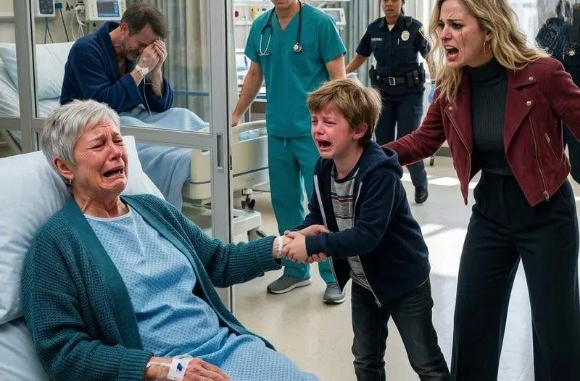
Margaret Collins sat on the edge of the pre-op bed in a thin blue gown, her silver hair tucked under a paper cap, her left hand trembling beneath IV tape. Through the glass partition, she could see her son Daniel in the adjoining room—pale, swollen, and barely conscious as machines hummed around him.
He was forty-two, her only child, and his kidneys were failing.
“Mrs. Collins,” Dr. Patel said gently, scanning the chart at the foot of her bed, “we’re almost ready. The transplant team is prepared. Are you still certain you want to proceed?”
Margaret swallowed hard. “He’s my child.”
Across the room, her daughter-in-law Rebecca stood with her arms folded, her expression sharp rather than sorrowful.
“It’s your duty,” Rebecca said. “You’re his mother. A real mother wouldn’t hesitate.”
Margaret flinched but stayed silent.
She had hesitated.
Not because she didn’t love Daniel—she had spent her life sacrificing for him—but because this was different. A kidney wasn’t money or time. It was part of her body.
Still, when Daniel called weeks earlier in panic, saying dialysis was failing and no donor matched, she agreed to be tested. When she was found compatible, Rebecca called it a miracle.
Now nurses moved around her, preparing for surgery, when a small voice suddenly broke through the hallway.
“Grandma!”
Margaret turned.
Her nine-year-old grandson Ethan stood there in a wrinkled hoodie, eyes red and wide. He broke past a nurse and ran straight to her side.
“Ethan?” Rebecca snapped. “What are you doing here?”
But Ethan ignored her. He grabbed Margaret’s hand tightly.
“Grandma,” he whispered, shaking, “should I tell them the truth about why Dad really needs your kidney?”
The room froze.
Dr. Patel looked up.
Margaret’s breath caught. “What truth?”
Rebecca went pale. “Ethan, stop.”
But Ethan continued, voice breaking.
“Dad didn’t get sick by accident.”
PART 2
Dr. Patel’s voice stayed calm, but firm.
“Security,” he said. “And stop the procedure prep. No one moves the child.”
Rebecca froze mid-step.
Margaret pulled Ethan closer despite the IV tugging at her skin.
Dr. Patel crouched to Ethan’s level. “Tell me what you mean. You’re safe.”
Ethan looked at Margaret, then down.
“Dad took things,” he said. “Pills. Shots. Mom said it was for work and Grandma couldn’t find out.”
Rebecca let out a nervous laugh. “He’s a child. He doesn’t know what he’s saying.”
But Ethan’s voice rose, panicked.
“I saw it! He hid bottles! He got sick in the garage and Mom told him to clean up before Grandma came!”
The room went silent.
Dr. Patel’s expression changed. “What substances?”
“I don’t know all the names,” Ethan said. “But there were pills—something like oxy—and supplements. Dad said it hurt his kidneys. Mom said not to tell doctors or he wouldn’t get the transplant.”
Rebecca stepped back as if struck.
Margaret looked through the glass at Daniel.
He was awake now.
Watching.
Not confused—afraid.
“Daniel,” she whispered.
He turned away.
That small movement shattered something in her.
Dr. Patel’s tone turned formal. “We cannot proceed. Consent may not have been fully informed.”
Rebecca snapped, “You’re stopping because of a child’s story?”
“We are stopping because of serious medical concerns,” he replied.
Margaret slowly sat up.
Rebecca turned on her. “You already agreed.”
Margaret looked at her. “You lied.”
From the doorway, Daniel spoke weakly. “Mom… please. Don’t do this.”
But he did not explain.
He did not defend her.
He only looked at her like she was the last option left.
Margaret removed her surgical cap.
“I’m not going forward with this today.”
Rebecca exploded. “Selfish!”
But Margaret didn’t move.
For the first time, she stayed still.
PART 3
The hospital did not become quiet—only calmer in a different way.
Margaret sat wrapped in a blanket as staff spoke carefully about “review,” “disclosure,” and “medical ethics.”
The truth became clear: Daniel had hidden substance use that directly affected transplant eligibility.
Dr. Patel confirmed it simply. “We cannot proceed under these conditions.”
Rebecca insisted Ethan was lying. Daniel insisted it was exaggerated. But records and tests suggested otherwise.
Margaret just listened.
Then she looked at Ethan. “What happens to him?”
A social worker answered gently that child services would need to intervene.
Before anything else could happen, Daniel entered the room, weak and disoriented.
“Mom,” he said. “It’s not what it sounds like.”
Margaret replied quietly, “Then explain it honestly.”
But he didn’t.
Instead, he said, “Ethan doesn’t understand.”
Ethan shrank.
Margaret tightened her grip on his hand. “Don’t call him that.”
Daniel hesitated.
Then excuses came—stress, pressure, mistakes, everyone does it.
Margaret listened, then said, “You asked a child to carry your secrets.”
Rebecca cut in sharply, blaming everyone else.
Margaret finally stood.
“No one is entitled to my body.”
Silence followed.
Daniel whispered, “I’m scared.”
“So am I,” she said. “But I won’t be manipulated by fear anymore.”
PART 4
Ethan stayed with Margaret that night.
Later, in her kitchen, he asked, “Are you mad I told?”
“No,” she said. “You told the truth.”
“Did I ruin everything?”
“No,” she replied. “You stopped something that wasn’t honest.”
He nodded slowly.
In the weeks that followed, Daniel entered treatment. The transplant was delayed indefinitely. Rebecca fought it. But evidence and medical reviews supported the decision.
Life became complicated, but clearer.
Ethan stayed with Margaret.
Daniel slowly faced consequences.
And Margaret stopped living as if love required self-erasure.
Months later, Daniel began therapy and treatment compliance. Eventually, he was reconsidered for the transplant list—but no longer with his mother as a donor.
He accepted it, slowly.
Not cleanly.
But honestly.
A year later, he told Ethan:
“I’m sorry I made you responsible for my secrets. You were right to tell.”
Ethan asked, “Are you still sick?”
“Yes,” Daniel said. “But I’m getting help.”
He looked at Margaret. “And I’m not angry anymore.”
Margaret didn’t respond with emotion.
She simply nodded.
Because some truths don’t need celebration—only acceptance.
That night, Ethan left a note on her table.
Grandma, I was scared to tell the truth. But you still loved me. Now I know truth doesn’t end love.
Margaret held the note for a long time.
She had gone into that hospital prepared to sacrifice herself completely.
Instead, she left with something she almost lost:
the right to live without being used.
And in choosing truth over obligation, she also gave her grandson something priceless—
a life where love didn’t depend on silence.
Leave a Reply