For most of my life, I never gave it much thought.
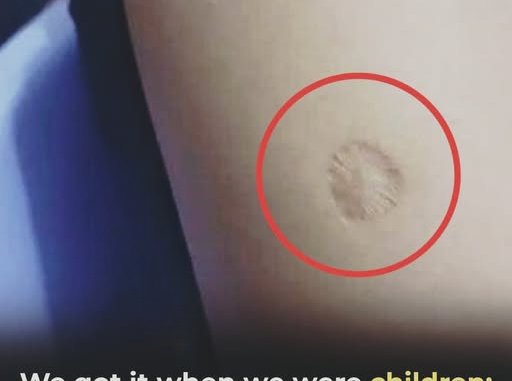
A small, round scar on my mother’s upper arm. It was subtle, unremarkable, and easy to overlook. Like many details from childhood, it became so familiar that it faded into the background of everyday life.
Years later, something happened that made me notice it again.
While assisting an older woman off a train, her sleeve shifted and revealed a mark that instantly stood out to me. It was in the same location and had the same circular shape as the scar on my mother’s arm.
That brief moment led me to a question I had never considered before.
Later that day, I called my mother and finally asked her about it.
Her response was simple.
“It’s from a smallpox vaccination.”
What once felt like a meaningless mark suddenly carried deeper significance.
A Small Mark Shared by Millions
For many people born before the 1970s—and in some places even later—a small circular scar on the upper arm is often the result of the smallpox vaccine.
In some individuals, the mark has nearly disappeared with time. In others, it remains clearly visible even decades later. Most people live with it without giving it much thought.
But that small scar represents an important piece of medical history.
A Disease That Once Terrified the World
Before it was eliminated, smallpox was among the most feared diseases globally.
It typically began with fever, fatigue, and body aches. As it progressed, a painful rash developed into widespread lesions across the body.
Many survivors were left with permanent scars.
Others did not survive at all.
Entire populations lived in fear of outbreaks, and families faced constant anxiety whenever the disease appeared nearby. It was not just history—it was a real and present danger for generations.
How Vaccination Left Its Mark
The smallpox vaccine was delivered in a way that differed from many modern immunizations.
Medical workers used a special multi-point needle to create tiny punctures in a small area of skin. The site then went through several visible stages as it healed.
A bump formed.
It became a blister.
The blister dried and scabbed over.
Once healed, it often left behind a small circular scar.
Because the upper arm was the standard injection site, many people ended up with nearly identical marks in nearly identical places.
Over time, this scar became a quiet symbol of a worldwide health effort that changed history.
A Milestone in Public Health
These scars are tied to one of medicine’s greatest achievements.
Through decades of coordinated vaccination efforts across nations, smallpox cases steadily declined.
Healthcare workers, governments, and global organizations collaborated to eliminate the disease.
Their efforts succeeded.
In 1980, the World Health Organization officially declared smallpox eradicated worldwide.
It became the first human disease to be wiped out through global public health cooperation.
What once claimed millions of lives had been completely eliminated.
This remains one of the most significant milestones in medical history.
More Than Just a Scar
Today, that small circular mark can mean more than a leftover sign of a vaccine.
For many, it represents survival and protection.
It reflects a time when the world worked together against a shared threat.
It stands for scientific progress, collective action, and the drive to protect future generations.
What once looked like a simple blemish now carries a much larger meaning.
A story of fear overcome by science.
A story of disease replaced by prevention.
A story of global unity that changed the course of history.
History Hidden in Plain Sight
We often imagine history as something stored in books, museums, or photographs.
But sometimes, it stays with us in quieter ways.
In family stories passed down over time.
In memories shared and retold.
And in small physical traces—like a faint circular scar that many people stopped noticing long ago.
The next time you see that mark on someone’s arm, you might see it differently.
Not just as a scar.
But as a reminder of one of humanity’s greatest victories over disease.
Proof that even the smallest details can hold stories far larger than they appear.
Leave a Reply