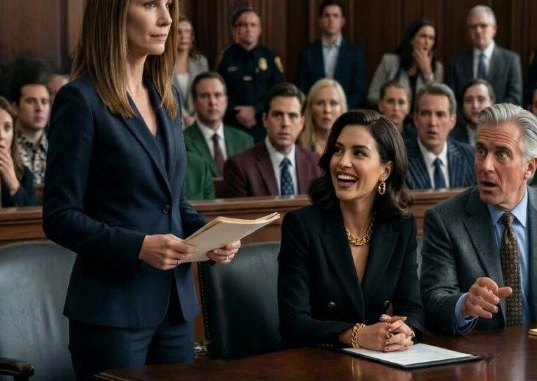
Outside the courthouse, my sister laughed and called me “legally stupid” while her attorney stood beside her, smiling with complete confidence. Then I calmly walked into court, handed over my disciplinary board credentials, and watched as the lawyer who had spent months threatening me realized—too late—that he had built his entire case in front of the one person who could dismantle it.
My sister, Vanessa, didn’t just mock me outside the courthouse—she enjoyed it. She leaned in close, perfume sharp in the air, and whispered that she was going to destroy me. Her lawyer stood there looking equally certain, like the outcome had already been decided.
For her, everything was a performance. Court, family, grief—it didn’t matter. She believed whoever played the victim best would win. That belief had carried her through years of rewriting the past after our father died, claiming I had “taken” his house simply because I had been the one living there while caring for him.
She ignored the fact that I had paid the bills, managed his medical care, and stayed by his side through months of illness while she was away living her own life. When the will left me the house and gave her a financial inheritance instead, she called it fraud. When the court upheld it, she sued anyway.
That lawsuit is where she found Attorney Blake Monroe—polished, confident, and very good at making truth look negotiable. He sent threats, gathered questionable “witnesses,” and built a case on statements that didn’t hold up under basic scrutiny. Vanessa, of course, believed every word.
In court that day, she told me I should have settled, smiling like victory was already hers. Even Blake treated me like I was out of my depth, speaking to me as if ignorance was my default position.
I didn’t argue. I didn’t react. I just documented everything.
So when the courtroom finally opened, I stood, calmly informed the judge of my professional role on the State Bar Association’s Disciplinary Review Board, and submitted a sealed envelope of evidence.
The shift was immediate.
Blake’s confidence cracked the moment the judge opened it. Inside were his own demand letters, falsified declarations, a discredited notary record, and proof that his investigator had tried to buy testimony.
For the first time, he had nothing to say.
The judge’s questions came quickly. The inconsistencies became undeniable. And the more Blake tried to recover, the clearer it became that he wasn’t defending a case anymore—he was defending himself.
Vanessa watched it all unravel in real time.
The petition she had filed was dismissed. The evidence she relied on was frozen for investigation. And my father’s recorded statement was played in open court, confirming exactly what he had intended for his estate.
Not anger. Not confusion. Just clarity.
By the time it was over, the courtroom had shifted completely. The lawyer who once threatened me was now facing disciplinary action, and the certainty my sister had carried into the building had collapsed into disbelief.
In the hallway afterward, she grabbed my arm and accused me of setting her up.
But I didn’t need to.
She had done that part herself.
Months later, her case was abandoned, her lawyer stepped down under investigation, and the house remained mine—not because I fought harder than she did, but because the truth was already documented long before she decided to rewrite it.
On a quiet morning afterward, I planted lavender outside the home my father left me. My phone buzzed with another message from Vanessa asking to talk.
I looked at it for a moment, then deleted it.
Because some people don’t want resolution—they only want a second chance after consequences have already spoken.
Leave a Reply