My sister disappeared before I even turned ten, leaving a void full of unanswered questions. Decades later, I stumbled upon something that finally explained what happened that morning.
My sister, Adele, vanished at 14. I’m Miranda, and I was only eight at the time.
I remember that Tuesday morning as ordinary — which somehow made everything worse.
Adele came downstairs with her backpack, complaining about staying up late to study for a math test. As usual, Mom handed her a packed lunch.
She barely said goodbye, grabbed a piece of toast, and left.
She never reached school.
I was just eight years old.
At that age, I couldn’t comprehend how something like this could happen. But I remember what came next.
Our parents hardly slept for days, driving the city streets searching everywhere. They asked Adele’s friends if they’d seen her.
Her photo was posted in store windows and on telephone poles.
People helped. Teachers, neighbors, even strangers joined search parties organized by her school.
Eventually, the police got involved. Days became weeks, and then silence.
The language changed. People stopped saying “when she comes back” and began speaking in the past tense.
Adele’s disappearance weighed heavily on our parents, especially when the police suggested she was likely dead.
They stopped hoping for her return.
Thirty-five years passed.
The neighborhood and our house changed, but Adele’s absence remained palpable.
A few days ago, Mom called.
Her voice sounded smaller than I’d ever heard. “Your father’s gone,” she said.
I drove over that same afternoon.
Mom moved like she carried an invisible weight. I stayed to help with funeral arrangements, paperwork, and the countless small decisions that come with saying goodbye.
I didn’t want to leave her alone.
On the second night, after Mom went to bed, I wandered the second floor and noticed Adele’s door was closed. I don’t know what drew me there, but I pushed it open slowly.
Nothing had changed. Mom had preserved the room almost exactly as it had been: her bed slightly messy, books stacked on the desk.
I stepped inside.
A sharp creak beneath my foot made me stop. One floorboard was loose. I lifted it to reveal a hidden space.
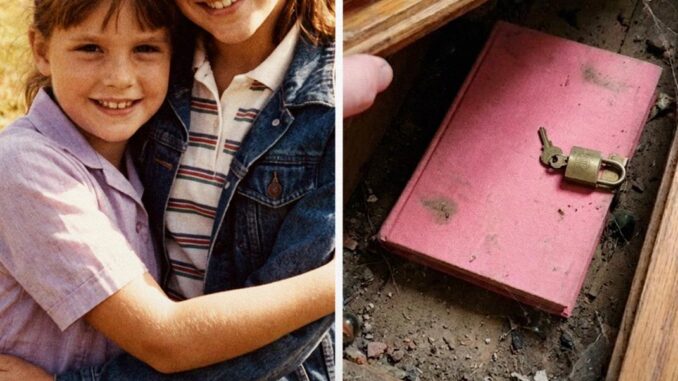
Inside, wrapped in faded fabric, was a small notebook with a rusty metal lock. I pried it open and immediately recognized Adele’s handwriting — her diary.
The first pages were typical teen complaints about homework, friends, and Mom. But the last entries made my hands shake.
The tone shifted. Entries became terse, careful, detailing a bus stop she visited repeatedly and someone she met there.
She never named the person, only hints: “She listens,” “She doesn’t rush me,” “She says I have options.”
She was planning something.
The night before she vanished, she wrote: “I packed a small bag but hid it. I don’t know if I’ll use it. I keep thinking about what he said. I wish I hadn’t heard it.”
Her final lines: “I’m going back there before school. I need to decide. She said she could help me hide. I don’t think I can stay here if it’s true. If I don’t go today, I never will.”
I grabbed my jacket and keys and drove to the bus stop she described.
It was barely used, still standing. Across the street, a small grocery store.
Inside, I asked an older man about a teenage girl from 35 years ago. He remembered her and a woman she sometimes left with — a woman who worked at a youth center across town.
The youth center was quiet, unremarkable, but warm inside. An older woman remembered Adele: she had come a few mornings before school, spoke briefly, and revealed she had overheard something devastating — Dad saying she was adopted and a burden.
She needed space to process it, and then she left. She didn’t vanish. She chose to leave.
For decades, we asked the wrong question. Adele wasn’t taken — she moved forward to understand herself.
I held the diary and said quietly, “She left because she didn’t belong, not because she didn’t care.”
Mom broke down, years of silence finally cracking.
We didn’t know where she was, but we knew why she left.
I stayed for Dad’s funeral, but afterward, I left and never returned.
Leave a Reply