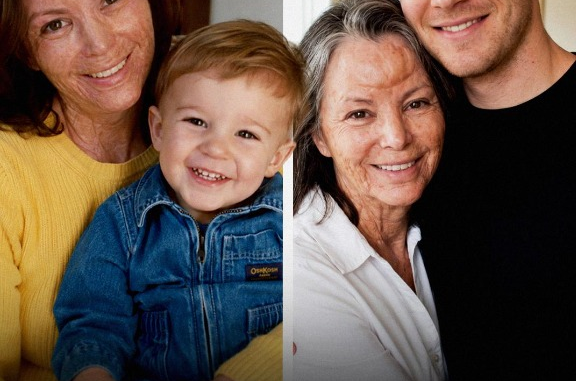
My father walked out on my mother after the worst night of her life, and for 30 years he stayed gone. Then he showed up at our door on my birthday asking for help, and I told him I would give it to him on one condition.
I’m 32 now, and the only reason I’m alive is because my mother carried me out of a burning house when I was two. The fire started from a gas leak in the kitchen in the middle of the night. My father was away on a work trip, so my mom woke up to the explosion alone, grabbed me from my crib, and ran through the smoke to safety. When my father came home and saw her after the hospital, he didn’t thank her for saving me.
I don’t remember the fire itself; I just remember the scars running along one side of her face, down her neck, and across her shoulder. When I asked about them, she simply said, “The house caught fire. I got you out. That’s all.” But that wasn’t all.
When my father saw her injuries, he didn’t even try to hide his disgust. He said he couldn’t live with the reminder and that he still had time to build a different life with someone he could admire. Then he left—no custody battle, no phone calls, nothing. My mother never told that story with drama, often just noting, “Some people leave when life stops flattering them,” before heading out to work double shifts at a diner to pay for skin treatments she could barely afford.
When I was 16, I got a job stocking shirts at a department store to help out. She got mad, telling me I should be studying and shouldn’t take a job because of her. I joked that I was taking it because groceries cost money, which made her laugh, and she stopped fighting me on it. I stayed in retail, learned the business, and saved hard. By twenty-nine, I opened my own clothing store. It did well enough that my mother could finally slow down.
Last week was my 32nd birthday, and I spent it at her place. We were having a quiet, easy evening grilling in the backyard when someone knocked on the front door. I went inside and opened it to find a thin, tired man in worn clothes and split shoes. I knew him right away; I had his eyes. He cleared his throat and said, “Hey. Son.”
My mother came up behind me and stopped cold.
“Dad?” I said.
He gave a small nod. He explained that he had gone bankrupt, his second wife had left him, and he had run out of people willing to help him. “I didn’t know where else to go,” he said. He had tracked me down through my public business website.
My mother turned away, refusing to participate, but he begged faster, asking for help to get back on his feet. Looking at his shame and his nerve, I knew exactly what I was going to do.
“I’ll help you,” I said. My mother turned so fast I thought she might throw her glass at me. “I’ll help. But I have one condition: Tomorrow morning, you’re getting in the car with us, and you’re coming back to the old property.”
He was confused, but agreed. I told my mother I needed this so he wouldn’t get to skip straight to the part where we save him.
The next morning, we drove out there. The old house was gone, replaced by a small rental property with a leaning fence and a porch that needed work. The current owner, Walt, was out front. When I introduced myself, Walt revealed that during renovations years ago, workers had found a buried, fire-damaged blue recipe box with faded flowers on the lid.
My mother’s hand went to her mouth. She had buried it there before the demolition because she couldn’t keep carrying its contents, but couldn’t throw them away either.
Walt brought the box out from his garage. Inside were scorched recipe cards, a photo of my mother holding me as a baby, and an unsent letter addressed to my father. I handed it to him and told him to open it.
The letter was short and direct. She wrote that her son was alive because she carried him through fire, and that if he could no longer love her, he still had a duty to love the child whose life she saved. She stated she would not spend her life asking a coward to be decent.
He read it twice, sat on the porch step, covered his face, and said he was sorry. I believed he meant it, but I didn’t think that mattered enough.
I asked Walt if he still needed repairs done around the property, then turned to my father. “I’ll pay for materials and help you get on your feet. But first, you’re going to fix this place. That’s the condition.”
He pushed back, claiming he came for help, not labor. But looking at the letter, then at my mother, he finally relented and agreed.
For the next week, he worked hard. I paid for the lumber and nails, and my father did the heavy lifting—tearing out rotten boards, resetting posts, and getting sunburned and blistered. My mother refused to come the first two days. On the third day, she brought him iced tea, setting it down with a piece of advice: “Check the support beam before you cover it. Rotten wood doesn’t get stronger because you hide it.”
Later that week, while digging near the porch, they uncovered a carved wooden block from my childhood crib, which my grandfather had made by hand. My mother ran her thumb over the carved star, amazed that any piece of it had survived.
By the end of the week, the porch was solid and the fence stood straight. An exhausted father asked, “So now what?”
“Now you get one month,” I replied. “A room above my store, food, and time to find work. That’s it.”
He protested that he was my father, to which I responded, “Biologically, yes.” He nodded slowly and told my mother he knew he didn’t deserve another chance. She answered plainly, “No. You don’t.”
A few days later, my mother went back to the property alone. When I picked her up, she softly noted that she was glad something good had finally been built there.
I took the surviving piece of the crib to a local woodworker, had it mounted on a simple board, and engraved a line beneath the star: Made worthy before the world said otherwise.
I hung the sign near the fitting room in my store with my mother and father both present. As my mother touched the edge of the wood, I realized I hadn’t set that condition to humiliate him. I did it because too many people confuse regret with repair—and they are not the same thing.
Leave a Reply