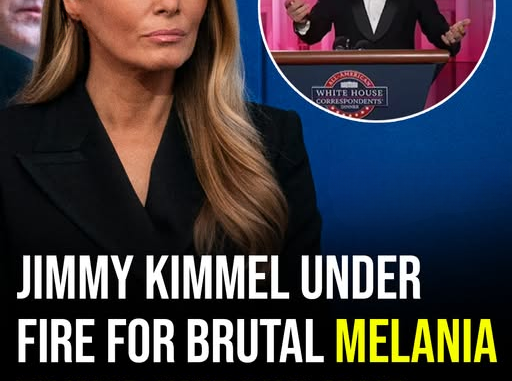
The polished image of the American media world has been shaken after one of late-night television’s most prominent figures became the center of intense backlash, following events that quickly escalated from a comedic segment into a national crisis. Jimmy Kimmel, known for his sharp political satire, now finds himself at the heart of a major cultural controversy that has reignited debate over the limits and responsibility of modern entertainment. The issue began with a joke aimed at Melania Trump, which, after a shocking shooting incident at the Washington Hilton, was reinterpreted by many as deeply inappropriate and unsettling.
Just days before the chaotic events at the 2026 White House Correspondents’ Dinner—where Donald and Melania Trump were urgently evacuated after gunfire erupted—Kimmel had delivered a monologue that included a pointed remark about the former First Lady. At the time, it was received as typical late-night humor, drawing laughter and online attention. However, after the violent incident, the same joke took on a far more serious and uncomfortable meaning, with many people viewing it through the lens of the tragedy that followed.
Critics, especially from conservative circles, quickly condemned the segment, arguing that such humor crosses a line from satire into harmful rhetoric. They claimed that joking about a spouse in terms of potential widowhood, especially so close to a real-life attack, risks normalizing political hostility. The disturbing scenes from the event—including a rapid security response and a wounded officer being evacuated—made the contrast between comedy and reality feel especially stark for many observers.
The conversation has since expanded beyond the incident itself to a broader debate about media responsibility. Some argue that modern political satire contributes to a climate of division, where public figures are increasingly dehumanized for entertainment. In this view, what once functioned as harmless comedy now carries heavier consequences in an already tense political environment.
Donald Trump responded to the controversy by framing it as further evidence of hostility from the media, using the moment to reinforce his long-standing criticism of the press. His supporters echoed this sentiment, seeing the situation as proof that entertainment and journalism have become dangerously politicized.
The White House Correspondents’ Dinner, traditionally a night of humor and symbolic unity between the press and political leaders, has now been overshadowed by the violence and controversy. Once a celebration of free expression and satire, the event is now being reevaluated in light of the risks surrounding political rhetoric in today’s climate.
As investigations into the shooting continue, public attention remains fixed on the broader implications. The incident has sparked renewed discussion about where the line should be drawn between comedy and responsibility, especially when real-world violence reshapes how past words are interpreted.
Footage of Kimmel’s monologue circulating alongside images of the emergency evacuation has intensified the debate, highlighting the uneasy overlap between entertainment and political reality. It has also underscored how quickly context can shift, turning jokes into points of controversy when viewed through the lens of tragedy.
Ultimately, the situation has become a flashpoint in a larger cultural reckoning over late-night comedy and political discourse. As audiences grow more sensitive to the consequences of rhetoric, the entertainment industry faces increasing pressure to reconsider how it engages with political figures. The controversy surrounding the Melania Trump joke is now part of a wider conversation about responsibility, tone, and the boundaries of satire in an era where words can carry unexpected weight.
Leave a Reply