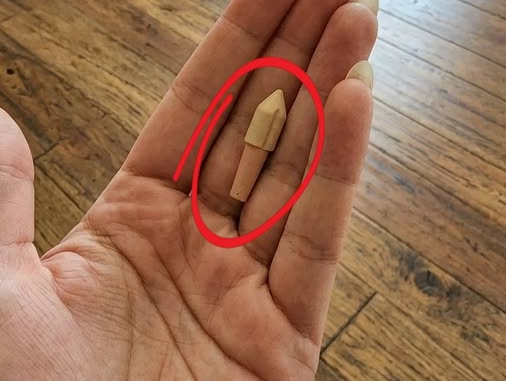
At first, I couldn’t explain what it was. Small, metallic, sharply shaped, and tucked away in a place it clearly didn’t belong, it immediately set off alarm bells in my mind. I jumped to worst-case scenarios almost instantly—was it part of a weapon, a surveillance device, something dangerous he had been hiding? The less sense it made, the more unsettling it felt. When something is unfamiliar, silence tends to fill in the gaps with the worst possible interpretations.
For hours, I kept going back to it, turning it over and over, trying to figure out what kind of life could exist alongside mine without my knowledge. It felt cold, precise, and purposeful in a way I couldn’t place. That uncertainty made it seem heavier than it actually was. Every explanation I imagined pointed toward secrecy, mistrust, or parts of him I thought I would have known.
But the truth was far simpler—and far more ordinary.
It wasn’t anything dangerous at all. It was a field point used in archery, the small tip that screws onto an arrow for target practice. Something meant for repetition, focus, and sport rather than harm. While I was building dramatic theories in my head, he had simply taken up archery in his free time, spending quiet hours at a range, clearing his mind after stressful days.
Strangely, that realization softened everything.
What had seemed suspicious a moment earlier suddenly felt personal in a different way. Not threatening, but private. A small piece of his life he hadn’t thought to explain. I imagined him standing at the range alone, drawing the bowstring, focusing on a distant target, repeating the same steady motion until everything else quieted down.
And somehow, that changed how I saw it.
It was no longer just a mysterious object—it was evidence of a private routine, a quiet way he managed stress that I had never been invited to witness. Not because he was hiding something harmful, but because people often keep their coping mechanisms to themselves.
It made me realize how quickly the mind can turn uncertainty into fear. When we don’t understand something—especially something connected to someone we love—we tend to fill in the blanks with suspicion instead of curiosity.
But most of the time, the truth is much less dramatic.
Sometimes what looks like secrecy is just solitude. And sometimes what feels like a red flag is really just a part of someone’s life you were never meant to see, unless you ask.
Leave a Reply