Part 1
There’s a certain kind of silence that only comes after years of hard work, sacrifice, and boundaries that no one respected until you were forced to enforce them. My name is Carter. I’m 36, a remote architectural consultant, and I built my home on three wooded acres overlooking Lake Superior. It isn’t a mansion, but it’s mine—every beam, window, and fixture earned through years of exhausting work.
That house wasn’t just property; it was my refuge. For two years, I had kept my parents, Arthur and Martha, at arm’s length. I sent gifts, answered holiday calls, and kept my personal life private. That distance brought peace. Until one cold Tuesday night, it ended.
I was working upstairs when headlights swept across the property. A large U-Haul sat in my driveway, with my father’s car behind it. My phone showed missed calls and messages telling me to come outside.
I went downstairs and opened the door.
“Dad. Mom. What is this?”
Arthur didn’t hesitate. “We’re moving in. Help unload.”
I froze. “What are you talking about?”
My mother stepped forward, shaking. “Please, Carter, don’t make this harder. We had a terrible day.”
“You can’t just move into my house.”
Arthur sighed. “We sold ours. This afternoon.”
The reason soon followed: they had sold their fully paid-off home to cover my sister Chloe’s financial crisis. The money was gone. Now they intended to stay with me.
“We’re your parents,” Arthur said firmly. “Family helps family.”
Then he tried to push past me.
That was the moment everything snapped.
I stopped him at the door and locked it behind me as he began shouting outside. Within minutes, I was watching them on my security cameras—standing in the cold, angry, refusing to leave. Then my phone lit up with a social media post painting me as the villain for “abandoning” them.
And that was only the beginning.
Part 2
Arthur began testing windows. Then he cut the main power. The house briefly went dark—then came back online thanks to backup systems I had installed. He stared at the lights like he couldn’t believe it.
By early morning, they were still in my driveway.
I checked the property records. They had indeed sold their home for $620,000. But something didn’t add up. The money should not have disappeared so completely.
Then I checked Chloe’s social media.
Luxury vacations. A brand-new Porsche. Posts about “wealth building” and “new beginnings.”
It became clear: my parents hadn’t just helped her—they had funded her lifestyle and burned through their security. And now they had nowhere to go but me.
At sunrise, Chloe arrived in the Porsche, irritated and entitled, acting as if nothing was wrong.
She dismissed the situation, called her car a “business asset,” and insisted everything was part of a “strategy.” My parents defended her blindly.
Then a folded paper appeared under my door.
A proposed “living arrangement” written like I was staff in my own home: my parents in the main suite, Chloe in the guest room, me in the basement, while I paid most of the expenses.
I refused immediately.
Arthur lost control, shouting that I owed them everything. Then he tried to bring in a locksmith to force entry. When that failed, he threw a garden ornament at my window, cracking it.
That was the point of no return.
I called the police.
Part 3
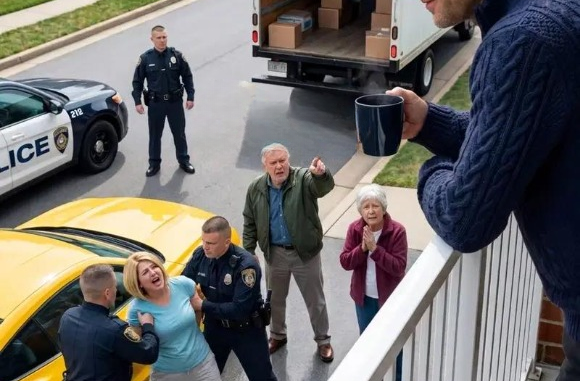
When Deputy Miller arrived, I presented everything: security footage, property documents, and the damage.
Arthur immediately tried to frame it as a misunderstanding.
“We’re his parents,” Martha insisted. “We have rights.”
But Miller was direct. “Do you have residency or permission?”
They didn’t.
The footage showed everything—the power cut, the attempted forced entry, the vandalism.
The officer gave them two choices: leave or face arrest.
Arthur finally gave in, ordering the truck packed while blaming me for everything. Chloe followed silently, stripped of her confidence.
As they left, Arthur told me I was “no longer family.”
My response was simple: I had already accepted that.
Later, I posted the evidence publicly. The truth spread quickly, and the narrative they built collapsed almost immediately.
Within weeks, their situation fell apart—financially and socially. Chloe disappeared soon after, chasing another unstable future. My parents ended up in a small rental, far from the life they tried to take from me.
One day, Arthur called—not to apologize, but to ask for furniture.
I blocked him.
Epilogue
Months later, winter settled over Lake Superior. My home stood intact, repaired, quiet.
The crack in the window was gone. The broken ornament replaced with something heavier.
Life was still.
Not perfect. Not painless. But mine.
I had learned something simple but final: family is not permission to destroy boundaries, and guilt is not a contract you’re obligated to sign.
For the first time, I wasn’t carrying anyone else’s collapse on my back.
I was just standing in my own house, in my own silence, finally allowed to keep it.
Leave a Reply