By the time my parents landed in Honolulu, my eight-year-old daughter Lily was sitting alone under harsh fluorescent lights in a child services office, clutching her unicorn hoodie like it was the only thing keeping her steady.
I was in Chicago for a medical conference I almost skipped because leaving her behind made me uneasy. My parents insisted she stay with them.
“Go,” my mother said, covering my hand at the kitchen table. “You need time for yourself. We’ll take great care of her.”
My father nodded confidently. “She’ll be perfectly safe with us.”
Safe.
That word later felt like a lie I should have questioned.
I found out something was wrong at 11:42 p.m. when an unfamiliar Virginia number called me twice. I almost ignored it, but answered the third time.
“Ms. Carter?” a woman said gently. “This is Denise Hall with Arlington County Child Protective Services. We have your daughter.”
For a moment, everything in my hotel room went silent in my mind.
“What do you mean you have her?”
“She was found near a fire station with a note in her backpack,” she explained. “She’s physically okay, just frightened.”
A minute later, the email arrived.
My mother’s handwriting was unmistakable.
Sorry, sweetie. She was too difficult and ruined the trip. Please find her somewhere suitable.
No explanation. No apology.
Just abandonment.
I called my parents repeatedly. No answer.
Then I saw a post from my sister: my parents smiling in Hawaii with leis around their necks while the kids played nearby.
Family time in paradise!
That’s when I stopped hoping it was a misunderstanding.
I went straight back to Virginia and began making calls—CPS, police, my attorney—quiet, controlled, step by step.
By morning, Lily was safe in my arms, shaking every time a door opened nearby.
Meanwhile, my parents were still in Hawaii, having breakfast like nothing had happened.
Until the knock came.
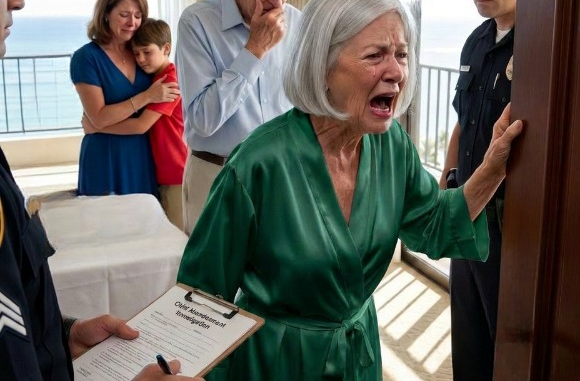
My mother later said she thought it was housekeeping. Instead, police stood outside their hotel room with the manager and my sister, who looked shaken and pale.
“What is this about?” my father asked.
“You need to come with us,” the officer replied.
And just like that, the vacation ended.
Back in Virginia, I told Detective Morales everything—the messages, the permission I had given them to watch her, the promise they made me.
We can’t wait to spoil her.
Don’t worry about a thing.
Enjoy your trip.
The detective’s expression hardened as he read the evidence.
“Leaving a child like this is not a misunderstanding,” he said. “It’s abandonment.”
Lily woke later that morning and immediately asked, “Am I in trouble?”
My heart broke in half.
“No,” I told her. “You didn’t do anything wrong.”
She hesitated. “Grandma said I was bad because I cried.”
That was the moment I stopped making excuses for them.
Later, authorities in Hawaii coordinated with Virginia. My parents were questioned and informed they were under investigation.
At one point, my mother called me from a blocked number.
“How could you do this to us?” she demanded.
I looked at Lily drawing quietly beside me.
“You abandoned my daughter,” I said. “I reported it.”
“She was fine! We left her where she’d be found.”
The words were chilling in their simplicity.
“You left a child alone,” I said. “Do not contact me again.”
And I hung up.
The investigation soon revealed surveillance footage, receipts, and even handwritten drafts from my mother describing Lily as “too difficult” and my sister noting concern the night before it happened.
It wasn’t a moment of panic.
It was a decision.
My sister later tried to distance herself, but messages showed she had known enough to question it—and still said nothing.
Are you sure this is okay?
They’ll take care of her.
She won’t make a scene.
She was wrong.
I didn’t make a scene.
I built a case.
Within weeks, their lives unraveled. Protective orders were issued. Contact was restricted. Friends quietly disappeared.
But the hardest moment came in court, when Lily finally spoke.
She stood up small and trembling and said, “You told me I ruined everything because I cried for my mom. I believed you.”
The courtroom went still.
Then she added, “My mom came back for me. So you were wrong.”
That was when I finally cried.
Months later, they accepted plea agreements—probation, counseling, and no contact with Lily.
We moved to a smaller home with yellow shutters and a maple tree in the yard. Lily slowly began to heal, one small step at a time—cartoons, laughter, sleep without fear.
One day she held up her old unicorn hoodie and asked, “Can we give this away?”
I asked if she was sure.
She nodded. “I don’t need it anymore.”
We donated it together.
Later, she climbed into my lap and asked softly, “You’ll always come get me, right?”
I held her close.
“Always,” I said.
And this time, she believed me.
Leave a Reply