Part 1
“If you ask me one more time what I do in that bathroom at four in the morning, I swear I’ll walk out of this house.”
That’s what my husband said to me after thirty-five years of marriage.
My name is Eleanor Mitchell. I’m seventy-eight years old, and for most of my life I believed I knew the man I shared a bed with better than anyone else.
Richard and I lived in a modest brick home in South Chicago, the kind built slowly through overtime shifts, careful budgeting, and years of sacrifice. To everyone else, he was dependable and quiet—a hardworking man who rarely caused trouble and almost never raised his voice.
People often told me I was lucky.
We met in 1969 at a church fundraiser. He was twenty-five, working at a steel plant in Indiana, and I was twenty-two under my father’s strict household rules. We married the following year and built a life together, raising two children, Michael and Claire, never wealthy but always persistent through hardship.
Still, there was one thing about Richard that unsettled me for decades.
Every single morning at exactly four, he woke up.
He would leave the bed without a word, walk down the hallway, lock himself in the bathroom near the laundry room, and stay there for nearly an hour.
At first I thought it might be medical. Later I imagined worse things—secret habits, private grief, something I wasn’t meant to know.
But nothing ever added up.
He didn’t smell like alcohol. He didn’t smoke. He didn’t stay out late. He lived like a man afraid of doing anything wrong.
What troubled me most wasn’t just the routine.
It was the secrecy.
Sometimes I heard running water. Sometimes the soft clink of bottles or wrappers. And occasionally, a sound from him—low, strained, quickly silenced.
The first time I asked him about it, his face went pale.
“It’s my stomach, Eleanor. Don’t ask me about it.”
So I stopped asking.
That was how women of my generation were taught to love—by not questioning what was meant to stay closed.
But other things didn’t sit right.
He never wore short sleeves, even in summer. He never changed clothes in front of me. He insisted on darkness when we were intimate. And if I touched him suddenly, he would stiffen like stone.
One night, when the children were grown, I finally asked what I had feared for years.
“Are you seeing someone else?”
The spoon fell from his hand.
His face drained of color.
“Don’t say that,” he whispered.
“Then tell me the truth.”
Instead of answering, he stood up shaking. Then he cried.
In all our years together, I had never seen that.
“I hide it to protect you,” he said.
And that frightened me more than any denial ever could.
After that, the house felt different. My children thought I was imagining things. But I knew something was behind that locked door.
Then one March morning, I finally followed him.
At four a.m., I pretended to sleep as he took a small pharmacy bag from the closet and went downstairs. After a few minutes, I followed quietly.
Light leaked from beneath the bathroom door.
I knelt and looked through the keyhole.
What I saw made my breath stop.
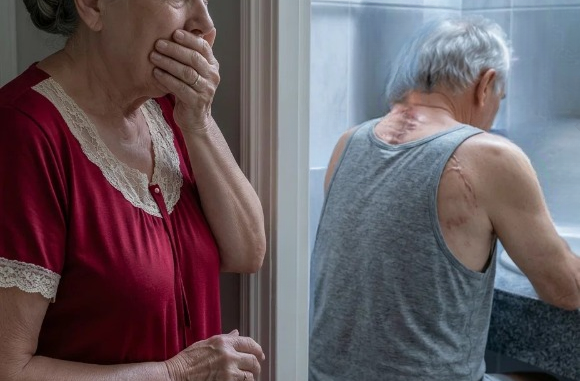
Richard had taken off his shirt.
His back was covered in scars—old, fresh, angry wounds he had been treating alone for years. He stood hunched over the sink, cleaning them carefully while biting down on a towel to keep from making a sound.
I covered my mouth to keep from crying out.
The man I had slept beside for thirty-five years had been enduring this in silence.
And I had never known.
Part 2
I went back upstairs shaking so badly I could barely stand. I lay in bed pretending to sleep while tears soaked my pillow.
When he returned, he moved carefully, as if even lying down hurt.
Neither of us spoke.
In that silence, something changed.
We were both pretending.
He was pretending he was fine.
And I was pretending I hadn’t seen everything.
The next morning, I made breakfast as usual, but I couldn’t look at him the same way. He sat across from me in another long-sleeved shirt buttoned to the top.
“Did you sleep?” he asked.
“Not really,” I said.
His eyes dropped immediately.
Later, I searched the closet and found the pharmacy bag—bandages, ointments, gauze stained with old blood.
I sat there holding it, realizing how wrong I had been.
For years I imagined betrayal.
Instead, it was pain.
That night I tried to talk to him gently.
“Do you remember when we were younger? The city felt different back then…”
His body went rigid.
“Don’t bring that up.”
“I just want to understand.”
His hand slammed the table.
“Some things stay buried.”
The tension only grew.
When our son Michael visited, everything finally cracked.
“Dad has always been like this,” Michael said bitterly. “Cold. Distant.”
Richard stood up sharply.
“Don’t speak about what you don’t understand.”
Michael laughed without humor.
“How could I? You never told us anything. I thought you didn’t love us.”
Claire went silent beside me.
“Enough,” I whispered.
But Michael continued.
“You missed everything. My games. My childhood. You were always gone.”
Richard’s expression collapsed.
He walked out without another word.
Two weeks later, everything came to the surface.
While repairing a pipe outside, Richard collapsed in pain. I ran to him, and his shirt shifted—revealing a reopened wound.
Michael arrived at the same moment and saw everything.
His face turned pale.
“Dad… what happened?”
Richard tried to hide it, but couldn’t move.
I broke down.
“I saw it,” I admitted. “The bathroom. I’m sorry.”
Silence followed.
Not anger.
Shock.
We helped him inside, and for the first time, all of us sat in the same room with the truth.
“Who did this to you?” Claire whispered.
Richard said nothing at first.
Then he finally spoke.
“If I tell you, you may hate who I used to be.”
Michael knelt beside him.
“Then tell us anyway.”
And after a long silence, Richard began.
“It started in 1972…”
Part 3
Richard’s voice was quiet, like it had been buried for decades.
He explained how he once volunteered through his church—delivering food, helping families, supporting community work. But in those years, suspicion followed even kindness.
One night, after work, he was taken.
A black car. Strangers. No explanation.
He was held for days, interrogated for information he didn’t have. They had mistaken him for someone else entirely.
“They chose the wrong man,” he said.
Michael’s voice broke.
“Why didn’t you report it?”
“They told me if I spoke, they would come after your mother.”
He looked at me then, eyes full of old fear.
“I believed them.”
Suddenly, everything made sense—the silence, the locked door, the long sleeves, the distance, the way he carried himself like someone who never fully returned home.
“I was ashamed,” he said. “Not of what they did—but that I survived it.”
I held his hand.
“You weren’t weak. You were protecting us the only way you knew how.”
Michael wiped his face.
“I’m sorry, Dad.”
And Richard finally broke.
“I wanted to hold you,” he whispered. “But even that hurt sometimes. And I was afraid loving you would put you in danger.”
That day, our family stopped guessing and started understanding.
After that night, the bathroom door stayed unlocked.
At four each morning, I sat with him while he treated his injuries. Slowly, we found doctors, then therapy. Healing didn’t erase what happened—but it made it easier to carry.
The distance between us slowly faded. Conversations returned. So did laughter, in small pieces.
Richard lived fifteen more years after telling us the truth.
And those were the most honest years we ever had.
Before he died, he squeezed my hand and said,
“Thank you for not leaving.”
I told him the truth.
“You were never alone in this. You just didn’t know how to let anyone in.”
I share this story because silence is often misunderstood.
Not every quiet person is cold.
Not every distance is rejection.
And not every locked door hides betrayal.
Sometimes, it hides survival.
Leave a Reply