PART 1
“Your wife is useless, Diego… and if she’s fainting, it’s only because she loves acting like a victim.”
Those were the first words I heard from my mother when I walked into my house in Querétaro on a Tuesday afternoon at two. Up until that moment, I genuinely believed Doña Carmen had come to stay with us to “help” after our son Mateo was born. That’s how she presented it—sweet voice, containers of homemade mole, rosaries on her bag, and her constant line:
“A mother never abandons her child when he needs her most.”
Mariana, my wife, had given birth just three weeks earlier. She was exhausted, barely sleeping, still recovering. I worked long hours at a tech company, trying to keep everything afloat, telling myself we just needed temporary help at home.
I thought bringing my mother in would make things easier.
It didn’t.
Every morning Mariana would reassure me she was fine, even though her hands shook. Sometimes I came home to her cleaning while the baby cried. Other times my mother would be watching TV loudly while Mariana struggled through chores. And every time I asked, my mother would smile and say Mariana preferred to “stay active.”
I believed her.
That Tuesday, I left for work as usual—but something felt off. Mid-meeting, I couldn’t shake the feeling that I needed to go home. So I left early.
From outside the house, I heard my son crying. Not a normal cry—something desperate and exhausted.
I rushed inside.
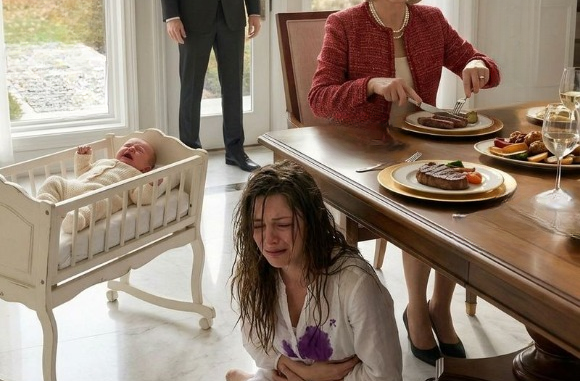
The smell of food hit me first. My mother sat calmly at the table eating like nothing was wrong. And Mariana—
She was unconscious in the armchair.
Mateo was crying in his bassinet, panicked and red-faced.
I ran to her.
“Mariana!”
My mother didn’t even stand.
She glanced at her and said, almost bored:
“Oh, Diego. Don’t be dramatic. She just didn’t want to finish her chores.”
In that moment, something in me snapped.
I picked up Mariana. I grabbed my son. I walked out without another word.
Behind me, my mother shouted that the house belonged to her son and that she was in charge.
I didn’t respond.
I had no idea yet how much worse things were about to get.
PART 2
I took Mariana straight to a private hospital. The diagnosis came quickly: extreme exhaustion, dehydration, sleep deprivation, and severe stress.
When she woke up, the first thing she asked for was Mateo.
Then she broke down.
Between tears, she told me everything. My mother had been humiliating her daily—calling her lazy, useless, and a bad wife. She told her I deserved better. She took her phone away, isolated her, and deliberately disrupted the baby’s sleep so she would seem unstable.
“She wanted me to look incapable,” Mariana whispered.
That was when I realized I hadn’t just failed to protect my wife—I had allowed someone dangerous into our home.
That night, we stayed in a hotel.
When they slept, I checked the home security cameras.
What I saw confirmed everything.
My mother walking through the house, searching drawers, opening documents, even taking Mariana’s personal belongings—including a family keepsake she kept from her grandmother.
The next day, I returned with police support.
She answered the door dressed as if she were going to church.
“I hope you’ve come to bring your wife back so she can apologize,” she said.
Instead, I handed her an eviction notice and a restraining order.
She laughed.
“You’re choosing her over your own mother?”
I looked at her clearly for the first time.
“I’m choosing my family.”
Her expression darkened.
Then she leaned in and said:
“Be careful, Diego. A mother knows things a wife doesn’t.”
That’s when I understood—this wasn’t over.
PART 3
My mother escalated publicly.
She posted online, painting herself as the victim—claiming Mariana had manipulated me and turned me against her. Family members and neighbors believed her immediately.
Mariana saw the comments and began to shake.
I took her phone.
“You won’t face this alone,” I told her.
Then I posted two videos without commentary.
One showed Mariana collapsing while my mother calmly ate nearby.
The other showed her deliberately disturbing the baby while he cried.
My caption was simple:
“This is the help she gave us.”
Everything changed overnight. The support my mother had online collapsed. People deleted comments. Some apologized. Others stopped speaking to her entirely.
Then came the missing medal.
I reported the theft and showed evidence from the cameras. At first she denied it, then called it “family property,” but the footage proved otherwise. Mariana recovered her grandmother’s keepsake in tears.
Not for its value—but for its meaning.
Months passed.
Our home changed completely.
No tension. No fear. No manipulation. Just peace. Mariana healed. Mateo grew calm. We became a real family again.
My mother kept trying to contact me. Messages. Calls. Voice notes. Never an apology—only demands and guilt.
One day, I received another letter.
I recognized her handwriting immediately.
I didn’t open it.
I didn’t need to.
I threw it away.
That night, I finally understood something I should have seen earlier:
Family is not defined by blood.
It’s defined by safety.
And sometimes, the person who destroys your home is the one you once called “mother.”
Leave a Reply