When my manager asked me to stay late to train the company’s newest hire, I took it as a compliment. I believed it showed trust in my experience and respect for the work I had put in over the past two years. I had built systems, streamlined workflows, solved ongoing issues, and helped keep the team steady during some of our busiest seasons. Passing that knowledge on to someone new felt like a natural responsibility.
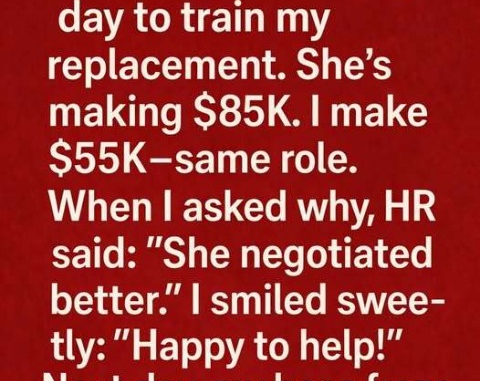
Then I learned that the new employee would be making $85,000 a year for the same role I was doing for $55,000.
The discovery hit me harder than I expected.
It wasn’t only about the salary difference — it was what it symbolized. Suddenly, I started questioning whether my loyalty, consistency, and years of hard work had been undervalued all along.
I eventually spoke with HR, hoping there had been some sort of mistake. Their response was brief and blunt:
“She negotiated better.”
That was the entire explanation.
There was no recognition of my contributions or discussion about performance — just the implication that negotiating confidence carried more weight than years of proven dedication.
Even so, I continued training her.
And truthfully, none of this was her fault.
She was smart, professional, eager to learn, and genuinely grateful for the help I gave her. Every day, I walked her through complicated systems, client histories, reporting structures, hidden deadlines, and all the unwritten details that only experience teaches you.
At first, I thought I was simply showing someone how to do the job.
But over time, something shifted.
As I explained processes, anticipated problems before they happened, and shared strategies I had developed over the years, I began to see my own role differently. For the first time, I realized just how much expertise I carried and how much value I had been treating as ordinary.
I wasn’t easily replaceable.
I was the person who understood why the systems worked, where the risks were, how clients responded under pressure, and how to avoid mistakes before anyone else even saw them coming.
One morning, while we were reviewing a workflow chart I had designed, my manager stopped by our desk. Behind us, the whiteboard was filled with process maps, efficiency plans, performance metrics, and backup strategies I had personally created over time.
He casually asked how the training was going.
Before I could answer, the new hire spoke up.
She explained how complex the role truly was and how much strategic knowledge I brought to the position. Pointing to the systems I had built, she admitted she had no idea how much invisible work happened behind the scenes until I walked her through it.
I watched my manager’s expression slowly change.
For the first time, it felt like he genuinely understood the full extent of what I contributed.
That moment gave me clarity.
A few days later, I requested a formal salary review.
This time, I came fully prepared.
I presented documented achievements, measurable results, workflow improvements, client retention data, and salary comparisons for similar roles in the industry. I explained calmly that while negotiation matters, long-term performance, leadership, and institutional knowledge matter too.
Most importantly, I stopped speaking about my value with uncertainty.
Whether my salary changes immediately or not, something inside me already has.
Training someone else didn’t diminish my worth.
It forced me to finally recognize the expertise, resilience, and leadership I had spent years overlooking.
And for the first time in a long while, I stopped relying on others to define my value for me.
Leave a Reply