Thomas Hail lived much of his life in quiet obscurity. To his family, he was just a reserved grandfather who repaired household items, kept his home in perfect order, and offered calm, practical advice when things went wrong. He lived alone in a simple Ohio house filled with the smell of cedar and coffee, spending his days gardening and helping neighbors without ever seeking attention. At family gatherings, louder voices always took center stage, while Thomas remained in the background, his silence gradually accepted as nothing unusual. Even his granddaughter, who loved him deeply, never thought to question the quiet discipline that set him apart. She only sensed that he carried himself like someone who had lived through something significant but chosen never to speak of it.
When Thomas was hospitalized after collapsing, his granddaughter was the only family member who came to see him. The rest of the family made excuses and delayed their visits, though Thomas already seemed to understand they would never come. He died peacefully two days later, and his funeral was attended mostly by neighbors rather than relatives. His granddaughter arranged everything herself, painfully realizing how little effort her family had ever made to truly know him. While going through his belongings afterward, she discovered a carefully wrapped silver ring with a worn military emblem and the year 1971 engraved inside. She put it on without knowing it would soon unlock a hidden chapter of his life.
Weeks later, she attended a veterans’ event with a colleague, where a retired general immediately noticed the ring and reacted with shock. He explained that it belonged to an elite recovery unit involved in classified wartime rescue missions. Thomas Hail, he said, had been a Gunnery Sergeant who repeatedly risked his life to rescue stranded soldiers after official operations were abandoned. On one occasion, he disobeyed direct orders to return behind enemy lines and save wounded men, an act that saved multiple lives. Despite being recommended for high military honors, Thomas refused recognition, believing survival itself was not something to be celebrated when others had been lost. Before his death, he had sent the general a sealed envelope containing letters intended for his granddaughter.
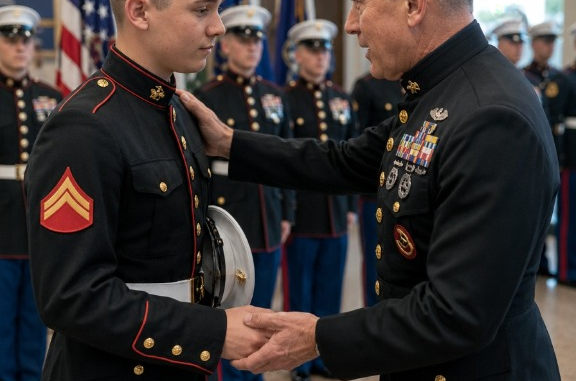
In those letters, Thomas revealed why he had kept his past hidden. He felt that painful experiences should remain private rather than turned into stories for praise or attention. He also disclosed that he had quietly placed his home and savings into a trust for his granddaughter, knowing the rest of the family would not honor his wishes. In fact, her parents had already attempted to sell the property without permission, but the transaction was stopped in time. Later, at a memorial attended by Marines and veterans who deeply respected him, the truth about his service was finally shared. Returning home, his granddaughter found a final note reminding her that true love does not demand constant proof. From then on, she kept his house, his ring, and the lessons he left behind—about humility, courage, and a strength that never needs to be announced.
Leave a Reply