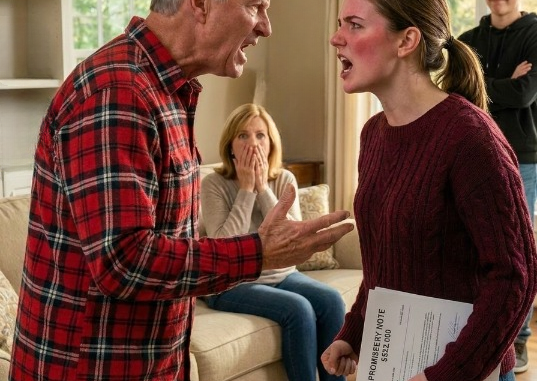
“My brother is in debt for $330,000. You’re going to pay it,” my father said, as casually as if he were asking me to bring a dish to dinner.
I was sitting at the dining room table where I’d once done homework while my brother Caleb broke rules, broke things, and somehow still got labeled “misunderstood.” Now he stood behind my father, arms crossed, looking uneasy but not nearly as cornered as he should have been.
My father slid a folder across the table.
Inside were loan documents, overdue notices, and a warning about a lien tied to Caleb’s construction business. There was even a personal guarantee using my parents’ home as collateral.
My mother, Elaine, twisted a napkin in her hands. “We could lose everything.”
I flipped through the pages. Then I saw it—my name on a business credit application.
Only I had never signed it.
My stomach turned cold.
My father didn’t hesitate. “Caleb said you approved it years ago.”
“I didn’t,” I said.
Caleb scoffed. “Don’t act innocent. You always say family helps family.”
“I said I’d help Mom after surgery. Not that you could forge my signature.”
My father slammed his hand on the table. “Mind your tone.”
That used to end every argument in my life. Not anymore.
He leaned forward. “If you won’t fix this, you’re no longer family.”
Silence followed.
My mother cried quietly. Caleb watched me like he was waiting for the version of me who used to give in, pay up, and clean up his messes.
I looked at all of them and said, “Then I’m not.”
My father blinked. Caleb let out a short, disbelieving laugh.
I stood, picked up the forged paperwork, and left.
That same day, I called my bank, then a lawyer. I froze every account, removed family access, locked my credit, and filed a fraud report.
Five days later, they showed up at my house.
My father. My mother. Caleb. Relatives I barely spoke to unless something was wrong.
My father knocked first.
I opened the door with my attorney on speakerphone.
“Too late,” I said.
“Too late for what?” he demanded.
“For pretending this is still just a family conversation.”
Caleb tried to soften his voice. “I messed up.”
“A mistake is late payments,” I said. “Forgery is a crime.”
My aunt gasped like I’d insulted someone’s honor. My father ordered me to hang up the phone.
A calm voice came through the speaker: “This is attorney Daniel Price. I advise you not to threaten my client.”
The air shifted instantly.
My mother stepped forward, shaking. “We’re still your family.”
I looked at her. “You knew.”
Her eyes filled.
My father used your house as collateral,” Caleb muttered.
“No,” I corrected him. “You did that.”
My grandmother begged me to “think about Caleb’s future.”
“He should have thought about that before stealing my identity.”
My father snapped, “You think you’re better than us?”
“I think I deserve not to be robbed by my own family.”
They didn’t like that answer.
No one had one that worked anymore.
I closed the door on them and locked it.
And that time, it stayed closed.
The fallout came quickly. They told different versions of the story to anyone who would listen. My bank’s investigation confirmed the fraud, traced the application back to Caleb’s office, and uncovered how my identity had been used to secure the loan.
Everything unraveled from there.
The bank removed me from the debt and pursued them instead. The house was at risk. Caleb’s business collapsed. His equipment was repossessed.
They had expected me to feel victorious.
I mostly felt drained.
Then, months later, my mother came alone with a box of old photographs.
“I thought you might want these,” she said softly.
She looked smaller somehow.
“Your father won’t apologize,” she admitted. “Caleb says you ruined his life.”
“What do you say?” I asked.
She hesitated. “I should have protected you.”
It wasn’t much, but it was the first honest thing I’d heard from her in years.
I took the box. “Thank you.”
“I love you,” she whispered.
“I love you too,” I said. “But love doesn’t mean access anymore.”
She nodded and left without arguing.
That spring, I bought a small cabin by a lake, far from everyone who had mistaken my stability for obligation.
One day, a message came from a cousin: Caleb says you could’ve saved him.
I replied: He could’ve saved himself by not committing fraud.
Then I blocked the number.
At sunset, sitting on my porch with coffee in hand, I realized something I hadn’t understood before.
They hadn’t taken me out of the family.
They had unintentionally given me my freedom.
Leave a Reply