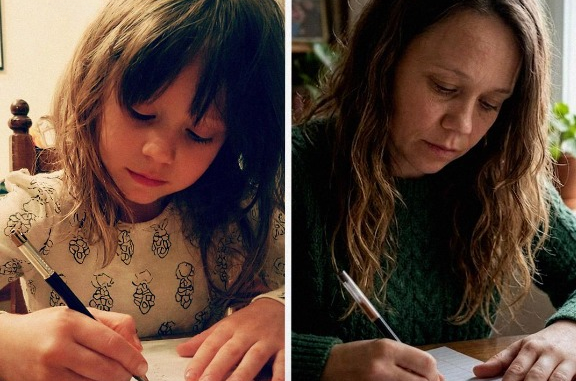
I thought I knew what abandonment meant—empty birthdays, a missing seat at school events, and the constant sting of writing “mother’s name” on forms. But everything I believed shifted the moment the woman I’d spent my life writing to appeared at my door, holding a box tied with a blue ribbon. That’s when I realized her silence wasn’t the worst thing she had given me.
For a moment, I couldn’t move or speak. She looked older than the photo I’d clung to for years—lined face, shorter hair, but unmistakably the same woman. I recognized her instantly, and that recognition hurt.
She asked to come in, saying she had tried to explain in a letter that never arrived. I should have shut the door, demanded answers for her decades of absence—but instead, I stepped aside.
Inside, my husband quickly sensed the gravity of the situation and took our daughter out, leaving us alone. With trembling hands, she placed the box on the table and asked me to look before turning her away.
Inside were hundreds of letters—every single one I had ever sent. Childhood drawings, awkward notes, milestones from my life—school, marriage, motherhood. She had kept them all.
When I realized she had received and read every letter, anger surged. All those years, she had stayed silent. She admitted she had written replies but never sent them. Fear, she said, had held her back—first when she was young and overwhelmed, then later because too much time had passed.
She explained how she believed I would be better off without her, how each year made it harder to return. But her words didn’t excuse the pain. Keeping letters wasn’t the same as showing up.
Still, there was more. She showed me notebooks she had filled over the years—private entries written after reading my letters. In them, she had followed my life from afar, marking every milestone as if she were there in spirit.
Later, I visited her old house, where she had stored my letters carefully, year by year, each one paired with her own unsent reflections. It was proof that she had loved me—but from a distance, and in a way that still left me alone.
When she brought me home, she said she didn’t expect forgiveness, only that I deserved the truth. I told her I wasn’t ready to call her “Mom,” and she accepted that.
That night, I read the letter she had tried to send. In it, she admitted her silence came from fear and shame, not indifference, and said she was finally ready to knock on my door.
I didn’t have answers, but I wrote back.
A few days later, we met at a park. There, with my daughter laughing nearby, we stood awkwardly between past and present. She met her granddaughter as “a friend,” careful not to claim more than she had earned.
Watching her walk behind my child, cautious and hopeful, I realized this wasn’t a reunion—it was a beginning. Slow, uncertain, and imperfect.
But when my daughter called out for us, I went to her.
And this time, so did she.
Leave a Reply