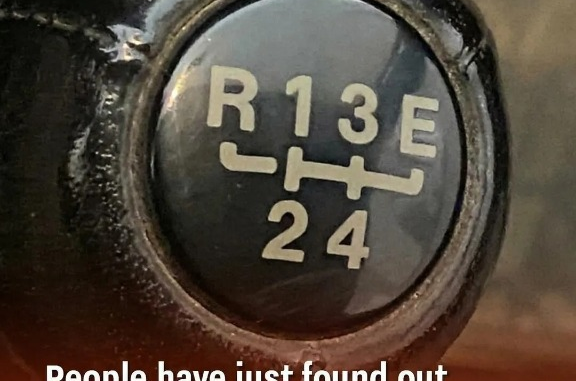
For many years, driving a car was relatively simple when it came to understanding gear systems. Manual cars typically used numbered gears along with “R” for reverse, while automatic vehicles featured familiar letters like “P” for park, “N” for neutral, and “D” for drive. Since these layouts became standard across the automotive industry, most drivers never really questioned what the letters on the gear selector meant. However, younger drivers have recently become intrigued after noticing an unusual “E” on the gear sticks of some older cars. The mysterious symbol has sparked curiosity online, leaving many people wondering about its original purpose.
In older vehicles, the “E” stood for “Economy,” a special mode created to improve fuel efficiency. Before modern cars introduced advanced computers and automated fuel-saving systems, manufacturers relied on simpler mechanical solutions to help drivers conserve fuel. Activating Economy mode changed the way the vehicle performed by reducing engine RPM, softening throttle response, and sometimes altering transmission shift patterns. These adjustments allowed the engine to operate more efficiently, especially during highway driving or steady cruising speeds. Although acceleration became less responsive and the car felt slightly less powerful, many drivers appreciated the reduced fuel consumption and long-term savings.
The presence of the “E” gear reflects an important period in automotive history when carmakers started placing greater emphasis on efficiency and fuel economy. During that time, drivers had more direct control over how their vehicles operated. Instead of computers making adjustments automatically, motorists manually selected driving modes based on their needs. Economy mode became especially valuable during periods of rising fuel costs, when saving gas became a priority for many households. It symbolized a growing shift within the automotive industry toward balancing performance with practicality while encouraging drivers to think more carefully about fuel usage.
As vehicle technology evolved, dedicated Economy gears slowly disappeared from modern cars. Today’s automobiles rely on sophisticated computer systems that continuously optimize fuel efficiency by automatically adjusting engine output and transmission behavior without driver input. Interestingly, the meaning of the letter “E” has also changed in today’s automotive world, where it is now commonly linked to electric vehicles and eco-friendly transportation. Even though the old Economy gear is largely a thing of the past, its legacy lives on in the smart fuel-saving technologies found in modern vehicles. In many ways, that small “E” on older gear sticks serves as a reminder of how far automotive innovation has progressed in the pursuit of greater efficiency and smarter driving solutions.
Leave a Reply