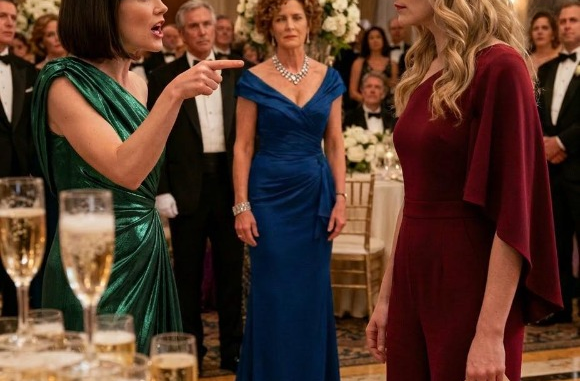
The first lie of the night arrived from my mother’s lips dressed up as a polite smile.
“There must be some mistake,” she told the woman at the registration desk, her tone polished and composed—the same tone she used when she wanted to sound gracious while quietly undermining someone. “My younger daughter wasn’t meant to be invited.”
I had just stepped under the warm golden lights of the ballroom when I heard her. The room around us glittered with carefully curated wealth—crystal chandeliers overhead, white floral arrangements spilling from silver vases, violin music weaving through the soft clink of champagne glasses. Men in tuxedos performed refinement, and women in designer gowns performed kindness, though neither performance was particularly convincing.
I stood there holding my invitation, already sensing I might not leave the evening with my dignity intact.
Then my sister, Victoria, turned and saw me.
Her expression shifted instantly—from bored elegance to something sharper, almost pleased. Like she had been given an unexpected source of entertainment.
“Maya?” she said loudly. “Oh my God. You actually came.”
Heads turned. A few people looked over. Then more followed. Nothing spreads faster in a room like that than the promise of humiliation.
“I was invited,” I said evenly.
Victoria’s gaze moved over me, slow and assessing. Navy dress, simple heels, hair neatly pinned back, no visible labels or diamonds. She took in everything she thought mattered and decided I didn’t.
“Invited by who?” she asked. “The catering staff?”
Her friends laughed immediately, too quickly, like they’d been trained to respond before thinking.
“Victoria,” my mother said, though her voice lacked any real force. “Don’t.”
But she was smiling too.
That was the part I had learned to recognize long ago—the difference between her public warmth and her private judgment. One performed generosity. The other measured worth. Victoria had inherited both instincts without hesitation.
My father used to call me his “correction,” the one daughter who saw people as they were. He said it like a joke. My mother never laughed.
I reached into my bag. “I have an invitation.”
Before I could fully hand it over, Victoria snatched it away.
She examined it dramatically. “This looks… convincing.”
My mother took it, her expression tightening slightly as she read it.
“This is odd,” she said under her breath.
“Odd?” Victoria echoed. “Mom, this is the Winter Benefit. This isn’t a drop-in event.”
The attendant at the desk froze, clearly regretting every life choice that led her here.
“You can’t just walk into a place like this,” Victoria said, leaning closer. “Not unless you belong.”
There it was—contempt, clean and unrestrained.
Not confusion. Not concern.
Just certainty that I didn’t fit.
My mother tried again, softer now. “Maya, this really isn’t your kind of event.”
I looked at her.
“I was invited,” I repeated.
Victoria scoffed. “By who? This is a room full of senators, CEOs, donors, judges. People who matter.”
She paused just long enough to let the final part land.
“And then there’s you.”
The words didn’t need volume to hurt.
People around us went still. Some recognized me. Most didn’t. But all of them recognized the situation forming in front of them.
My mother returned the invitation between two fingers, as though it might stain her.
“Maya,” she said gently, “this is embarrassing.”
“Embarrassing?” I asked.
Victoria stepped in again. “It means you don’t belong here. You work a normal job. You drive a normal car. You don’t just appear at events like this.”
I could feel the room leaning in now, hungry for the outcome.
“You should leave,” my mother added, more quietly.
That was when Victoria turned fully toward me and smiled.
“You’ve always confused being tolerated with being wanted.”
For a moment, everything inside me went still—not broken, not reactive. Just still.
Because I had heard that kind of cruelty before, and I finally understood it wasn’t about me at all.
It was about how little they needed me to be real.
People began to shift uneasily. Someone cleared their throat. The registration desk reached for a phone with shaking hands.
That was when the club manager arrived.
“Is there a problem?” he asked calmly.
“Yes,” Victoria said immediately. “She doesn’t belong here.”
My mother added, “We’d prefer she be escorted out quietly.”
The word “quietly” almost made me laugh.
The manager looked at me, then at them.
Then he said carefully, “I may need to contact the owner.”
Victoria’s expression brightened. “Yes. Please do.”
And just like that, she had asked for the one person she should never have invited into the room.
Because I didn’t interrupt her.
I didn’t defend myself.
I simply waited.
When the call was made, the atmosphere changed. Conversations faltered. Music felt suddenly too loud. Servers paused mid-step.
Victoria mistook the silence for support.
“This is about standards,” she said to the room. “If you let anyone in, nothing means anything anymore.”
My mother tried to soften it. “We’re just trying to avoid a scene.”
But the scene was already happening.
When the board members arrived with the manager, Victoria straightened, confident now that authority was on her side.
“Finally,” she said. “Someone reasonable.”
Then the manager turned toward me.
“Ms. Anderson,” he said, “would you prefer to address this personally?”
A pause fell over the room.
I nodded once.
And that was enough.
The change wasn’t loud.
It wasn’t immediate.
It was comprehension—slow, spreading, irreversible.
The board president spoke first.
“The owner of this property is present,” she said.
Victoria looked around, confused.
“Where?” she demanded.
I stepped forward slightly.
“I am the owner,” I said.
Silence didn’t follow.
It collapsed.
Victoria blinked. “No.”
My mother froze.
“That’s impossible,” Victoria said again, but weaker this time.
The legal counsel opened a folder. “Ownership of this portfolio was transferred to Ms. Anderson eighteen months ago.”
The room tilted.
Victoria looked at me like she was trying to find the version of reality where this made sense.
“You drive a Honda,” she said faintly.
“Yes,” I replied. “It works fine.”
A few people laughed under their breath—not at me, but at the realization that they had misread everything.
My mother finally spoke. “Why didn’t you tell us?”
I looked at her.
“Would it have changed how you treated me?”
She didn’t answer.
Because it wouldn’t have.
Victoria tried again, scrambling now. “You let us think—”
“You assumed,” I corrected.
That was the moment something in her face cracked—not apology, not understanding, but fear.
Because she finally realized the mistake wasn’t just social.
It was irreversible.
The manager quietly signaled security.
Victoria’s voice sharpened. “This is insane.”
“No,” I said. “This is consequence.”
My mother’s voice tightened. “You’re humiliating us.”
I met her eyes.
“No,” I said. “You did that yourselves. I’m just not fixing it.”
When they left, the room didn’t erupt.
It exhaled.
People began speaking again slowly, carefully, as though the air had changed density.
Catherine, the board president, turned to me afterward. “That was handled… cleanly.”
“I prefer clean outcomes,” I said.
The rest of the night continued—donations, speeches, polite conversations that pretended nothing extraordinary had happened.
But everything had.
Outside later, the river moved beneath the city lights, steady and indifferent.
Richard found me there before I left.
“I think I understand now,” he said.
“Understand what?”
“Why you never needed anyone to notice you.”
I didn’t answer right away.
Because it wasn’t that I didn’t need it.
It was that I stopped expecting it.
He left quietly after that.
In the weeks that followed, the story spread exactly as stories like that always do—reshaped, exaggerated, refined into something easier to repeat than the truth.
My mother called. I answered. We spoke carefully, without pretending the past hadn’t happened.
Victoria did what people like Victoria always do: she left the environment that no longer reflected her image of herself.
And I stayed.
Not because I needed to prove anything.
But because I finally understood I didn’t have to.
A year later, I walked back into the same ballroom.
No hesitation. No anticipation.
Not looking for acceptance.
Not avoiding rejection.
Just entering a room I already knew was mine.
And for the first time, that distinction was enough.
Leave a Reply