The first thing that broke wasn’t the plate—it was the certainty that my father would ever put me before anyone else.
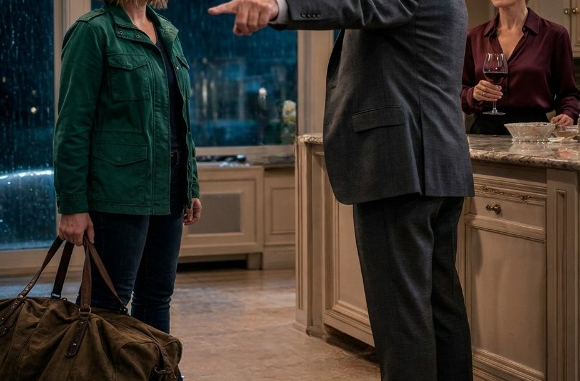
Porcelain exploded across the kitchen floor in sharp white shards, scattering between my boots and Elaine’s immaculate heels. Roast beef slid off the broken dish and hissed against the tile. Elaine stood at the counter with a wineglass in hand, lips parted in practiced shock, as if fragility were something she could turn on at will.
But my father wasn’t looking at the mess.
He was looking at me.
Colonel Richard Holbrook—thirty years Air Force, a man whose voice still made people stand straighter—stood at the head of the table like he was issuing orders.
“Either you serve my wife in this house,” he said evenly, “or you leave it.”
No shouting. No hesitation. Just a command delivered like fact.
Elaine lowered her eyes, but not before I caught the satisfaction she tried to hide.
Two weeks earlier, she had started calling me “the girl,” as though eight years in the Navy had erased my name instead of sharpening it. She corrected how I poured coffee, complained about my boots, and once asked if women like me ever truly “came back” from pretending to be men at war.
I had survived deployments, firefights, and nights where survival was uncertain.
But nothing made me feel colder than hearing my father say, “She is your superior under this roof.”
I looked at him, waiting—just once—for hesitation. Regret. Anything.
There was nothing.
Elaine gently suggested I just needed time to adjust. My father didn’t correct her.
I nodded once. “Understood.”
He didn’t stop me when I went upstairs to pack. I used the same duffel I had carried through deployments. Medals, uniforms, a photo of my mother.
When I came back down, Elaine was humming as she cleaned. My father stood by the doorway.
“You’re being dramatic,” he said.
“No,” I replied. “I’m following orders.”
For the first time, uncertainty flickered in his face.
Outside, rain hit the pavement as I left the house behind.
I didn’t cry. I just drove.
Somewhere down the highway, I stopped at a diner and sat with black coffee, watching the flag outside snap in the storm. A waitress saw my duffel and quietly told me I didn’t have to pay for refills.
“Once it’s in you,” she said, “it never leaves.”
I believed her.
Days later, I found a small apartment near the naval base. It wasn’t much, but it was mine. I took a job at a veteran center helping others rebuild what war and life had taken from them.
Slowly, routine returned.
Then one night, my phone lit up: 48 missed calls.
All from him.
The man who had told me to leave had discovered what silence feels like when it answers back.
I didn’t return the calls.
Not out of anger—but clarity.
Time passed. Work continued. Life steadied in ways that didn’t ask permission.
Then a call came from the hospital.
My father had been admitted.
When I arrived, he looked smaller than I had ever seen him. Machines kept him steady; pride no longer could.
“She’s gone,” he said finally. “Elaine.”
The woman he had chosen over me had taken everything and disappeared.
In the days that followed, the truth unraveled—accounts emptied, signatures forged, assets gone. Not just betrayal, but collapse.
And for once, he had no orders to issue.
Just silence.
I didn’t stay because I forgave him. I stayed because duty, even when broken, still recognizes responsibility.
We rebuilt in fragments after that—calls, repairs, long silences that slowly turned into conversations.
One day, he finally admitted, “It took me too long to see it.”
That was as close to apology as he could manage.
Weeks later, the house sale collapsed. Investigations began. Elaine was eventually found.
And my father—once a man who gave ultimatums in kitchens—stood in a courtroom and finally said the truth out loud: he had been wrong.
Not just about her.
About everything.
On the drive home afterward, he stared out the window for a long time before saying, “I thought control was protection.”
“It isn’t,” I told him. “It’s just fear with discipline attached.”
He nodded.
That was the beginning of something neither of us had a name for.
Not forgiveness yet.
But something closer to understanding.
Months later, he stood at a podium at a veterans’ event and said, “My daughter taught me honor doesn’t come from command. It comes from humility.”
I didn’t cry until then.
Just once.
Enough to feel it, not drown in it.
Time passed again.
He softened. Rebuilt. Learned to listen more than he spoke.
And one evening, he handed me his medal case.
“These should have gone to a son,” he said quietly.
I almost smiled. “Bad luck, then.”
His voice broke slightly. “Best luck I ever had.”
Years later, we opened a foundation together for veterans and families—built not on rank, but on recovery.
At the dedication, he looked at me and said, “I led men into war. You led me back from it.”
And for the first time in my life, I believed I had never been the one following orders.
I had been the one learning when to stop obeying them.
Because years ago, my father told me to serve or leave.
So I left.
And two weeks later, his 48 calls finally taught him what absence sounds like when it refuses to answer.
Leave a Reply