My phone rang at 2:17 p.m.—one of those quiet weekday moments when nothing is expected to go wrong.
I was at my desk, half-working through yet another revised spreadsheet when an unknown number appeared on the screen. I almost ignored it. Almost.
Then I answered.
“Anna Walker?” a man asked.
“Yes.”
“This is Officer Miller. Your daughter, Lucy, has been taken to Mercy General Hospital. She’s stable, but you need to come immediately.”
The word stable didn’t reassure me. It felt like a warning.
“What happened?” I asked.
“We’ll explain when you get here,” he said, then added, “The vehicle involved is registered in your name.”
The line went dead.
For a moment, I just sat there as if nothing had changed around me. But everything inside me had already shifted. My hands started to tremble.
Lucy.
I stood so quickly my chair fell back and rushed out, grabbing my things without thinking.
Outside, the heat was overwhelming. The city had been under a severe heatwave for days, with constant warnings to stay safe, avoid cars, and check on children.
My stomach dropped.
I ran to where I had parked.
My car wasn’t there.
Then it hit me.
That morning, I had lent it to my sister, Amanda. She said she was taking the kids out with my parents and needed the space. Lucy was supposed to be with them.
And I had agreed.
I ordered a taxi, pacing while I waited, each minute dragging out longer than the last. My calls to my parents and Amanda went unanswered.
Nothing.
At the hospital, everything felt strangely calm—too clean, too quiet.
“I’m Anna Walker. My daughter was brought in,” I said at the desk.
“She’s here,” the receptionist replied. “She’s stable.”
Again that word.
A nurse came out to meet me.
“She’s awake,” she said gently.
Relief flickered—then disappeared.
“She was found alone in a vehicle,” the nurse continued. “We had to report it.”
My legs nearly gave out.
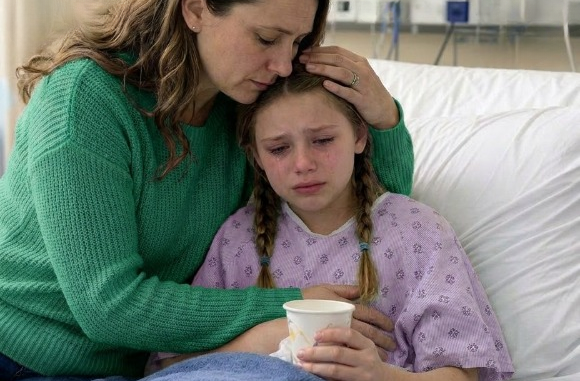
When I finally saw her, Lucy was sitting on a hospital bed, holding a cup with both hands. Her face was flushed, her hair damp, her eyes wide and exhausted.
The moment she saw me, she broke.
“Mom…”
I ran to her and held her as tightly as I could while she cried into me, shaking.
“I’m here,” I kept saying. “I’ve got you.”
When she finally calmed down, I checked her carefully.
“Are you hurt?”
She shook her head. “I was thirsty… and it was so hot.”
Her voice cracked. “I waited. I thought they were coming back.”
A nurse explained that a passerby had heard her crying in a parked car and called emergency services. She had been rescued from the heat and brought in immediately.
A police officer later confirmed they were still determining how long she had been inside.
Not briefly.
Not safely.
When I spoke to Amanda, her voice was casual, almost cheerful, as if nothing had happened.
“She was in the car?” she said. “Yeah, we needed a break. She was being difficult.”
“In a heatwave?” I asked, stunned.
“We parked in the shade,” she replied. “Window was cracked.”
Then she added, “She’s fine. You’re overreacting.”
That was the moment something inside me went still.
Because they didn’t see it as serious.
They never had.
Back in the room, holding Lucy’s small hand, I understood that this wasn’t just carelessness. It was a pattern I had ignored for too long.
But this time, it wasn’t only about me tolerating it.
It was about my daughter.
And that changed everything.
Leave a Reply