My father gave me an old countryside house while my brother received a luxury apartment in New York—and even without anyone saying it outright, the meaning behind it was clear.
My brother, Adrian, was handed a sleek Manhattan apartment with glass walls, a doorman, skyline views, and marble interiors that made my mother visibly proud. I was given a neglected farmhouse outside Hudson instead—its roof leaking, porch falling apart, pipes frozen, and acres of land left abandoned since my grandfather died.
My mother called it “practical.” My father called it “fair.” Adrian called it “perfect for you,” which really meant quiet, outdated, and unimportant.
I just said thank you.
Three years passed.
While Adrian lived a polished city life and posted about it online, I spent my weekends repairing everything—fixing structures, clearing land, learning plumbing, and slowly rebuilding the property from the ground up. I invested my savings, my training in architecture, and all my effort into turning a broken house into something functional and alive again.
By the time my mother finally visited, it was no longer a ruin. It had become a boutique retreat with guest suites, a restored barn for events, a working kitchen, landscaped trails, and a full schedule of bookings. The neglected orchard had become a dining garden, the broken shed a studio, and the once-empty porch overlooked a glowing courtyard.
She stood in the driveway in silence, clearly stunned.
Then her expression changed.
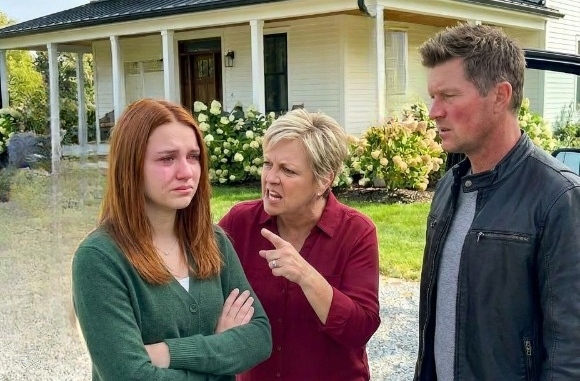
“You have seventy-two hours to give this property back,” she said. “Your brother will be taking over.”
I almost laughed.
“Back?” I asked. “You never wanted it before.”
“You manipulated your father,” she snapped. “This has always been family property.”
“It was ignored when it had no value,” I replied. “Now that it’s successful, you suddenly want it back?”
Her tone sharpened. “Don’t be selfish, Claire.”
The next day, Adrian arrived expecting to take control of something he had never contributed to.
But the moment he saw the entrance sign—clearly marking it as my business—his confidence faltered.
My mother stood beside him, no longer just proud, but unsettled.
“This is bigger than I thought,” he muttered.
“You didn’t ask,” I said simply.
As they saw the full scale of what I had built—events, bookings, and a functioning business—Adrian’s frustration shifted into something heavier: realization that it was no longer something he could casually claim.
My mother stepped forward. “Your father gave you a simple property. You turned it into a business without discussing it.”
“No one funded it but me,” I said. “Not the renovations, not the staff, not the years of work.”
Adrian scoffed. “So you want credit for fixing what Dad gave you?”
“I want you to stop calling work luck just because you didn’t do it,” I replied.
That made him pause.
Then my mother offered a folder. “We can fix this. Adrian will manage it, and you’ll receive a salary.”
I didn’t even look at it.
“A salary… for my own work?”
“Our work,” Adrian corrected.
That was when I led them inside.
The dining room had been transformed into a reception space. Waiting there were my lawyer, my manager, and a bank representative.
My lawyer stood first. “I represent Willow Hart Retreat LLC.”
Adrian frowned. “LLC?”
“Yes,” she said. “The property was transferred to Claire years ago, legally and without conditions. She is the sole owner. Any attempt to pressure her would be considered coercion.”
My mother tried again. “We’re her family.”
“That does not equal ownership,” the lawyer replied.
The bank representative added that no changes could be made without my approval.
For the first time, Adrian understood the reality: I hadn’t just repaired a house—I had built something fully mine.
“You planned all of this,” my mother said.
“Yes,” I replied. “That’s how you protect what you build.”
They left without the property.
That night, my father called. His voice was quieter than I expected.
“I thought I was giving you the lesser share,” he admitted. “I didn’t realize what you would turn it into.”
“I didn’t either at first,” I said. “But I had space to build.”
A long silence followed.
“I didn’t see it,” he said finally.
“No,” I replied. “You didn’t look.”
Time passed. My mother kept her distance, Adrian struggled on his own, and the difference between building and inheriting became clearer than ever.
A year later, my father visited alone. Standing in the orchard, he looked around and said quietly, “You built something real.”
This time, there was no demand behind it.
“I’m sorry,” he added. “I thought I was giving you less. I didn’t realize I was giving you a start.”
And for the first time, that was enough.
I never returned the property—because it was never something to return.
By the next spring, the retreat had grown into a thriving business.
And on the wall, I kept a photo of how it once looked—abandoned, broken, forgotten.
People often asked why I kept it.
My answer never changed:
“Because some people only recognize value after someone else creates it.”
Leave a Reply