My father gave me an aging country house while my brother received a luxury apartment in New York—and even without saying it aloud, everyone understood what that meant.
My brother, Adrian, got a polished Manhattan place with glass walls, a doorman, sweeping skyline views, and marble floors that made my mother proud. I, on the other hand, was handed a deteriorating farmhouse outside Hudson—leaky roof, crumbling porch, frozen pipes, and acres of land left untouched since my grandfather’s time.
Mom called it “practical.”
Dad called it “fair.”
Adrian called it “perfect for you,” which really meant outdated and not worth fighting over.
I just said thank you.
That was three years ago.
While Adrian hosted stylish rooftop parties and flaunted his lifestyle online, I spent my time tearing out mold, repairing fences, learning plumbing, and sleeping on an air mattress beneath a roof that leaked into buckets. I invested my savings, my architecture background, and all my determination into turning that neglected property into something worthwhile.
By the time my mother finally visited, it was no longer a burden—it had become a flourishing boutique retreat. There were guest suites, a restored barn for events, a farm-to-table kitchen, scenic walking trails, and a wedding waitlist booked months ahead. The old orchard had become a dining garden, the broken shed a glass studio, and the worn porch now overlooked a courtyard filled with lavender and soft lights.
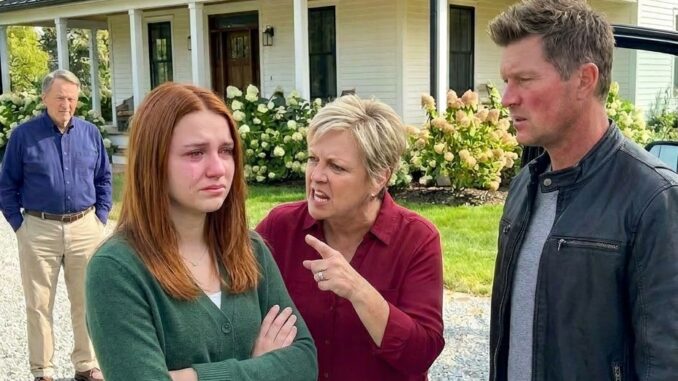
My mother stood in the driveway, stunned, as if she’d come to the wrong place. Then her expression hardened.
“You have seventy-two hours to give this back,” she said sharply. “Your brother will take over.”
I almost laughed. She spoke as if being my mother gave her authority over it.
“Give it back?” I asked. “You never wanted it.”
“You manipulated your father,” she snapped. “This has always been family property.”
“It was ‘family property’ when it was falling apart,” I replied. “Now that it’s profitable, suddenly it belongs to Adrian?”
Her tone grew colder. “Don’t be selfish, Claire.”
The next morning, Adrian arrived, already acting as though he was there to claim what he once dismissed. But the moment he saw the sign at the entrance, his confidence faltered:
Willow Hart Retreat — Founder: Claire Bennett
Private Property. No Unauthorized Management Access.
He stepped forward, clearly expecting to pressure me into handing it over. My mother stood beside him, no longer impressed—now calculating.
“This is bigger than you said,” Adrian muttered.
“I didn’t say anything,” I replied. “You never asked.”
As they grasped the scale of what I’d built—retreats, weddings, corporate events, seasonal stays—his expression shifted from arrogance to unease.
My mother spoke again. “Your father gave you this because he thought you needed something simple. You turned it into a business without consulting us.”
“The family didn’t invest in any of this,” I said. “Not the renovations, permits, staff, or the years I worked without income.”
Adrian scoffed. “You want credit for fixing something Dad handed you?”
“No,” I said calmly. “I want you to stop calling effort ‘luck’ just because it wasn’t yours.”
That struck a nerve.
Then my mother handed me a folder. “Your father is willing to correct things. Adrian will manage the property, and you’ll receive a salary.”
I didn’t even take it.
“A salary… from my own business?”
“Our business,” Adrian corrected.
I smiled—not because it was amusing, but because I no longer needed their approval.
“Come inside,” I said. “There’s someone you should meet.”
Inside, in what used to be the dining room—now a reception area—my lawyer, my manager, and the bank officer who supported me were waiting.
My lawyer stood. “I represent Willow Hart Retreat LLC.”
Adrian frowned. “LLC?”
“Yes,” she said. “The property was legally transferred to Claire three years ago, without conditions. The business is entirely hers. Any attempt to pressure her could be considered coercion.”
“We’re her family,” my mother protested.
“That doesn’t grant ownership,” my lawyer replied evenly.
The bank officer added, “Any management changes would also require lender approval.”
That’s when Adrian finally understood.
I hadn’t just restored a house—I had protected my future and set boundaries he couldn’t cross.
“You planned this,” my mother said bitterly.
“Yes,” I answered. “That’s what it takes to keep something alive.”
Adrian glared. “You think you’re smart.”
“No,” I said. “I just know that anything valuable needs to be protected.”
They left shortly after—empty-handed.
That evening, my father called. I expected anger, but instead, he sounded tired.
“I gave you the farmhouse because I thought Adrian needed the apartment more,” he admitted. “I figured you’d prefer something quieter.”
“I did,” I said. “It gave me room to build.”
There was a pause.
“I didn’t realize what you created,” he said softly.
“No,” I replied. “You didn’t look.”
Time passed. My mother kept her distance, Adrian struggled with his own place, and it became clear he had never learned how to build something for himself.
A year later, my father visited alone. Standing in the orchard, he looked around and said quietly, “You’ve made something beautiful.”
This time, there were no expectations attached.
“I’m sorry,” he added. “I thought I was giving you less. I didn’t realize I was giving you freedom.”
And for once, that was enough.
I never returned the property—because it was never theirs to take back.
By the next spring, Willow Hart Retreat had grown into a thriving business, employing dozens and welcoming guests from all over.
On one wall, I hung a photo of the house as it once was—damaged, abandoned, forgotten.
Guests often asked why I kept it.
I always gave the same answer:
“Because some people only recognize value after someone else has done the work.”
Leave a Reply