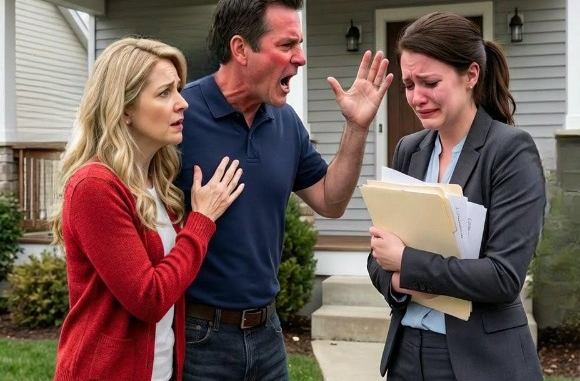
My parents sold their home, used the money to buy my sister an $860,000 house, and then turned their attention to mine. They didn’t hint or negotiate—they arrived at my door, walked inside as if it already belonged to them, and told me I needed to “do the right thing” and sign it over.
When I refused, my father slapped me across the face.
Three months later, I received a call saying, “Your parents are in big trouble.” I replied calmly, “I know.”
My name is Claire Donnelly. I was 36, divorced, living in a four-bedroom home outside Raleigh, and working long hours as a senior procurement manager. That house was something I built on my own after my divorce—paid for entirely through years of work no one in my family ever celebrated.
My sister, Melanie, had always been the opposite. She lived a life of constant crises and constant rescue. My parents had spent years funding her marriage, her debts, her treatments, and eventually even an $860,000 house after selling their own home.
I learned about it through social media—my mother proudly posting about sacrifices for “children they believe in.” I wasn’t mentioned.
Days later, they came to me.
They looked around my home and decided it was “the better fit” for Melanie. They said I could rent elsewhere while I “helped my sister stabilize her life.”
It wasn’t a request.
It was an expectation.
When I said no, my father stepped forward and struck me across the face.
I didn’t react the way they expected.
After they left, I documented everything—the injury, their words, the entire sequence—and called my attorney, Rebecca Shaw.
What they didn’t realize was that my house wasn’t something they could simply take. It was held in a trust I had set up years earlier to protect my son and my assets.
And what they also didn’t realize was that their own finances were far more fragile than they appeared.
My lawyer began investigating. Within days, it became clear: the money behind my sister’s house was built on debt, guarantees, and risky financing they had hoped to cover later—likely by pressuring me.
Then everything started to unravel.
A legal letter went out documenting the assault and blocking any further contact. The lenders began reviewing inconsistencies. The structure they had built around Melanie’s home began to collapse under its own weight.
Three months later, the situation reached a breaking point.
That’s when my uncle called to say my parents were in serious trouble.
And I told him, “I know.”
What followed wasn’t dramatic—it was procedural, slow, and unavoidable. Financial reviews, legal scrutiny, and mounting pressure forced the sale of my sister’s house. Their guarantees drained what remained of my parents’ savings, and their credibility in business circles collapsed.
My mother tried to frame it as family destruction. My father said nothing at all.
But I did not move.
I kept my home. I kept my boundaries. I kept my son safe.
And I finally understood something clearly:
The moment my father raised his hand, this was no longer a family dispute.
It became evidence.
And once truth enters a situation like that, it doesn’t leave quietly.
Leave a Reply