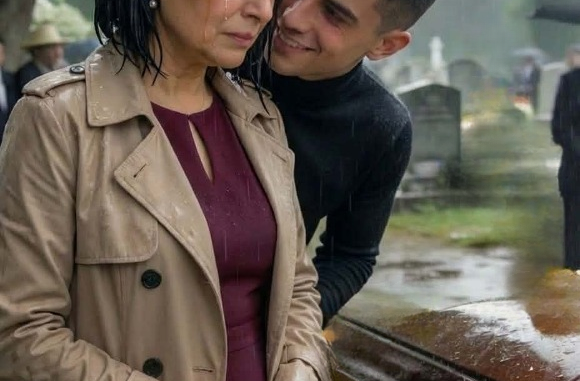
At my husband’s funeral, my son tightened his grip around my hand and leaned in close.
“You’re no longer part of this family,” he whispered.
In that moment, I felt everything around me collapse as he took the keys and the will from me, smiling as though I meant nothing at all.
I simply nodded.
Before walking away, I quietly slipped something into his coat pocket. No one noticed. No one questioned it. But I knew that when it was finally discovered, it would already be too late.
The day we buried my husband Eduardo, the air was heavy with marigolds and damp earth.
I stood in black, my shawl too thin to hide my tears. Beside me was my son, Diego—rigid, distant, watching the coffin as though it were something he needed to finalize rather than mourn.
After Eduardo’s sudden heart attack, Diego had changed. He became colder, withdrawn. I heard rumors about inheritance, the house, the business—and even Valeria’s involvement—but I refused to believe them.
When the service ended, mourners approached with condolences.
Then Diego took my hand—too firm to be comforting—and whispered again:
“You’re not part of this family anymore, Mom.”
Before I could respond, he signaled Eduardo’s lawyer, Mr. Ramírez.
The will was produced, sealed and official. Diego took it without hesitation, as if it had always belonged to him. Then he reached into my bag and took the house and office keys.
“This is a mistake,” I said quietly.
Ramírez wouldn’t meet my eyes. “Your son is the sole heir,” he stated flatly.
Humiliation burned through me, followed by disbelief and grief. But I didn’t react the way they expected. I didn’t argue or break down.
Instead, I turned and walked away.
As I passed Diego, I paused just long enough to straighten his coat.
And slipped the small device into his pocket.
He never noticed.
But I did.
The soft click confirmed it was active.
Outside the cemetery gates, my phone vibrated. The tracker had been triggered.
I didn’t go home. I couldn’t—because it no longer felt like mine.
Instead, I sat in a quiet café and watched the signal move across the map.
Diego wasn’t grieving.
He was moving with purpose.
That’s when I remembered Eduardo’s hidden instructions—his private safe, his email, and the warning he had left for me to trust what wasn’t inside the house.
Following the signal, I traced Diego to a notary office.
Through the glass, I saw him with Ramírez—and Valeria, my husband’s so-called “business partner.”
I stayed outside and watched as papers were signed and exchanged, and as Valeria smiled like everything had already been decided.
Then they left, heading straight for my home.
I followed at a distance as they let themselves inside, acting as though they owned it.
I didn’t stop them.
Instead, I returned to the café and opened Eduardo’s email.
There was a scheduled message waiting for me.
“Mariana, if you’re reading this, Diego has tried to remove you. Do not sign anything. Go to box 317.”
My hands shook as I read it.
The next morning, I went to the bank.
Inside box 317 were documents, a USB drive, and a letter.
Eduardo’s voice filled the video—calm, exhausted, but certain.
“If I’m gone and they push you out, it means they continued what I refused. The real will is here. Fight.”
And I did.
With legal proof in hand, everything shifted—accounts frozen, filings submitted, investigations opened.
When Diego called, his voice broke with rage.
“You’re ruining everything!”
“No,” I replied calmly. “You’re being used.”
Then I ended the call.
Weeks later, in court, the truth unraveled. The forged will was suspended. The scheme began to collapse.
That afternoon, I returned to my home—not as someone being erased, but as the one who still belonged there.
I changed the locks. Secured what was mine.
And for the first time in a long while, I slept in peace.
I don’t know what becomes of Diego. Perhaps one day he will understand what he mistook for power.
But I know this much:
At that funeral, he believed he had taken everything from me.
He didn’t realize—I had already taken the truth back.
Leave a Reply