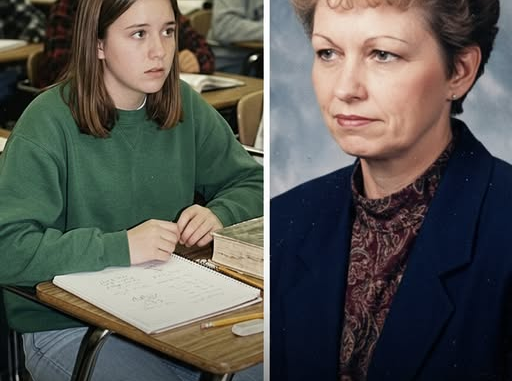
When I was in high school, my algebra teacher spent an entire year embarrassing me in front of the class, constantly implying I wasn’t very smart. Then one day, she unknowingly gave me the perfect chance to prove her wrong.
One afternoon, years later, I heard the front door slam before I even got off the couch. My son Sammy dropped his backpack in the hallway and shut his bedroom door hard. I could tell immediately that something had gone wrong.
“Sammy?” I called out.
“Just leave me alone, Mom!”
Instead of arguing, I went to the kitchen, grabbed a bowl of the chocolate treats I’d baked earlier, and knocked on his door before stepping inside.
He was lying face-down on the bed like only a frustrated fifteen-year-old can.
“I said leave me alone,” he groaned.
“I heard you,” I said gently, sitting beside him and placing the bowl nearby.
After a moment he sat up and grabbed one. Then his eyes filled with tears, the kind that come quickly when someone has been holding things in all day.
“They all laughed at me today,” he said.
“What happened?”
“I failed my math test.” He shoved another chocolate bite into his mouth. “Now everyone thinks I’m stupid. I hate math. I hate it even more than broccoli… and Aunt Ruby from Texas.”
I laughed a little, which made him crack the smallest smile.
“I understand that feeling better than you think,” I told him.
He looked surprised. “You do? But Mom, you’re good at everything.”
“Not always,” I said. “When I was your age, my algebra teacher made school miserable for me.”
That got his attention immediately. He sat up and turned toward me.
“What do you mean?”
“She humiliated me in front of the whole class,” I said. “For an entire year.”
Math had always been difficult for me, but algebra felt impossible. My teacher, Mrs. Keller, had been teaching for years and was adored by parents and administrators. She had a polite smile that hid a very sharp edge.
The first time she embarrassed me, I thought maybe I had misunderstood.
I raised my hand and asked if she could repeat a step. She sighed dramatically and said, “Some students need things explained more than others… and some students simply aren’t very bright.”
The class burst out laughing.
I hoped it was a one-time comment.
It wasn’t.
Every time I asked a question after that, she had another remark ready.
“Oh, it’s you again.”
“We’ll have to slow the whole class down.”
“Some people just don’t have the brain for this.”
Sometimes she said it sweetly, as if she were being helpful. Other times she sounded irritated, like I was wasting everyone’s time.
The laughter from classmates hurt the most.
By winter I had completely stopped raising my hand. I sat in the back row and just counted the minutes until the bell rang.
Then one Tuesday in March, everything changed.
For the first time in weeks, I raised my hand again. Mrs. Keller saw me and gave one of her exaggerated sighs.
“Some students,” she said loudly, “just aren’t built for school.”
Normally the class would laugh right away.
But this time I spoke first.
“Please stop mocking me, Mrs. Keller.”
The room fell silent.
She raised an eyebrow and smiled. “Oh? Then perhaps you should prove me wrong.”
I thought she meant solving a problem on the board.
Instead, she pulled a bright yellow flyer from her desk and held it up for the class to see.
“The district math championship is in two weeks,” she announced. “Maybe Wilma should represent our school.”
The room exploded with laughter.
My face burned as I stared at the flyer on my desk.
She folded her arms and smiled. “Well? I’m sure Wilma will make us proud.”
Something inside me snapped.
“Fine,” I said. “And when I win, maybe you’ll stop telling everyone I’m not very bright.”
She chuckled. “Good luck with that.”
That evening I told my dad everything. He listened quietly.
“She expects you to fail,” he said finally.
“I know.”
“Well,” he replied, “we’re not going to let that happen.”
For the next two weeks, we studied every night at the kitchen table. My dad patiently explained problems over and over in different ways until they finally made sense.
Some nights I cried from frustration and said I couldn’t do it.
But he always told me the same thing: “You can do this. Let’s try one more time.”
Slowly, things began to click. The equations started to feel less confusing.
It was like someone had finally shown me the door to a room I’d been locked out of.
When the competition day arrived, the gym was full of students, teachers, and parents. Mrs. Keller sat with the other faculty members, clearly expecting an easy loss for me.
But question after question, I kept solving them.
Students around me began dropping out.
Eventually it came down to two of us: me and another student who had won the previous year.
The final equation appeared on the board. For a moment my mind went blank.
Then I remembered my dad’s voice.
“Break it down. One step at a time.”
I worked through it carefully and checked every step.
Then I raised my hand.
The judge looked over my work.
A moment later, the entire gym erupted in applause.
I had won.
They handed me a small trophy and, unexpectedly, a microphone.
“I want to thank two people,” I said.
First I thanked my father for sitting with me every night and refusing to let me give up.
Then I paused.
“The second person I want to thank is my algebra teacher, Mrs. Keller.”
The room grew quiet.
“Because every time she laughed when I asked a question, I went home and studied twice as hard. And every time she told the class I wasn’t very bright, it gave me another reason to prove her wrong.”
The gym went completely silent.
“So thank you for the motivation,” I finished.
The following Monday, another teacher was standing at the front of our algebra classroom.
No one explained what had happened, but Mrs. Keller never treated me the same way again.
Back in the present, Sammy sat quietly thinking about the story.
“So what should I do?” he asked.
“The best way to deal with someone who thinks you can’t do something,” I told him, “is to prove them wrong.”
He disappeared into the hallway and came back moments later with his math textbook.
“Okay,” he said. “Teach me.”
For the next few months, we studied together at the kitchen table just like my father and I had.
It wasn’t easy. Sammy got frustrated many times.
But every time he wanted to quit, I told him the same words my dad once told me.
“One more try. You can do this.”
Yesterday, Sammy ran through the front door holding his report card like it was a winning lottery ticket.
“I got an A!” he shouted.
The same kids who had laughed at him earlier in the year were now congratulating him.
As I hugged him, I thought back to that Tuesday in March long ago and the teacher who tried to make me feel small.
In the end, the best thing she ever did for me was give me the motivation to prove her wrong.
Leave a Reply