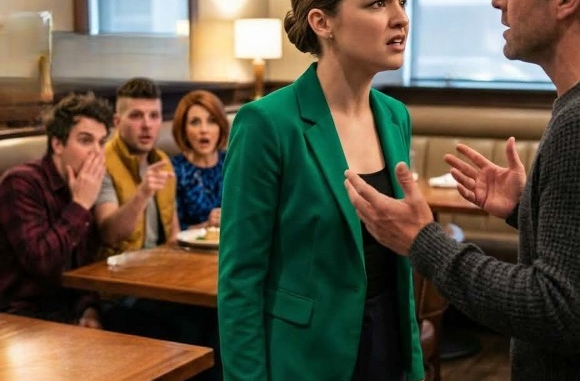
My boyfriend lost his temper and told me I needed to be “more feminine” if I wanted him to stay. He said it at 9:16 p.m. in our kitchen while I stood in scrubs over a frying pan, exhausted from a twelve-hour ER shift.
“Could you just… be more feminine?”
The room went still.
My name is Rowan Blake. I’m an ER nurse in Houston, working brutal shifts while paying most of the rent on the apartment my boyfriend Trevor liked calling “ours” when it sounded good, and “mine” when the bills arrived. He worked in real estate, and for the first years of our relationship, he loved everything about me that now suddenly bothered him—my independence, my directness, my ability to handle life without needing help.
Now he called those same traits unfeminine.
He had just come home from drinks, loosened his tie, and looked at me like I was something he’d outgrown.
“You never try anymore,” he said.
“Try what?” I asked.
“To look like a woman.”
At first I thought he was joking. He wasn’t. He went on about softness, makeup, dresses, effort—like femininity was a performance I had stopped attending.
I shut off the stove and looked at him. “So what do you want?”
He shrugged. “A girlfriend who acts like she cares she’s a woman.”
That was the moment I understood: he didn’t want a partner. He wanted a version of me that was easier to look at and easier to manage.
So I asked, calmly, “You want feminine?”
“Yeah,” he said.
I smiled. “Okay. I can do feminine.”
He thought he’d won something.
He had no idea I’d just started.
Over the next few days, I didn’t argue. I observed. I made a mental list of everything he meant by “feminine”: soft, agreeable, decorative, quiet, supportive, never intimidating. What he actually wanted wasn’t femininity—it was comfort without challenge.
So I gave him exactly what he asked for.
Saturday night, I showed up in a black dress, heels, makeup, hair styled, perfume my grandmother used to wear. When he saw me, his face lit up instantly.
We went to dinner with his coworkers. I played the part perfectly—smiling, laughing at the right moments, charming, warm, effortless. Trevor relaxed into it, visibly pleased, like I had finally corrected myself into something acceptable.
But I wasn’t performing for him. I was studying him.
Every time he introduced me, it wasn’t as an equal—it was as something he was proud to display.
And I let him.
Until the bill arrived.
The waiter said casually, “Split is already handled—Ms. Blake covered the table.”
Trevor turned to me, confused.
I just smiled. “I thought you wanted a woman who doesn’t compete.”
The air shifted.
That night, in the parking garage, he finally snapped.
“You embarrassed me,” he said.
“No,” I replied. “You just realized I’m not smaller when I’m quiet.”
“You’re impossible,” he said.
I looked at him. “No. I’m just done translating myself into something easier for you to handle.”
That was the beginning of the end.
At home, I had already packed his things. I showed him every financial contribution I had made to our life together—the rent I covered, the bills I carried, the gaps he ignored.
Then I handed him a printed page titled:
What Trevor thinks “feminine” means.
At the bottom, I wrote:
What you actually want is emotional labor without accountability.
He tried to argue. Then justify. Then apologize.
But it wasn’t confusion anymore.
It was realization.
He moved out two days later.
Months passed.
I got a message once from one of his coworkers’ wives thanking me for a conversation that came out of that dinner—about how often “feminine” is just a softer word for “convenient.”
Trevor texted once too.
I miss you.
Then:
I didn’t realize how much you did.
I never replied.
Because by then I understood something simple:
Being missed isn’t the same as being respected.
And I wasn’t interested in going back to anything that couldn’t tell the difference.
He told me to be more feminine.
He just never expected I already knew exactly what that word meant—and what I refused to shrink myself into.
Leave a Reply