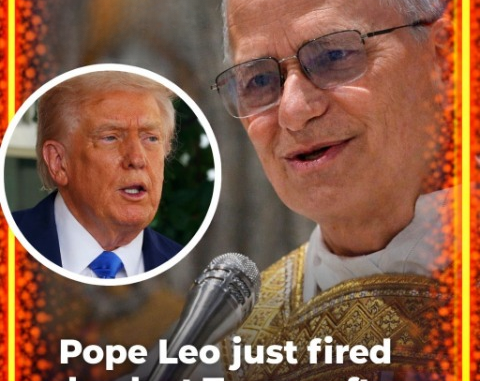
The global political stage intensified this week as a sharp exchange of rhetoric unfolded between the Vatican and the White House. What started as a series of online remarks from President Donald Trump quickly grew into a deeper moral and ideological clash, with many observers describing it as one of the most notable tensions between a Pope and a U.S. President in recent history. Disagreements over international security and social issues had been building for months, but the situation escalated when Pope Leo XIV chose to respond publicly. Speaking aboard a flight to Algiers, the 79-year-old pontiff delivered a composed yet firm reply, pushing back against a leader known for his direct and forceful style.
The conflict was sparked by a late-night series of posts from Trump, in which he criticized the Pope as ineffective on crime and foreign affairs. He portrayed Leo XIV as overly sympathetic to globalist ideas, arguing that his positions weakened national security. Trump also targeted the Pope’s views on border policies and his support for diplomatic engagement with countries like Iran and Venezuela, even suggesting the pontiff had lost touch with past controversies during the COVID period. At one point, his comments reportedly turned personal, referencing aspects of the Pope’s background.
In contrast, when Leo XIV addressed reporters, he avoided personal attacks and instead responded with calm authority. He stated that he had “no fear” of the Trump administration, framing his remarks as a moral stance rather than a political argument. By doing so, he shifted the discussion away from policy disputes and toward broader ethical concerns, reaffirming his commitment to speaking out against violence and what he described as “bloodstained leadership.”
The divide between the two figures is striking. Trump’s approach emphasizes strength through military power and economic pressure, while Leo advocates for diplomacy, reconciliation, and moral responsibility. The Pope’s remarks extended beyond Trump alone, criticizing any leader who seeks victory while engaging in violence, and challenging the idea that peace can be achieved through force alone.
His trip to Algiers reinforced this message. By promoting peace and unity on an আন্তর্জাতিক stage, Leo XIV underscored the global scope of his influence, contrasting with Trump’s “America First” stance by emphasizing a broader humanitarian perspective. Notably, the Pope chose not to engage directly with Trump’s insults, instead maintaining a measured tone that positioned him above the political back-and-forth.
Behind the scenes, the dispute could carry significant political consequences. Analysts suggest it may influence Catholic voters in the United States, a group that has often played a pivotal role in elections. Some may view Trump’s criticism of the Pope as excessive, while others see it as a sign of his willingness to challenge any institution in defense of national priorities. This dynamic highlights a growing cultural divide, with the Pope becoming an unexpected figure in domestic political debates.
The disagreement over countries like Iran and Venezuela further reflects a deeper philosophical split. While the U.S. government often prioritizes containment and pressure, the Vatican tends to favor dialogue and humanitarian engagement. For Trump, negotiating with adversaries can appear weak; for the Pope, refusing dialogue represents a moral failure.
As Leo XIV arrived in Africa, his message remained firm—he would not back down. His stance has elevated the situation beyond a simple political disagreement, turning it into a broader debate about leadership, ethics, and the pursuit of peace in today’s world.
Now, attention turns to how the White House might respond. Trump could escalate his criticism or shift tactics, but given his past approach, continued confrontation seems likely. What is emerging is not just a disagreement between two leaders, but a deeper ideological struggle between competing visions of power and global responsibility—one rooted in national strength, the other in moral authority.
Leave a Reply