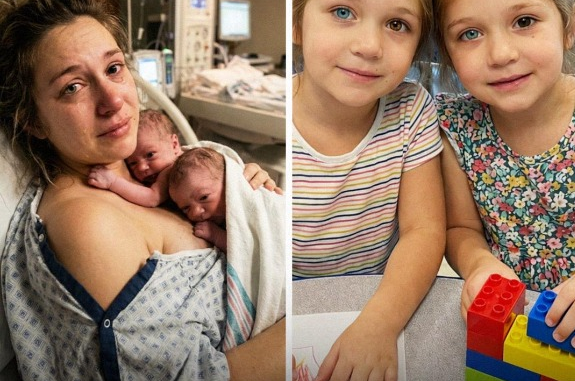
I was told my twin daughters died the day they were born. I spent five years grieving them—until my first day working at a daycare, when I saw two little girls with the same unusual eyes I have, one blue and one brown. One of them ran up to me and cried, “Mom, you finally came!” What followed unraveled everything I thought I knew about my life.
I wasn’t supposed to cry on my first day.
I kept repeating it to myself on the drive to work—that this was a fresh start, a clean slate, a chance to move forward in a new city. I told myself I had to be composed, professional, and okay.
But then the children arrived.
Two little girls walked in holding hands. They were about five, with dark curls and bright confidence, the kind of presence that fills a room instantly. At first, I thought nothing of it—until I looked closer.
Something about them felt unsettlingly familiar.
Then they ran straight toward me.
They wrapped their arms around my waist like they had been waiting for me forever.
“Mom!” one of them cried. “You finally came to get us!”
The room went silent.
The teacher apologized awkwardly, but I could barely breathe. The girls clung to me like I belonged to them.
I forced myself through the rest of the day, but I couldn’t stop watching them. The way they moved, the way they spoke—it all felt strangely recognizable.
And then I noticed their eyes.
One blue. One brown.
Just like mine.
I was born with heterochromia—my mother used to say I had “two different skies” in my face.
By the afternoon, I had to step into the bathroom just to steady myself. Memories I had buried for years came rushing back: a long, painful delivery… an emergency… and then waking up alone in a hospital room.
A doctor telling me both babies were gone.
I never even saw them.
My husband, Pete, told me he handled everything. The funerals. The paperwork. All of it. Six weeks later, he handed me divorce papers and said he couldn’t stay with me anymore—that I was the reason everything had fallen apart.
I believed him. I had no choice but to.
For five years, I lived with that loss.
Back in the daycare, the girls wouldn’t leave me alone. They followed me everywhere, calling me “Mom” like it was the most natural thing in the world.
On the third day, one of them asked, “Why didn’t you come for us sooner?”
I told them gently that I wasn’t their mother.
But they insisted otherwise.
Then came a detail that made my stomach drop.
“They showed us your picture,” one of them said. “The lady at home said you’re our real mom.”
A woman. A picture. A home I didn’t know.
Later that day, a woman arrived to pick them up—and I recognized her immediately. She had once appeared in the background of Pete’s life, someone I assumed was just a colleague.
She looked at me, and I saw something flash across her face—shock, guilt, maybe even relief.
Before leaving, she pressed a card into my hand and told me I should come if I wanted answers.
I went.
At the address, I found a house—and Pete.
I hadn’t seen him since the divorce. He went pale the moment he saw me.
Inside was the woman from the daycare, holding a baby.
And on the walls were photos: Pete, her, and the twins. Happy. Living a life I had never known existed.
Then she said it outright:
“Those girls are yours. The daughters you were told died.”
Pete immediately denied it, panicked. But the truth came out anyway.
While I was unconscious after childbirth, Pete had orchestrated a lie. With help from people inside the hospital, he falsified records and took the girls. He told me they had died so he wouldn’t have to share custody or responsibility with me.
I had spent five years mourning children who were alive the entire time.
The woman admitted she had eventually told the girls the truth—that I was their real mother—after struggling with her own resentment.
She told them to find me.
And they did.
I called the police.
Pete was arrested. The others involved were investigated and charged. Everything unraveled from there.
But none of that mattered the moment I saw the girls again upstairs in that house.
They ran into my arms like they never wanted to let go.
“We knew you’d come,” one of them said.
For the first time in five years, I held my daughters.
And I didn’t let go.
Now, a year later, we live together again.
I have full custody. We’ve rebuilt our lives in my hometown. I teach at the school they attend. They are loud, joyful, and very real.
Grief once convinced me that everything had ended.
But I’ve learned something since then:
Truth doesn’t disappear. It waits.
And sometimes, it comes back when you least expect it—walking into your life, holding your hand, and calling you Mom.
Leave a Reply