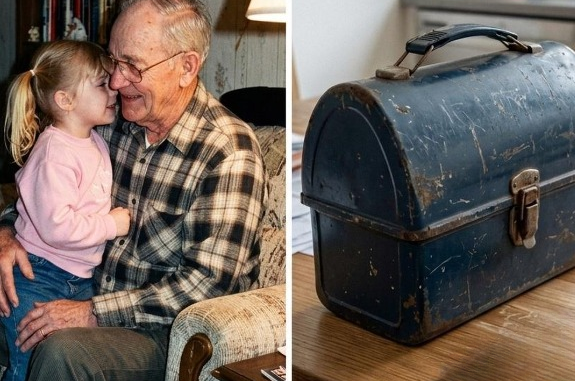
When my grandfather died, I thought I already knew where I stood in the family: the quiet one, the forgotten one, the youngest grandchild who never quite got noticed. He had raised us after our parents passed away, and while my siblings eventually left to build their own lives, I stayed to care for him in his later years. So when the will was read and my brothers and sister received the house, the car, and the money, I tried to prepare myself for disappointment.
But nothing prepared me for the attorney’s words: “To Angelica, your grandfather leaves his personal lunchbox.” My siblings laughed out loud as I stood there in shame, holding the worn metal box he had carried for years.
Heartbroken, I left and went to the park we used to visit when I was a child. Sitting alone on a bench, I opened the lunchbox expecting nothing of value—but instead found old receipts and a notebook. At first, they seemed random, until I noticed numbers circled on each one. As I sorted through them, I realized they formed coordinates. It was a trail of clues, like the games he used to make for me when I was young. For the first time since the funeral, I felt a spark of hope.
The clues led me across town—to a garage, a café, a library, and an office—where people who had known my grandfather handed me envelopes, documents, and pieces of a hidden history. Gradually, the truth emerged: he had quietly built wealth over the years through investments and properties, all while living modestly. I also discovered that my siblings had frequently asked him for money, and he had always helped them. I, on the other hand, had never asked for anything—I stayed because I loved him, not for gain.
The final stop was a bank safe-deposit box. Inside were property deeds, financial records, and proof that he had left me ownership of multiple rental properties and significant assets—far more than what my siblings received combined. At the bottom was a handwritten note: “You stayed when leaving was easier. This was never about fairness. It was about trust.”
As I read it, I finally understood. The lunchbox wasn’t a joke or an insult—it was his way of giving me something far greater than money. It was his way of showing that love, loyalty, and kindness are seen, even when no one else notices.
Leave a Reply