I didn’t think much about the camping trip until a phone call came the next morning that I couldn’t ignore. Walking into the school later that day, I had no idea what my son had set into motion.
I’m Sarah, 45, raising my 12-year-old son Leo on my own. Losing his father three years ago changed him—he became quieter, more thoughtful, carrying emotions he rarely put into words.
Last week, he came home from school different. There was a spark in him I hadn’t seen in a long time. Not loud or excited—just steady, almost glowing.
He dropped his bag by the door and said, “Sam wants to go too… but they said he can’t.”
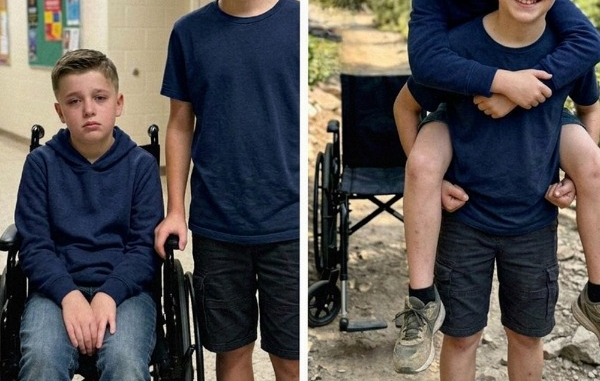
Sam had been his best friend since elementary school. Bright, funny, full of life—but he had been in a wheelchair since birth, and often left out of activities others took for granted.
“They said the trail is too hard for him,” Leo added.
“And what did you say?” I asked.
“Nothing,” he replied quietly. “But it’s not fair.”
I thought that was the end of it. It wasn’t.
The buses returned from the camping trip late Saturday. Parents were gathered in the parking lot when I spotted Leo getting off. He looked completely drained—mud on his clothes, shirt soaked, shoulders slumped as if he had carried more than just a backpack.
I rushed over. “Leo, what happened?”
He looked up and said softly, “We didn’t leave him.”
Before I could ask more, another parent explained what had happened on the trail: it was long, steep, and difficult. And Leo had carried Sam on his back the entire six miles.
According to them, Sam said Leo kept telling him, “Hold on. I’ve got you.” And he never once gave up.
Soon after, his teacher confronted us, upset that Leo had gone off protocol and taken risks by not following the designated plan. I apologized, but beneath my worry was something unexpected—pride.
The next morning, everything escalated. The principal called and asked me to come in immediately. Her voice was tense, almost shaken.
When I arrived, I saw five men in military uniforms outside the office. Waiting. Serious. Controlled.
Inside, I learned they were there because of what Leo had done. My son was called in, terrified and confused, convinced he was in trouble.
But instead of punishment, the situation took an unexpected turn.
They weren’t there to discipline him. They were there to recognize him.
Sam’s mother arrived too and explained what her son had told her—that Leo refused to leave him behind, even when it became difficult, and kept saying, “As long as we’re friends, I won’t leave you.”
Then came the truth behind it all. Sam’s father had been a military man who always carried his son so he wouldn’t miss out on life. The officers knew him. What Leo had done reminded them of him—so much so that they chose to honor it.
In the end, Leo was presented with a scholarship fund in his name, and a military patch symbolizing recognition for his character and courage.
By the time we left the office, the fear had turned into something else entirely. Relief. Understanding. Pride.
Later that night, I saw Leo asleep in his room, the patch resting on his desk. And I realized something I won’t forget:
You don’t always get to choose the moments that shape your child—but sometimes, you get to witness exactly who they are becoming when it matters most.
Leave a Reply