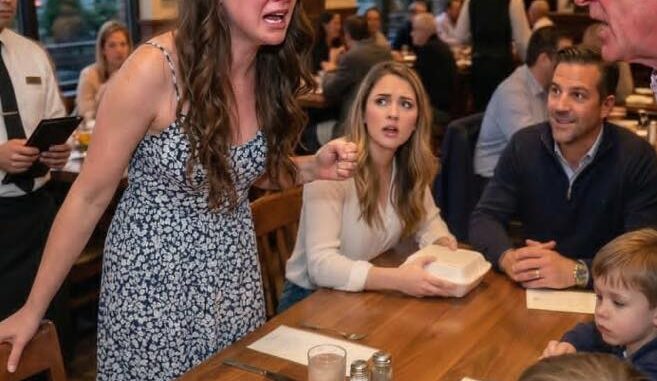
“My dad shrugged and said, ‘Your kids can eat when you get home,’ tossing them a few napkins while my sister packed up $72 worth of pasta for her boys. Her husband chuckled and added, ‘Next time, feed them first.’ I simply replied, ‘Understood.’ Then, when the waiter came back, I stood up and said

The silence that followed felt bigger than the entire restaurant. Even the noise from the kitchen seemed to fade, as though everything was waiting to see what would happen next. My father’s smile was the first to slip—men like him expect anger, not calm certainty. Anger can be brushed aside; clarity cannot.

“Sit down, Claire,” he said.
“No.”

The waiter stood beside me, frozen, holding the card machine and glancing around like he was searching for an escape.

Rebecca let out an awkward laugh. “Oh my God, don’t be so dramatic.”

I turned to her. “You packed up three full meals for your boys while my daughters sat here acting like they weren’t hungry—and I’m the dramatic one?”

Mitchell leaned back, already wearing that smug look of someone expecting a meltdown to confirm their assumptions. “No one stopped you from ordering.”

“No,” I replied. “But all of you made it very clear which children matter at this table.”

That hit harder than I expected. My mother immediately looked down. Neil finally put his phone away. Aunt Cheryl closed her eyes, as if she’d been waiting years for someone else to say what she never could.

My father’s tone sharpened. “Don’t twist this into an accusation. No one here owes you a free meal.”

There were plenty of things I could have said. I could have reminded him how he gave Rebecca and her husband twenty thousand dollars when they needed help, or how, during my divorce, I asked for almost nothing and still got complaints. I could have listed every holiday where her boys received big gifts while my girls got smaller ones “because girls prefer little things.”

But I didn’t. The truth was enough.

“You’re right,” I said. “No one owes me dinner. But grandparents who watch some grandchildren go hungry while others take home leftovers are making a choice—and I’m finally seeing it for what it is.”

Emma clutched the back of my sweater, and Lily pressed close to my side. I rested a hand on each of them, feeling how small they still were.

My father shoved his chair back. “I’m not going to be lectured in public by someone who can’t even manage her own life.”

There it was—the line he always used to tear me down. Not a mother doing her best, not a woman rebuilding after hardship—just someone he could dismiss as a failure.

Usually, it hurt. This time, it only made things clearer.

“My life is managed,” I said calmly. “What I don’t accept anymore is disrespect.”

Rebecca rolled her eyes. “So now you’re leaving because Dad made a joke?”

“No,” another voice said from the far end of the table.

We all turned. It was my mother.

Elaine Baines had spent most of her life quiet and accommodating, letting others take control. But now she sat upright, looking at my father in a way I hadn’t seen since I was a child.

“She’s leaving,” my mother said, “because you humiliated her daughters.”

My father looked genuinely surprised. “Elaine—”

“No.” Her voice wavered for a moment, then steadied. “Not this time.”

The table fell completely still.

She turned to the waiter. “Please bring two children’s pasta meals to-go—and charge them to my card.”

My father laughed sharply. “You don’t need to encourage this nonsense.”

My mother stood, and I was reminded how strong she looked when she wasn’t trying to disappear.

“This isn’t nonsense, Russell,” she said. “It’s a pattern. Rebecca gets generosity. Claire gets judgment. Her girls get scraps, and you call it a lesson.”

Rebecca flushed. “Mom, that’s not fair.”

My mother met her gaze. “No—it isn’t.”

Mitchell muttered, “This is getting ridiculous.”

Aunt Cheryl spoke up before I could. “No, Mitch. What’s ridiculous is two little girls sitting hungry while your boys take food home.”

The waiter slipped away, clearly relieved to have something to do. My father looked around and seemed to realize, maybe for the first time, that the silence wasn’t backing him anymore. Neil rubbed his neck and said quietly, “Dad… it didn’t look good.”

“Since when do we care about appearances?” my father snapped.

“Since always,” I said. “You just notice when it affects your control.”

Rebecca stood abruptly. “Can we not turn this dinner into some kind of lecture?”

I let out a small laugh. “This isn’t a lecture. It’s basic decency.”

My phone buzzed in my bag—probably the babysitter—but I ignored it. This moment mattered. Emma and Lily were watching what I would allow.

The waiter returned with two paper bags and placed them beside me. My mother handed over her card before my father could object. Then I took out enough cash to cover my meal, the girls’ food, tax, and a generous tip, and left it on the table.

My father stared at the money. “What is that supposed to prove?”

“Nothing,” I said. “I’m done trying to prove anything.”

I picked up the bags and looked at my daughters.

Emma met my eyes. “Are we leaving?”
“Yes.”
Lily asked softly, “Are we in trouble?”

I knelt and kissed her forehead. “No, sweetheart. We’re leaving because you should never stay somewhere that makes you feel small just for being hungry.”

That’s when my father’s expression shifted—not softer, not quite regretful, but uncertain. As if he was beginning to understand that this moment might be beyond his control. I stood, gathered my girls, and walked toward the door. Behind me, I heard my mother say something I never would have expected.

“Russell,” she said, “if they walk out like this tonight, you may not get them back.”

“My kids can eat when you get home,” my father said, casually tossing a couple of cocktail napkins onto the table as if he were doing my daughters a favor.

My youngest, six-year-old Lily, glanced at the napkins, then at the basket of garlic bread near my sister, before quietly lowering her eyes. Emma, my nine-year-old, already old enough to recognize embarrassment, sat stiffly beside me with her hands folded in her lap.

Across the table, my sister Rebecca slid two takeout containers toward her sons. The waiter had just packed up their leftovers—creamy pasta, grilled chicken, breadsticks—about seventy-two dollars’ worth, judging by the receipt near her husband. Her boys were still finishing dessert, while my girls had split a small salad and fries because I had decided to wait until payday before spending more than I could afford.

Rebecca didn’t even look up. “Honestly, Claire, you should’ve fed them before coming. Kids get cranky.”

Her husband Mitchell chuckled. “Yeah, next time feed them first.”

I took a slow sip of water. “Understood,” I said.

That was all—but I felt something inside me crack, even if no one else noticed.

We were at Bellamore’s, an Italian restaurant outside Columbus where my father liked to host “family dinners” whenever he wanted attention more than connection. Since my divorce two years ago, those gatherings had quietly turned into comparisons. Rebecca was the successful one—with the big house, the polished life, and two loud boys my father proudly called “future men.” I was the daughter who came back to Ohio after my ex emptied our savings and left.

I worked full-time, paid my bills, took care of my daughters—but somehow still represented everything that had “gone wrong.” My father admired struggle only when it belonged to someone else.

“You can have mine if they’re really hungry,” my aunt Cheryl offered awkwardly, sliding a breadstick toward my girls.

Dad scoffed. “They’re not starving.”

No one argued. Not Rebecca. Not Mitchell. Not my brother Neil, glued to his phone. Not even my mother, who had mastered the art of being physically present while emotionally absent.

“I’m okay, Mommy,” Lily whispered.

That nearly broke me. Kids shouldn’t have to comfort their parents in a room full of adults.

When the waiter returned with the bill, my father reached for it. “I’ll cover Rebecca’s side. Neil, you and Tara can handle yours. Claire…” He glanced at me and my daughters. “You didn’t order much, right?”

There it was again—the quiet, public measure of my worth.

Something inside me settled. I pushed back my chair, the scrape cutting through the conversation, and the table fell silent.

I looked at the waiter and said gently, “Please separate my daughters’ meals from this bill.”

My father laughed. “Their meals? They didn’t have any.”

I met his eyes. “Exactly,” I said. “And that’s why we’re done here.”

The silence that followed felt overwhelming. Even the kitchen noise seemed to fade, as if everything was waiting for what came next.

My father’s smile disappeared first—because men like him expect anger, not calm clarity. Anger is easy to dismiss. Clarity isn’t.

“Sit down, Claire,” he said.

“No.”

The waiter stood frozen, unsure what to do. Rebecca laughed nervously. “Oh my God, don’t be dramatic.”

I turned to her. “You packed three full meals for your boys while my daughters sat here pretending they weren’t hungry—and I’m the dramatic one?”

Mitchell leaned back smugly. “No one stopped you from ordering.”

“No,” I replied. “You all just made it clear which children matter here.”

That hit harder than I expected. My mother looked down. Neil finally put his phone away. Aunt Cheryl closed her eyes, as if someone had finally said what she never could.

My father’s voice sharpened. “Don’t turn this into an accusation. No one owes you dinner.”

I could have listed every example of his favoritism—every financial gift to Rebecca, every dismissal of my struggles—but I didn’t. The truth was enough.

“You’re right,” I said. “No one owes me dinner. But grandparents who let some grandchildren go hungry while others take leftovers are making a choice—and I see that now.”

Emma clutched my sweater, and Lily pressed against me. I rested a hand on each of them.

My father shoved his chair back. “I won’t be lectured in public by someone who can’t manage her own life.”

There it was—the line he always used to reduce me to failure.

But this time, it didn’t hurt the same. It clarified everything.

“My life is managed,” I said calmly. “What I don’t accept anymore is disrespect.”

Rebecca rolled her eyes. “So you’re leaving over a joke?”

“No,” another voice said.

We all turned. It was my mother.

For once, she sat upright, steady. “She’s leaving because you humiliated her daughters.”

My father blinked in surprise. “Elaine—”

“No,” she said, her voice firm. “Not this time.”

The table went still.

She turned to the waiter. “Please bring two children’s pasta meals to go. Put them on my card.”

My father scoffed. “You don’t need to encourage this.”

My mother stood. “This isn’t encouragement. It’s a pattern—Rebecca gets generosity, Claire gets judgment, and her girls get scraps.”

Rebecca flushed. “That’s not fair.”

“No,” my mother said quietly. “It isn’t.”

Even others began to speak up, and for the first time, my father didn’t have the room on his side.

When the food arrived, my mother paid before he could object. I left cash for our portion—everything we owed, plus a generous tip.

“What are you trying to prove?” my father demanded.

“Nothing,” I said. “I’m done proving things.”

I picked up the bags and turned to my daughters.

“Are we leaving?” Emma asked.
“Yes.”
“Are we in trouble?” Lily whispered.

I knelt and kissed her forehead. “No. We’re leaving because you should never stay where you’re made to feel small just for being hungry.”

For a moment, my father looked uncertain—not softer, but shaken. As if he realized this moment might last longer than his control over it.

I didn’t look back as we left.

Outside, the air was cool and sharp. In the car, Lily held the pasta bag like it was something precious, while Emma quietly asked, “Why doesn’t Grandpa like us as much?”

I paused before answering. “He should do better,” I said. “And that’s his failure—not yours.”

That night changed things.

There were angry messages, accusations, and silence—but I stopped saying yes to situations that diminished us. Instead, I built something different with my daughters: small traditions, simple dinners, a home that felt intentional rather than leftover.

My mother eventually showed up, trying in her own way to make things right. Boundaries were set. Dynamics shifted. My father resisted, then slowly began to change—but only when faced with consequences.

A year later, things weren’t perfect, but they were better. My daughters no longer sat at tables wondering if they mattered less.

And the most important lesson from that night wasn’t what I said to my father—it was what I showed my girls:

We don’t stay in places where our dignity is treated like it’s worth the least.

Be the first to comment

Leave a Reply

Your email address will not be published.


*