“Claire,” my sister warned me more than once, “you’re tearing your whole life apart for someone who barely even notices you anymore.”
“He’s sick,” I replied. “That changes people.”
Maybe I just needed to believe that.
On the morning of his surgery, Daniel gripped my hand as they wheeled him away. His skin felt cold, his voice weak.
“You stayed,” he murmured.
“Of course I did.”
He gave me a strange look—almost like guilt—but before I could think about it, the nurses were already pushing him through the doors. I spent nine hours in that sterile waiting room, sipping awful vending machine coffee and whispering the same quiet prayer again and again. When the surgeon finally came out and said, “He made it. The operation was successful,” my knees nearly buckled.
I cried the entire walk down the hallway.
And I was still smiling when I stepped into recovery.
I sold all three of our homes in just eleven weeks.
The lake cabin was the first to go. After that, the duplex my father had helped us buy when Daniel and I were newly married. The hardest was the last—the brownstone we called home, with its chipped white porch railing and the maple tree that burned bright orange every fall. By the time the hospital confirmed his surgery date, I had nothing left—my savings were drained, my credit cards maxed out, and I was crashing on a pull-out couch in my cousin’s basement.
None of that mattered.
Daniel was alive.
For six months, I drove him from one specialist to another, sat through endless appointments, signed forms, and kept smiling when he couldn’t. I made meals he barely ate, washed bloodstained sheets, and reassured anyone who asked that he was strong—that he’d make it. At night, after he finally slept, I’d sit with spreadsheets and contracts, trying to figure out what else I could give up before the debt swallowed me whole.
“Claire,” my sister told me more than once, “you’re tearing your life apart for someone who barely notices you anymore.”
“He’s sick,” I replied. “That changes people.”
Maybe I just needed to believe that.
On the morning of the surgery, Daniel squeezed my hand as they wheeled him away. His skin was cold, his voice barely steady.
“You stayed,” he whispered.
“Of course I did.”
He looked at me oddly—almost like he felt guilty—but the nurses were already taking him through the doors. I spent nine hours in that sterile waiting room, sipping vending machine coffee and repeating the same quiet prayer. When the surgeon finally came out and said, “He made it. The surgery was successful,” my knees nearly gave out.
I cried all the way down the hall.
I was still smiling when I stepped into recovery.
Then I saw her.
A blonde woman in a cream sweater sat beside his bed, their fingers intertwined. Daniel looked pale and weak—but calm. More at peace than I’d seen him in months. I stopped just outside the curtain.
He turned toward her.
Not me.
And then, softly—but loud enough to break me—he said, “Now I know what real love feels like.”
My breath caught.
She leaned in, tears in her eyes, and kissed his hand. He smiled at her… as if I didn’t exist.
Something inside me shattered completely.
But I wiped my face, stepped forward, and forced a smile.
“You’re right,” I said quietly.
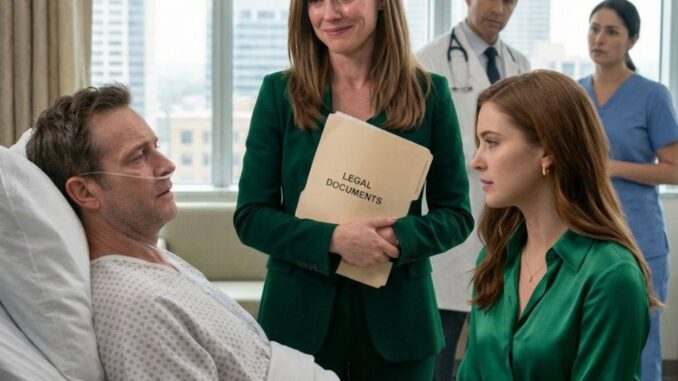
Then I reached into my bag and pulled out the document that would change everything.
The room fell silent the moment they noticed the envelope.
Daniel’s expression shifted—first confusion, then irritation, then something closer to fear.
“Claire… this isn’t the time.”
“No,” I said calmly. “It’s exactly the time.”
The woman stood quickly, her chair scraping the floor. She looked polished, expensive—mid-thirties, maybe—with a diamond bracelet catching the light. She looked at me like she already knew who I was.
“I think you should leave,” she said.
I met her eyes, then looked at my husband.
“You’re letting your mistress tell your wife to leave? In a room I paid for? After a surgery I funded?”
Daniel’s jaw tightened. “Don’t do this here.”
“Do what? Tell the truth?”
My hands were steady now. Funny how betrayal burns away fear. I opened the envelope and set the papers down.
“These are the final documents for the brownstone sale,” I said. “The last house is gone. Just like the cabin. Just like the duplex. Everything we owned—sold.”
The woman’s expression changed instantly.
Daniel pushed himself up slightly. “You sold everything?”
I let out a short, empty laugh. “That was the deal, remember? ‘Whatever it takes, Claire.’”
“I didn’t think you actually would—”
“Follow through?” I finished. “That’s the difference between us. When I make vows, I mean them.”
The woman crossed her arms. “He didn’t ask you to give up everything.”
“No,” I replied. “He just stood by and let me.”
Daniel looked away.
That small movement told me everything.
I reached into my bag one last time.
“And this,” I said, holding it up, “is the postnuptial agreement you signed eight months ago.”
He froze. “What?”
“You remember. Your lawyer called it routine—protection in case medical debt piled up. You were overwhelmed, medicated… ready to sign anything I put in front of you.”
The blonde stepped closer. “What does that mean?”
I looked straight at her.
“It means every financial asset was transferred to me. Every property, every account, every cent from those sales. Legally, none of it belonged to him when I sold anything.”
Daniel stared at me like I was a stranger.
I leaned in and said quietly,
“You found your true love. Congratulations. But you’ll have to build your life together without my homes, my money, or the future I built while you were lying to me.”
For the first time, he looked afraid.
“Claire… please tell me you didn’t—”
“I did,” I said. “And I’m done.”
He called me seventy-three times in the two weeks after he left the hospital.
I know because my phone kept count.
At first, he was angry. Then demanding. Then scared. Then… broken.
I listened to only one voicemail.
“Claire… Lena left. She thought I still had money. She didn’t sign up for this… please call me back.”
I deleted it.
The truth was simple.
She loved the version of him that seemed secure—
not the reality.
A month later, I filed for divorce.
He tried to fight it, but the paperwork held. Everything was legal. Clean. Final.
No dramatic ending. No redemption.
Just reality.
I rebuilt quietly. Went back to work. Furnished my space with secondhand pieces. Grew herbs by the window. Learned what peace feels like when no one is lying to you.
Sometimes I still cried—not for him, but for the woman I used to be.
Six months later, I saw him in a grocery store. He looked smaller. Older. Lost.
He stepped toward me.
I stopped him.
“I really loved you,” I said.
His eyes filled with tears.
“But loving you almost destroyed me.”
Then I walked away.
And in that moment, I understood something no one ever tells you:
The strongest kind of revenge isn’t destruction.
It’s survival.
It’s peace.
It’s building a life so steady that the people who broke you can never touch it again.
So tell me—
What would you have done?
Leave a Reply