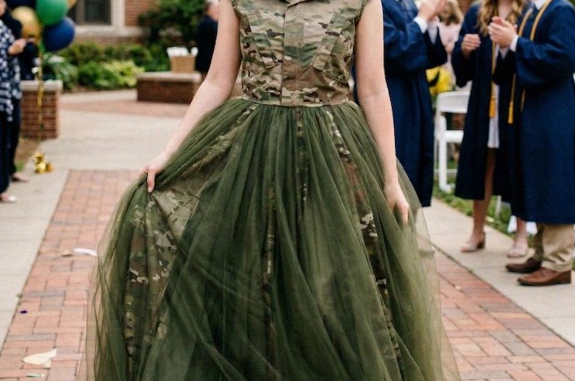
Prom night was supposed to be just another event, until I stepped out in a dress made from my dad’s old uniform. My stepfamily mocked me—but everything changed with a knock at the door. That night, I learned about loyalty, loss, and claiming my own story.
The first night I started sewing, my hands shook so badly I jabbed the needle through my thumb. I bit back a cry, wiped the blood, and kept going, careful not to stain the olive-green fabric. If Camila or her daughters saw me working on Dad’s uniform, they’d never let me live it down.
Dad’s jacket was frayed and worn. I had buried my face in it the night we learned he wasn’t coming home, breathing in traces of his aftershave and the faint scent of machine oil. Every cut of the scissors and pull of the thread felt like stitching myself back together.
I never dreamed about prom like my stepsisters, Lia and Jen. One Saturday, Lia asked me to pick between strapless and sweetheart necklines for her dress, while Jen mocked me for not caring about prom at all. I smiled but secretly thought about Dad teaching me to sew, his big hands guiding mine, small moments that had become everything after Mom died.
After Dad married Camila, the house changed. My chores doubled, and the stepsisters left piles of laundry outside my door. Sometimes I’d stand in Dad’s closet, clutching his old jacket, whispering, “Miss you, Dad.” I imagined him saying, “Wear it like you mean it.”
That night, I decided I would wear his uniform to prom—not as it was, but remade, a secret between us. I worked in silence for weeks, stitching under the lamp after finishing chores. I whispered goodnight to him as I went, pouring my heart into every seam.
Three nights before prom, I pricked my finger again, a bead of blood staining the hem. For a moment, I thought of giving up—but I didn’t. When I finally put on the finished dress, I saw more than fabric: I saw Dad, my stitches, my story.
Prom night, the house was chaos. Camila barked orders, Lia and Jen argued, and the kitchen smelled of burnt toast and perfume. Upstairs, I buttoned the bodice, pinned Dad’s silver pin, and braced myself. Their laughter downstairs was sharp, cruel—mocking my creation.
Then, the doorbell rang. A military officer in full dress uniform stood on the porch, with a woman in a suit holding a briefcase. They asked for Camila—but their eyes quickly found me.
They delivered a letter from Dad, meant for prom night. He had left instructions ensuring I would never feel alone in my own home. The house was mine, the stepsisters and Camila had to leave. I felt frozen, clutching my dress, hearing his words again: “Wear it like you mean it.”
Sergeant Brooks, beside Dad’s old Chevy, escorted me to prom. The students stared as he opened my door. I braced for ridicule—but instead, applause spread through the gym. Mrs. Lopez touched my sleeve and said, “You honor him, sweetheart. Don’t forget that.”
I danced awkwardly at first, then freely, feeling Dad in every stitch. Later, Brooks drove me home. The house was quiet. Camila and her daughters had left, and on the table was another envelope from Dad:
“Chels, if you’re reading this, it means you made it. You’re braver than you think. Love, Dad.”
For the first time since he died, the house—and my life—felt truly mine.
Leave a Reply